I am always a little reluctant to make any reference to the mafia in my reports on Italy. Not that I try to deny its existence, but I am far from being an expert on the subject and I am keen to dispel as much as possible the clichés and stereotypes of Italy being the country of pizza, pasta and mafia. To be honest, in my everyday life in Italy, I do not notice much evidence of its existence. To the outsider, the mafia is extremely discreet and almost invisible, even if their frequent executions aren't.
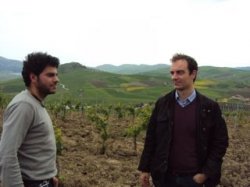
But what has this all to do with wine, you may wonder? Well, much more than you'd imagine. On my trip to Sicily last April, I wanted to go and see Francesco Galante of Centopassi (pictured here with the agronomist Vito Rappo on the left) to taste the new vintage. Centopassi is the viticultural and winemaking merger of two Sicilian co-ops, those of Placido Rizzotto-Libera Terra and Pio La Torre-Libera Terra. They run confiscated mafia agricultural holdings including wine. I already mentioned here that although such organisations work hard for the common good, this is not necessarily a guarantee of great wine. But Centopassi is different: it insists it will be known for quality first, and only then for its efforts to create a legal, mafia-free environment.
I met Galante in a suburb of Palermo on a dusty road flanked by apartment blocks and refuse containers overflowing with garbage. It reminded me a little of the ongoing rubbish tragedy in Naples, which is caused indirectly by the mafia. But it turned out that the private company that collects the refuse for the city of Palermo had gone bust because of long-overdue payments the city has been unable to settle. One can get a little paranoid here.
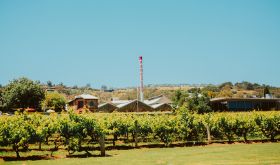
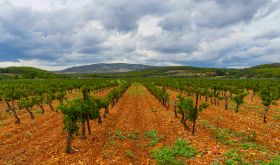
Galante, Centopassi's marketing manager, was behind the wheel as we drove out of the city and into Palermo's hinterland, the Alto Belice Corleone. This triangle formed by Palermo to the north, the agricultural town of San Giuseppe Jato to the south west and Corleone to the south east has been a mafia stronghold for ages and is home to the exceptionally brutal Cosa Nostra. It is a rough, wide, beautiful landscape that is eerily quiet. It is also where Centopassi has taken over some 90 hectares of confiscated vineyards.
While we drove up to San Giuseppe Jato to have a look at some of Centopassi's vines, it was Francesco who started to talk about the mafia, as I have a self-imposed rule never to be the first to bring up the subject. Contrary to all the clichéd images we have in our heads, Galante explained that mafia first and foremost stands for corruption: corruption that permeates all layers of society, creating an intricate and seemingly indestructible net through which nothing can fall. Corruption has been able to entangle large parts of society because it has become a mentality, and one that is reinforced by omertà, or total silence. People literally keep their mouths shut. (Omertà explains also why it is possible that wanted mafia bosses can live quietly in the countryside and go about their business for years without being discovered by the police.) Francesco explained this to me by the example of pizzo ˗ racket or protection money that the mafia extorts from every business activity they can get their hands on.
I must admit I never understood why there wasn't more resistance to pizzo, probably because I didn't understand its core working. It turns out that the system works so well because it is much more sophisticated than the vulgar protection money that exchanges hands. Pizzo has virtually taken the place of paying taxes. So if you pay pizzo you do not pay taxes and, miraculously, you will not be prosecuted by the tax authorities either. Therefore, you do not 'pay twice', so to speak. This system can only work with collaborators on the inside: the town hall, the local government, national government, building societies, the list is endless. Through this network between criminals and legal authorities corruption becomes part of daily life, and almost reaches official status. And because of this it seems impossible and futile to break this vicious cycle. That is why a lot of people have accepted the status quo. And to be honest, I too believed the situation was a hopeless one, and best ignored.
But a spark of hope was ignited in 2004 when a group of young people opened a bar in Palermo, and because they didn't want to pay the racket, they literally covered the whole of the city overnight with stickers saying 'people who pay pizzo are a people without dignity'. Soon the so-called Addiopizzo, or 'goodbye racket', movement became a fact, and lists appeared online of other commercial activities, like shops, plumbers, construction companies and so on, which also refused to pay. The Addiopizzo had to have wide public recognition for it to be able to work, because the mafia would not allow anyone not to pay their pizzo. The mafia would not use direct intimidation to extract the racket, but would simply turn off the tap of the supplies any business needs to be able to run its activity. By publishing lists online, any business that was affected could find new suppliers who were also against pizzo and were themselves victims of the block in supplies. It allows consumers too to support only those businesses brave enough to resist the mafia.

The principle behind Centopassi is exactly the same. By taking back into use the confiscated mafia land, it creates lawful work and pays better than illegally working the land for the mafia with no claims to either healthcare or pensions. Mafia keeps the people poor and dependent, it blocks development and change, while Centopassi tries to break through this vacuum by offering a legal alternative.
Centopassi also put in requests with local authorities to use sequestered lands with immediate effect, instead of having to wait for years until the process against its illegal owners has led to a conviction. It is only then the Italian state can officially confiscate the property. (By the way, Francesco told me that Italy is one of the first countries where the properties of criminals can be confiscated, whereas elsewhere there has yet to be a European law set up to regulate this, and hence the reason the mafia have begun to invest heavily outside Italy.) This process can take years, during which abandoned buildings and land are allowed to deteriorate. Centopassi had to replant quite a few hectares of vineyards because years of neglect left them beyond repair. Furthermore, confiscated properties see a high incidence of arson.

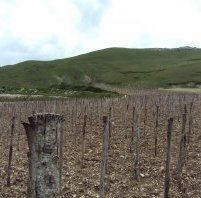
Before we could enter the Pietralunga vineyard (pictured below left), so called because of a menhir-like rock dominating the landscape, we needed to change cars and got into a four-wheel drive instead. The vineyard is at 550 m elevation reached by a steep goat's trail. It is planted with the local white Grillo, at a surprisingly high density of 5,000 plants per ha. Pietralunga is a windy and rather cool place, guaranteeing a long ripening season. The vineyard, confiscated from the Riina clan, was replanted only in 2004, its soils consisting of heavy clay and rock fragments. Notwithstanding the youth of the vines, the resulting Pietralonga Grillo (see label above) shows amazing depth of flavour.
Centopassi seems to have a propensity for hard-to-reach vineyards in isolated places, the higher and rockier the better. Their most isolated and, from a viticultural perspective, perhaps most beautiful one is the newly planted Portella della Ginestra vineyard (pictured above left) at an astonishing 950 m. It is planted at a density of 4,200 vines per ha with Nerello Mascalese, Nerello Cappuccio and Nocera. The vines will be bush trained and when we finally reached the Portella della Ginestra I saw a sea of wooden poles, waiting to offer their support to the vines. The vineyard is planted in such a rough and stony place that you almost feel sorry for the young plants.
When I contacted Giovanni Ascione, Centopassi's wine supremo, of whom more later, to understand why they had chosen this barren place, he told me that they are aware of the risk, but that it was one they felt worth taking. The aim is to make an important but fresh, austere, elegant red wine coming from a vineyard that is the most symbolic of all the confiscated mafia vineyards Centopassi manages. It was here on 1 May 1947 that a massacre took place when Sicily's notorious bandit Salvatore Giuliano opened fire on a group of about 2,000 peasants demonstrating for better conditions of life and work, leaving 11 dead, including some children, and many wounded. The mafia also had a hand in it, but the highly intricate case, involving Giuliano's gang, the mafia, as well as police and politicians, was mired in secrecy, while all parties involved did their very best to erase any evidence that could have led to its resolution. It has been etched into the Italian consciousness ever since.
Ascione also confessed that the wine from the Portella vineyard may be made only in exceptionally hot years, 'of which we see more and more, unfortunately', he added in an email. The grape variety mix that has been planted only by accident mirrors that of the DOC Faro. 'We chose the mix of varieties to minimise risks, and we didn't want to plant whites, because we already have plenty of them', Asicone wrote to me. But yes, also at Centopassi they like Faro a lot.
Giovanni Ascione is Centopassi's wine supervisor and as such its vinous mastermind. A wine writer as well as a vinegrower, he himself produces a fine red wine from a minuscule patch of land he leases in Campania near his home town Caserta, which he has called Nanni Copè. Ascione's great knowledge of not only Italian but also international wines has given Centopassi a clear push upwards in quality. It is also he who suggested the creation of an ambitious range of wines made from single vineyards and even single plots within these vineyards, which Centopassi call their 'crus'. Although the vineyards also contain international grape varieties, these have wisely been kept out of cru bottlings, leaving the indigenous ones to put a firm stamp on the wines.

Ascione explained that the crus are specific vineyards, which take the names of the place or communes nearby. The names are spelt differently from the actual place names, using local dialect forms, because until recently wines classified as IGT were not allowed to use a more specific geographic designation. The cru sites more or less revealed themselves through the exceptional quality of the grapes, which, year after year, seem to outdo those of their neighbouring plots or, in some cases, rows.
When only a part of a plot shows cru quality, it gets special attention: for example, by more regular pruning throughout the vegetative cycle, and a stricter green harvest than elsewhere in the vineyard. Every plot that is considered a cru is clearly marked with red paint on the posts and during the manual harvest, the crates in which the grapes are transported to the winery are filled only half full and transported to the winery in a refrigerated truck. It is what Ascione calls 'a maniacal attention to detail'.
The only cru made from a variety that is not strictly indigenous is the one made from Trebbiano. Trebbiano is generally considered merely a mediocre variety but in Centopassi's case it comes from an old, pergola-trained vineyard which, after a strict selection during harvest, produces the best Trebbiano grapes. The fruit is of such exceptionally high quality that it has been given full-blown cru treatment with fermentation as well as 12 months' ageing in new tonneaux.
All the Centopassi vineyards are managed organically. The grapes are delivered to the functional but unadorned Centopassi cellar, a barn-like structure near San Giuseppe Jato, which was built with financial support from the Italian state as well as from the EU. Stainless-steel tanks are joined here by large 20-hl oak casks, as well as a couple of tonneaux. Everything is kept to a bare minimum, and it is clear that Centopassi prefers to focus all the effort and attention as well as investment on its vineyards. It is this focus and attention to detail that have resulted in some of the most exciting wines currently being made in Sicily.
Centopassi also runs two B&Bs in the countryside, agriturismos in Corleone and Portella della Ginestra near San Giuseppe Jato. The landscape is nothing less than stunning and Portella della Ginestra is only 25 km from Palermo. Prices are extremely reasonable and on Sunday the B&B is open for lunch, serving simple but delicious local foods all produced from confiscated mafia lands and grown completely organically. A range of Centopossi wines complements the whole. Highly recommended.
The wines
Presented in the order tasted.

From the Tagliavia vineyard on 550 m near Corleone. Confiscated...
Deep crimson. Lifted raspberry and cassis almost jumping out of...