It was a well-timed visit for a Burgundy newbie. After what seemed like weeks of rain in the UK, we arrived for a three-day whirlwind trip in glorious sunshine to vineyards turning gold and scarlet. As we approached our first stop in Chablis, our guide Richard Bampfield MW sounded as though he were dropping names at a party: ‘on our right is Blanchot, and here is Les Clos. Now we’re passing Valmur, and Grenouilles...’ Thrilled as a child, I pressed my nose to the window. These were names I’d only ever edited in Jancis’s tasting notes! We hit the vineyard road with a lurch and crunch of stones and started heading uphill into a fold of land, vineyards left and right – Preuses and Vaudésir (both sides). Out the car, limbs a little stiff from several hours in train and car, we clambered up a path through Vaudésir until we reached a white wall that cut through the vineyard and offered a viewing platform over what is probably one of the most expensive amphitheatres I have stood in: five Chablis grand cru vineyards in one sweep of the eye.
We were standing in La Moutonne, a vineyard wholly owned by the Bichot family’s Domaine Long-Depaquit which straddles Preuses and Vaudésir. It’s an interesting vineyard: 2.34 ha of south-facing vines excluded from the 1938 classification, but after much lobbying from Albert Bichot the INAO has now allowed it to be labelled as a grand cru in its own right. Shades of another Mouton perhaps? The most striking thing about this vineyard (in the bottom half only) is the sight of thick black wires running along the rows and coiled at each end. This is the million-Euro-plus frost-management project installed by Bichot and William Fèvre, their next-door neighbours. For a few days every year, automatic sensors kick in when the temperature drops, sending electrical heat humming along the wires to warm the vineyard. It’s an impressive piece of modern technology in a place where the ground is littered with ancient fossils. It has replaced stinking oil burners and the necessity for 15 people to get up on icy nights and lug litres and litres of diesel up the slopes. And yes, tourist-like I have come home clutching my two pieces of La Moutonne vineyard, beautifully imprinted with perfect tiny oyster shells. There is something quite special about picking up your first crumbling chunk of pale Kimmeridgian soil in a real Chablis vineyard after three years of seeing the word pop up in WSET study books. It looks every bit as beautiful as the word sounds.
Driving into Beaune with its magnificent tiled rooftops and elegant old buildings was a little like stepping into an old story book – I half expected chevaliers round the next corner. Dinner was a five-minute walk from our blue-shuttered hotel, down cobbled streets still warm from the afternoon sun. Caves Madeleine is a tiny place, below street level, with not a lot of room to manoeuvre between the large communal tables and benches and the walls panelled with a treasure trove of wine bottles. Somehow above the warm hubbub, Laurent Brelin, smiling and affable, managed to give us a blind tasting of burgundies and treat us to his kitchen’s generous traditional burgundian cuisine. Plates of escargots in fragrant garlic jostled for space with boudin noir and seductively tender Charolais bavette en meurette. I spied, among his collection of bottles, a corner devoted to German wines (Dönnhoff among others) and several New World wines lined up next to bottles from Alsace and the Languedoc. At the other end of our table sat a Japanese group, in animated counsel with a Japanese winemaker who is apparently living and working in Beaune. It was an intriguing slice of the old and new that Burgundy is today.
The next day we stood on very different soil in Les Charmes, Meursault. At an average of €2.4 million per hectare, it was sobering to listen to Dominique Bon (régisseur for Bichot) talk about the complexities and cost of land ownership (no return on investment here); about the fine-spun warp and weft of relationships that make up the world of the négociant. The realisation slowly dawned on me that the role of négociant requires project-management, man-management and diplomatic skills far beyond anything I had imagined. The grower contracts alone are bewildering: many of them just word of mouth (just as well this isn’t the litigious US); terms that pay by volume at 70 hl/ha but require production at 40 hl/ha; the 3%:2% grower:négociant cut for the courtier (apparently the most lucrative job in Burgundy right now, Bichot regularly uses 15 different courtiers); the four payments to be made to each grower during the season; the loyalties, friendships, feuds and family ties to traverse like a minefield; the tallying of fickle market demands (did you know that Pommard is the fashion of the moment?) and unchanging traditions.
Bon pointed out ridiculously small subdivisions of vineyards owned by different growers overlaid by equally small plots of terroir nuances within and across these subdivided vineyards. The logistics of harvest alone are enough to crumple the most Zen-like countenance: a 10-day window (if you’re lucky); 100+ different plots; 150+ different terroirs each ripening at a different time and in a different way; with one (maybe two) teams of pickers; dodging the rain; sharing vehicles and hurtling around puddle-carved criss-crossing dirt tracks; organising receiving capacity at the wineries; keeping countless parcels of grapes separate and tracked from vine to destemmers; presses and fermentation vats; keeping 70-odd growers happy; feeding hordes; maintaining quality and still staying on speaking terms with everyone. The whole operation has to happen with military precision, yet hangs on a decision that must be made in a heartbeat on a hunch. A really good négociant, I realised with some shock, must be everything a grower-producer is and then some. A truly good bottle of négociant wine requires all the usual ingredients of good fruit, perfect timing, knowledge, experience and good winemaking, plus an extraordinary level of people skills, organisation and management.  The level of detail is nowhere more apparent than in the wineries we visited, where there was a bewildering array of fermentation vessels in every possible size from little old wooden vats to great shining steel tanks. I was persuaded to clamber up a wobbly ladder and, balancing precariously on a wooden plank, try my hand at pigeage on a fermenting vat of premier cru – Sally Easton MW captured the moment for posterity (left). Until then I had no idea how difficult pigeage is – that crust of grape skins is like cement!
Feeling a little uncertain now that a neat personal rule (small récoltant = default good, négociant = default rubbish) had been somewhat confounded, I squeezed back (now four of us on the back seat) into the gutsy little Renault as we beetled off towards Beaune for dinner at Bissoh. A complete contrast to the homely bosom-like embrace of Caves Madeleine, Bissoh is precise, cool and elegant. The food was prepared with understated precision, elegantly served and danced a seductive tango of flavours.
We headed north on day three. After a brief discussion on who had the smallest rear end, we packed bags, glasses, wine bottles and people into the car with strictest instructions for the One With The Skinny Bottom (who was balancing precariously on the edge of the back seat with door handle and someone else’s knee for support) to duck into the footwell should we spot the police. I can confirm that he managed this with startling speed and contortionist-like pliability when the occasion did arise.
I am quite sure I betray my callowness when I write that I got goosebumps as I climbed onto a tumbling stone wall and looked out over Échezeaux, glowing scarlet in the sun. I had to keep pinching myself to make sure I was really there, with a sweet second-crop bunch of grapes in my sticky fingers.
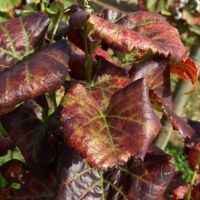
I have two of those Échezeaux leaves pressed in my notebook now – one a ruby jewel of autumn and the other red trimmed with disease. Leaf roll, Christophe Chauvel told us, is the biggest single problem in the Côte d’Or vineyards today. They believe it is passed from one vine to another by beetles as it is often worse near the forests where the beetles lurk. We could see literally hundreds of vines affected all around us and Kevin Ecock (Irish winewriter) has kindly let me use his photograph (above left) showing a perfect example. It is deceptively beautiful from a distance.
Chauvel told us of another curious thing that happened this year. It’s a phenomenon that they have seen before in the region (in 1999 and 2001), but apparently it doesn’t happen everywhere. The way things were ripening, they had planned to start picking the reds first as the acids in the white grapes were still pretty high and needed time. On Sunday 12 Sep they had big electrical storms with plenty of lightning. Almost overnight the grape skins of the Chardonnay started to go brown. From having seen this before, Christophe knew that they had to move very quickly with picking because, if left. the grapes would start to oxidise rapidly from the outside in. He told us that they have no idea what the scientific explanation for this is, but it seems that there is some connection between lightning and a grape pH of 3.2 with high acidity which makes the skins brown! So the whites came in before the reds and the schedule went in the bin. I was assured that sugar levels were good when they picked, but acidity was still very high. For no discernible reason, Corton-Charlemagne wasn’t affected by the lightning.
Another challenge that Burgundy is beginning to face is that of black rot, which up to now has been much more common in south-west France. This year they saw a lot of it in Mercurey. Although Christophe Chauvel believes that there are far fewer marginal vintages than there used to be, and harvests are earlier, the more unpredictable extremes of weather have resulted in different problems, such as much tighter harvest windows. There is a three-day window of perfection, he says, anything on either side of that and the wines are either too green or too fat. Like many other producers, Bichot has made drastic changes to their vineyard management in the last 10 years such as cutting out all pesticides and insecticides, introducing clonal variety and above all, reducing yields dramatically. It was at this point that I learned that there are a number of words for the critical task of évasivage (bud rubbing) including the rather evocative ‘enlever les bâtards’ (roughly translated, ‘get rid of the bastards’). After having read Richard Hemming’s description a long while ago of doing the same job, I can imagine the task force approve particularly of this expression.
There are many more qualified than I to write vintage reports for Burgundy so the following comments are merely the impressions formulated by a wide-eyed, spellbound novice while trailing after the Bichot senior team (managing vineyards and wineries from Chablis to Côte de Beaune). The image I have of the 2010 vintage is a patchwork quilt. Microclimate counts this year more than any other, and detail is the byword of the vintage. Vines planted within metres of each other were affected differently by the quixotic nature of the vintage, and even within individual plots harvest dates had to differ from one side to another. Good wines will depend entirely on harvesting and winemaking detail plot by plot, each section and even subsection treated independently and separately. The quality of the wines will depend on the little patches of beautiful and less beautiful terroir being stitched together artfully, with stitches so fine that they can barely be seen. Then, the parts will go to make the whole.