See 70 UK fizzes reviewed in England sparkles – tasting notes.
I have never felt more excited by the quality of English sparkling wine. But perhaps the best thing that could happen to the finest producers would be that they didn’t sell a bottle for a year.
My fellow Master of Wine and English wine specialist Stephen Skelton recently organised the second annual blind tasting of fine English (and one Welsh) fizz and overall it was a heartening experience. The wines were generally extremely well made, with really fresh, vibrant fruit, just the right amount of bubble (not the aggressive froth that can plague some Cava) and certainly none of the excess sweetness that mars many Proseccos for me, and is widely used in Champagne to attempt to cover up tartness and underripeness.
One of England’s most successful and admired sparkling winemakers, Mike Roberts of Ridgeview in Sussex, is adamant that the quality of base wines is better overall in England than across the Channel. ‘We have the opportunity to make excellent sparkling wine because we pick phenologically riper grapes than in Champagne. We very rarely pick grapes that aren’t over 10% potential alcohol whereas in Champagne they generally start to pick at 9% because they want the pH and total acidity right – and of course it’s cheaper for them to add sugar [to ferment into alcohol] than to buy grapes at Champagne prices. But we can grow our grapes to full ripeness, with a growing season that’s three to four weeks longer than in Champagne.’
The quality and frank fruit of many of the English sparkling wines I tasted earlier this month certainly bore this out, but there was a problem with many of the wines, however well made: they were just so young.
At last year’s similar tasting we had compared 52 fizzes. This year there were 90 representatives from English vineyards with, as last year, a handful of foreigners lurking in the line-up. Last year the champagnes tended to be obviously superior. This year, Sainsbury’s own label Blanc de Blancs NV Champagne from Duval Leroy was one of my seven favourite wines but neither bottle opened of the Lanson Black Label NV performed at all well and Domaine Chandon’s Green Point fizz from Australia lacked zest in this context.
One thing the English wines were not short of was zest. Thanks to the relatively cool English climate, acidities are uniformly high and the big question is how to compensate for this. As Champagne’s much more experienced winemakers know well, there are basically two ways: sweetening the blend before it goes on the market and/or ageing the wine, on the lees left by the second fermentation in bottle that creates the bubbles in the first place and/or in bottle once those lees have been disgorged. Age is the big healer of the high acidity that marks young wine.
To judge from our tasting, and from the technical analyses available afterwards, English winemakers in general have a horror of adding too much post-disgorgement sweetness, or dosage. The residual sugar was never more than 12 g/l and in several cases was under 2 g/l even though the total acidity ranged up to an eye-watering 13.6 g/l (most French still white would be around 4 gl). As Stephen Skelton puts it, ‘English sparkling wine producers are wedded to dry. “So will you drink all 30,000 bottles yourself?” I ask them.’
The high acid and low sugar would be fine if the wines had time to mellow a bit in bottle, but a typical current vintage for English sparkling wine is 2009 – a good quality vintage but a painfully young one. Many champagne houses are currently selling their 2002 vintage wines (see, for example, my review of the recently released Pol Roger 2002). The sad fact is that most producers are too young or too cash strapped to be able to afford to give their wines more bottle age. And such is current enthusiasm for the potential of the downs and wealds of England as a competitor to Champagne that there is a host of new producers dying to test the market rather than give their first releases the bottle age they might benefit from.
Quality-conscious Champenois, incidentally, are devotees of ageing their best wines on the lees before disgorgement whereas the influential Mike Roberts of Ridgeview is increasingly convinced of the superiority of post disgorgement ageing. But while demand is as strong as it is for English sparkling wine this debate is likely to remain theoretical for most producers, even though relative newcomer, the South African-owned Gusbourne, has deliberately decided to hold back stocks and is currently selling their 2007s.

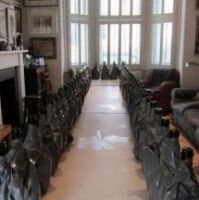
Stephen Skelton, seen above marshalling the bottles in his back garden (and counting his blessings that outdoor temperatures the night before were helpfully low, is convinced that in terms of grape varieties, the future for the English sparkling wine industry lies in strict adherence to the Champagne recipe of Chardonnay with Pinot Noir and Pinot Meunier. This may be true in the long term, but I found that no fewer than four of my seven favourite wines had been made of the non-classic varieties Seyval Blanc and Reichensteiner that used to dominate English vineyards when grape ripening was so much less certain than it is this century. The age of the vines may have made a positive impact on the quality of the wine, but probably a more important factor was the age of the wines themselves. Two of them were 2006s, which, to judge from a 2006 Bloomsbury Merret from Ridgeview tasted after the big blind tasting, seems to be an optimal age for English fizz.
The 25 rosés in the tasting proved more popular with my fellow tasters on average than the whites but I quailed at the prospect of tasting all 94 wines and limited myself to the six pink wines (still tasted blind) most enthusiastically recommended by tasting organiser Stephen Skelton. Unfortunately he failed to persuade Nyetimber, the pioneer of English counterparts to champagne – Britagne, as newcomers Coates & Seely would have it - and the country’s biggest producer to participate in our tasting.
English wine producers are hoping to benefit from the Olympics and a wave of patriotism that may result from the Queen's Diamond Jubilee this year. English Wine Week has been cunningly timed for 2-10 June to coincide with the Jubilee-related bank holidays. It is to be hoped that they manage to capture the affection of wine drinkers since the volume of English sparkling wine on the market is expected to double to five million bottles a year by 2015.
Even without additional ageing, English sparkling wine is generally made on too small a scale to be cheap, however. Retail prices of the wines we tasted at the recent big blind comparison ranged from £16 to £30 with most in the low twenties – more than basic champagne on special offer in a supermarket, but not necessarily worse quality. So long as you like your fizz dry, and very crisp.
SOME FAVOURITES
Bluebell Estates, Hindleap Blanc de Blancs 2008
Breaky Bottom, Cuvée John Inglis Hall 2006
Camel Valley Pinot Noir Rosé 2010
Chapel Down, Blanc de Blancs 2007
Davenport, Limney Blanc de Blancs 2006
Ridgeview, Bloomsbury Merret 2006
Stanlake Park, Heritage Brut NV