
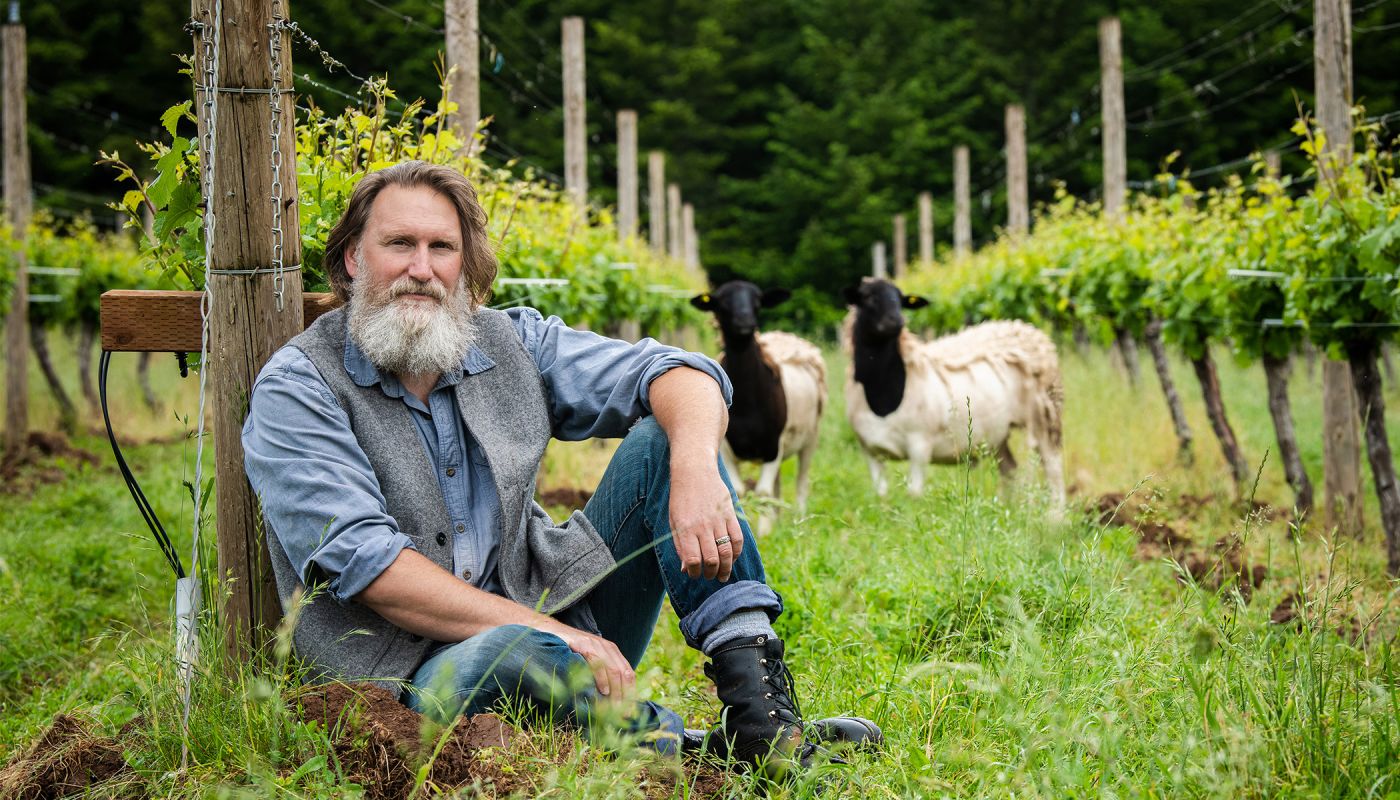
21 February 2023 Stephen Hagen is pioneering a new form of regenerative viticulture at Oregon’s Antiquum Farm.
If your social-media feeds are as laden with wine producers as mine, you may have noticed that the number of sheep in vineyard photos is on the rise. And, as excellent a marketing campaign as they make, that’s only a small part of their overall utility. The sheep have arrived, for the most part, due to regenerative agriculture.
One of the tenets of regenerative agriculture is to decrease tillage: tilling encourages the decomposition and release of organic carbon into the atmosphere. It also breaks down organic matter in the soil, reducing the water-holding capacity of the soils, and may also encourage erosion.
But if you’ve forgone tilling, and you eschew herbicides, then you have weeds. You might choose to mow the weeds, but mowing can have its own issues: instead of one or two tillage passes for weed management, wetter regions with insistent verdancy (eg Oregon) can require up to 15 mowing passes a year. Those passes burn diesel and compact the soils.
Hence the sheep. But, just like trading a plough for a mower, trading a metal mower for a woolly one presents its own challenges: given half a chance, sheep will eat any green growth a vine has to offer (read Tam’s story, Britain's heritage-vine heroes, for a drastic example).
So I was stunned recently to hear that a well-regarded producer was grazing not only sheep in his vineyards year-round but also a host of other animals. I set off to the southernmost end of Willamette Valley (nearer Eugene than Salem) to visit Stephen Hagen and see how he does it.
At Antiquum Farm, Hagen practises what he calls ‘grazing-based viticulture’, which he describes as ‘expensive, labour-intensive, a huge pain in the ass, and deeply meaningful’. He grazes not only sheep but also pigs, chickens, geese and turkeys in his vineyards. He sees this as one of the most respectful and terroir-expressive ways to farm, as the animals help him maintain a system that requires few outside inputs.
‘I can’t bring myself to bring inputs from across the country’, he explains. ‘For fertilisers, conventional farmers are drawing on potassium sulphate sources that are limited, and that’s true for a number of inputs. All that these purchased inputs do is homogenise your site with everyone else’s site.’
Instead of inorganic fertilisers, some producers use compost, but Hagen doesn’t. ‘Compost is like behavioural therapy for the way we approach farming’, he says. ‘Most compost piles that you see aren’t big enough to service a tenth of the vineyard that made them, and they require machinery to collect inputs, build the piles and turn the piles. The only way to build the amount of organic matter that you need in a vineyard is to figure out how to grow enough dry matter on that site.’
Grass and cover crops, Hagen explains, will grow until they go dormant. At that point, you might have 4–5 tons per acre (9–11 tonnes per hectare) of organic material – not enough to build the organic matter he believes is necessary to maintain vineyard health and keep yields economical. However, if you introduce livestock, the equation changes. ‘The key is to keep things in blaze-growth stage. You get up to 8 to 10 inches of growth and take it down to 3 or 4. The constant fluctuation keeps the grass from going dormant and it’s amazing how long you can stretch the season before water scarcity forces you to dormancy. Every time you graze there’s corresponding root die-off underground and then, when the plant grows again, there’s new root growth.’
Hagen estimates that he’s getting 20 tons an acre (45 tonnes/ha) of organic material this way. But it takes him 12–15 grazing rotations a year … something he’s worked hard to figure out how to do. ‘We planted in 1999 and brought sheep in for the first time in 2001. We only put them in during the winter and I watched our soil audits. They didn’t move. So, I thought, this isn’t true. How do I make it true? How do I keep sheep in the vineyard year-round? The entry-level myth, of course, is baby-doll sheep. I’ve lived that lie. If you can reach the vine head, so can the sheep.’ Hagen examined his options. Short of retraining his entire vineyard to a head height that he found ridiculously high, he didn’t have many, so he came up with a new system.
In every row of Antiquum Farm’s 20.5 acres (8 ha) of vineyard there are two electric wires at a sheep’s rump height, one on either side of the vine. The sheep can still get under, but they have to stay low. Hagen breeds his flock for big ears. ‘I need them to get shocked a time or two – it makes them realise that that’s not where the food is.’ He runs each section of wires (about 14–20 rows depending on row length) on two 70-watt solar panels and a deep-cycle marine battery. He has installed ground rods the entire length of the vineyard to keep everything in good working order.
I ask if the amount of live wire that’s buried in the vineyard compromises the environmental ethics of the system. Hagen is blunt. ‘That’s a compromise. So is spraying SO2 and Stylet-Oil [a mineral oil used as a fungicide] and using a tractor to do it. So is glass* and international travel. But I’m confident that this system is a net positive and captures a shit-pile of carbon every year. It makes sense to me ethically. I can burn diesel, or I can feed people. And there’s no joy in an air-conditioned tractor cab.’
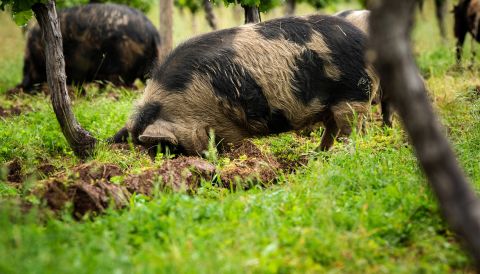
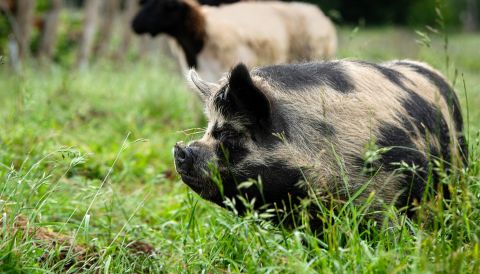
Hagen and I discuss the sheep and the other animals he’s bred for the vineyard. His sheep are Katahdin/Dorper crossbreeds that he’s selected for large ears, sloping rather than upright necks, small but meaty frame, and ability to subsist on grass alone. His pigs, too, are vineyard specific: ‘Kune kune pigs are the only breed I know that can get fat on forage. They eat grass, windfall apples, acorns, anything they can find, and they’ll still get so fat that their eyes start to close up. Short snouts mean they don’t root very well so I can still get a tractor through. They also tend to be small. I need them to be under 150 pounds [68 kg]. If they’re heavier than that and they scratch themselves on a vine, they’ll damage it.’ The sheep and pigs go through the vineyard together with meat breeds of chickens, turkeys and geese following behind eating vineyard pests and parasites. Hagen explains the not-so-glamorous argument for increasing diversity in your grazing programme. ‘Sheep, pigs and poultry don’t share parasite species. Having diversity lowers the potential parasite load for each species.’ Hagen argues that the diversity has resulted in healthier livestock, healthier vines, better meat and better wine.
‘When we used conventional fertiliser, there was one year that I got 9 tons per acre [135 hl/ha]. I paid money for fertiliser, money to train a massive canopy I didn’t need, and money to drop crop. The best wines we’ve ever made are off vines that set their crop at 3 to 3.25 tons per acre [45–50 hl/ha] with no inputs. The grapes average around pH 3.05–3.2 and 25.5 °Brix [c 14.6% potential alcohol].’ Hagen attributes his ideal chemistries to the vine balance that’s been achieved through better farming. Any differences in the flavour profiles of the wines are due to differences in areas of the vineyard; the winemaking itself is simple. ‘You have to understand something: a lot of people get into this business because they love wine. But I love this system. And I love wines’ ability to drive this system and express its benefits.’
If the vibrancy and depth of flavour in Hagen’s wines are any indication, we’re lucky that sheep in vineyards have taken over my social-media feed. As you’ll see from the tasting notes below, the Pinot Noirs are juicy, savoury and bright. The Pinot Gris wines are richly textured with high acid, well-integrated oak and floral notes. I highly recommend their entire portfolio.
*A note on glass weight. Antiquum Farm’s bottles are heavy (I don’t know how heavy because I was tasting with Hagen and didn’t have my scales). When asked, Hagen said that it was important to him that the bottles were manufactured on the West Coast to avoid double shipment (glass bottles are often shipped empty from China). All his wine, save 2%, is sold in the US market. The wine that leaves the market goes to Hong Kong and, as of March, to UK importer Wanderlust Wine.
The eight wines below are shown in the order tasted.

Aged 50% in stainless steel, 50% in neutral oak. Full malolactic...
All neutral oak. Ambient yeast. Unfiltered and unfined. More or...
Made in two 1,000-litre barrels. Stephen Hagen tells me that...
Orange wine: 30–40 days on skins. All neutral oak.
A rich onion...
This is a blend of 6 clones. They put a ton of each in a six-ton...
The fruit for this is taken from the two highest-elevation...
Fruit for this bottling is taken from a 1.5-acre section in the...
This bottling is a blend of 2017, 2018, 2019 and 2021. The...













