In the super-sensual world of wine, scientists tend to lurk in back rooms – in the often malodorous small labs attached to bigger wineries where they analyse what is produced and save it from disaster, or behind the high walls of academe, working on theses too abstruse for the average wine drinker to comprehend.
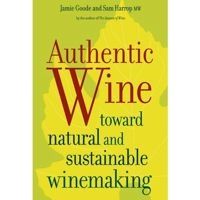
There is one obvious exception, however. Dr Jamie Goode is a British wine writer with a wine column in the Sunday Express, a much-visited blog and website at www.wineanorak.com (sic) and, now, a second book to his name, written with Master of Wine and winemaker Sam Harrop. Its title is surprising: Authentic Wine – Toward Natural and Sustainable Winemaking. As I pointed out in Naked as nature intended?, 'natural wine', the sort made without chemical additions, is a distinctly woozy, artistic concept, an increasingly fashionable cause maybe, but not one you would immediately expect a scientist to espouse.
 So fashionable is it in fact that Authentic Wine is not the only second book to have been published recently on the theme of natural wine. American wine writer and celebrated eponymous blogger Alice Feiring's offering Naked Wine is a much slighter volume, less nutritious and more impressionistic, but much closer to what one would expect from a devotee of natural wine.
 To judge from his online enthusiasms, Goode, counter-intuitively, is as big a fan of wines made without additives, notably sulphur, as Feiring, but between hard covers he seems markedly more circumspect. Every proposition is introduced with a rhetorical question before the arguments for and against are adduced and carefully weighed.
In each book the history of natural wine is traced back to Jules Chauvet, who pioneered winemaking without added sulphur in his native Beaujolais. But Goode and Harrop, for all their 27 pages specifically on The Natural Wine Movement, including a meticulous overview of the role of sulphur dioxide in winemaking, at no point that I could see spell out why so many of the natural winemakers I have come across started to experiment with low-sulphur wines: because they liked drinking and found that sulphured wines gave them worse hangovers.
I learnt a humbling amount from Goode and Harrop's clearly written book, however, and by no means all of it scientific. I didn't realise until they reported the fact from California hi-tech wine scientist Clark Smith that so few wine-related patents had ever been taken out: 150. I also enjoyed the comments of Foster's Australian winemaker and Master of Wine Justin Knock on quite how common it is to add sweetening (plain old sugar in Marlborough Sauvignon Blanc until 2009 when the EU insisted on grape juice concentrate) to finished wine in commercial blends – particularly from the likes of Hardys, McGuigan and Yellow Tail (whose soaraway success in the US was surely predicated on its exceptionally high sugar levels) but much less so for Jacob's Creek, McWilliams and Yalumba's wines. I am also glad to have discovered that there is a way of telling whether a wine producer has added water to their wine (stable isotope analysis, of course, silly).
Goode and Harrop, who gallop through all possible additives to, and manipulations of, wine, arguably give insufficient attention to the subject of ingredient labelling for wine. I don't see why wine should be exempt from a requirement that has long been imposed on all food manufacturers, but Goode and Harrop produce the rather puny counter-argument about the difficulties of translating the additives used into different languages for export.
Yeast, arguably the most important additive of all since without it there is no alcohol, gets a whole chapter, and one which is, surprisingly, in favour of the sort of cultured yeasts marketed by Lallemand, for whom Goode has undertaken work in the past. (His estimate of the proportion of wine made without cultured yeast at 80 per cent seems high to me.) But the book is delightfully clear about the different species of yeast and the argument for and against believing that the dominant wine yeast Saccharomyces cerevisiae is effectively a man-made creation, unlike the wild yeast so cherished by natural wine enthusiasts. The authors are also right to do their bit to dispel the myth that yeast live on grape skins.
In a particularly extensive chapter on biodynamics is a host of interesting case studies of high-profile growers who have converted to the voodoo (cow horns and lunar cycles) but at the end Goode and Harrop seem to nail their colours firmly to the much more middle-brow mast of sustainable viticulture, which makes far fewer demands on its adherents. Biodynamics consultant Monty Waldin is interviewed and quoted at length, not least on why so few Bordeaux properties have taken the biodynamic plunge – because, to paraphrase, they tend to be run for cautious shareholders anxious to maximise yields in a damp climate. (Although the most high profile BD exponent in the Médoc, Château Pontet-Canet, is flying high.) It's refreshing to have someone quoted who has clearly got his trainers dirty. 'Tractor drivers are seen as the lowest of the low', argues Waldin, 'but in fact without them 99 per cent of vineyards couldn't function.' He explains he has managed to persuade tractor crews of the virtues of the biodynamic preparations by mixing them with more conventional sprays to demonstrate how effective and benign they are. (NB: see our forum for the latest lively debate on our forum about biodynamic calendars.)
The chapter on wine's (slightly dodgy) environmental record is also welcome, but virtually ignores winery design and includes arguably too much detail on closures (two of whose manufacturers Goode has also worked for). I especially relished natural wine producer Eric Texier's quote, 'Natural wines are full of good intentions. They are full of fossil fuel too', although the comment was made about the increased costs of 'natural' viticulture rather than the amount of energy used keeping wine, especially low-sulphur wine, cool.
But whereas I suppose I was expecting a rather more passionate espousal of non-interventionist methods throughout the book, at the very end Harrop and Goode (who now says he realises that they should have explicitly stated all their commercial links with the industry in the book) seem suddenly a bit too idealistic to me. They are right that fine-wine production is at a crossroads between authentic and over-manipulated. But to call for all of the most commercial, inexpensive wine to be made in a more natural, terroir-driven manner is surely whistling in the wind.
The most user-friendly book on natural wine, a guide to those producing it, has yet to emerge – although Naked Wine has a useful list of Alice Feiring's favourite producers at the end.
SOME CURRENT FAVOURITES
In the meantime, here are some wines billed as natural that I have particularly liked, in roughly north to south geographical order.
FRANCE
Audrey & Christian Binner, Riesling d'Ammerschwihr 2009 Alsace
Audrey & Christian Binner, K Non-Filtré Riesling 2007 Alsace
Josmeyer, Le Kottabe Riesling 2008 Alsace
Réné Mosse 2009 Anjou Blanc
Frederik Filliatreau, Ch Fouquet 2010 Saumur Rouge
Catherine & Pierre Breton, Trinch 2010 Bourgueil
Catherine & Pierre Breton, La Dilettante 2010 Bourgueil
Dom Jean Foillard, Côte du Py 2009 Morgon
Dom Julien Sunier 2010 Morgon
Dom Marcel Lapierre 2009 Morgon (his last-ever vintage)
Dom Jean-Claude Lapalu, Vieilles Vignes 2010 Beaujolais-Villages
Ch Le Puy, Duc de Nauves 2009 Bordeaux
Causse-Marines, Les Greilles 2008 Gaillac Blanc
Bellegarde 2010 Jurançon Sec
Mas Coutelou, Ouest 2001 Coteaux du Murviel
Ferrier-Ribière Grenache Blanc 2009 Côtes Catalanes
Matassa, Three Trees Le Cayrol Blanc 2009 Côtes Catalanes
Vinci, Coyade 2006 Côtes Catalanes
Le Roc des Anges, Vieilles Vignes 2009 Pyrenées-Orientales
ITALY
Panevino, Is de A'Nanti Rosso 2009 Sardegna
Panevino, Kussas Intrendu A Manu'e Manca 2009 Sardegna
I Vigneri 2008 Etna Rosso
Cornelissen, Munjebel 5, 6 and 7, Magma 7 and 8, Sicilia
COS, Rami 2010 IGT Sicilia Bianco
For stockists, see wine-searcher.com.