It has been my favourite meal of the week for over 40 years. Ever since, in fact, in an era when my own restaurant would be closed and we, as a growing family, were often out of London, sometimes abroad, where many more restaurants tended to stay open. It was then that Saturday lunchtime became my favourite meal of the week.
It was more than just that we were closed and they were open. Saturday lunchtimes have always seemed particularly relaxed. There tend to be more large tables as groups of men go off to football games and groups of women go shopping. (Or vice versa today, of course.) In the 1980s, because my restaurant in Soho in London was not especially close to a sporting venue or a concentration of shops, there was little demand to open. That would not be the case today.
Today, my passion for Saturday lunch seems to be much more widely shared. After Thursday evening, Saturday lunch is invariably the next-busiest service as, certainly in central London and lured by social media, fascinated customers rush to enjoy a good lunch and, possibly, some well-chosen wines. As lunches during the week have in general declined in popularity, Saturday lunch is enjoying the limelight.
The scene in a busy restaurant on a Saturday lunch repays close scrutiny; people-watching can be fun. There are invariably young couples with small children and a buggy to navigate between tables. There are the groups of families of mixed generations; there are celebratory parties that start reasonably quietly but rarely continue like that. Everybody is relaxed – other than the staff.
And that has to be the key. Most people are off work. Many are tourists in cities that are perhaps unknown to them. Many of them are out to be impressed. And there are always the shops to relax in before and after.
Such was the crowd of customers as we walked into the recently opened Lilibet’s on Bruton Street in Mayfair last Saturday at 1.15. There was a lady lunching with her elderly mother. There was a table of two couples enjoying a plateau de fruits de mer (seafood is the restaurant’s speciality). And then close to 3 pm, as we were finishing our lunch, six young women walked in wearing not very much. They were promptly surrounded by a bevy of the most attentive waiters.
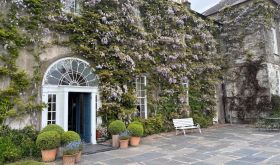
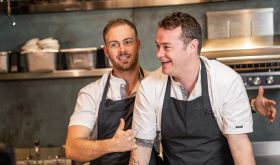
Lilibet’s has been open for only the past 12 weeks. It takes its name from how the late Queen Elizabeth was affectionately known soon after she was born at this address when it was a Mayfair townhouse – though surely very differently decorated! The man in charge is Ross Shonhan whose business card describes him as ‘Founder’. Shonhan has done the hard yards, having cooked for numerous years at Nobu and Zuma, before opening the Bone Daddies group of ramen restaurants. He also has interests in restaurants in the UAE.
He answered my initial question, how had he managed to secure such a prime site, revealing that patience had been the precondition. ‘I had been in discussions with the landlord about a site for several years. Initially, we signed a lease agreement for the back side of the building, where development was planned for 2014, but this never materialised. Fortunately, after a few years of waiting, I was shown this space, which was then used as offices and meeting rooms.’
(Jancis adds I’m pretty sure it was at this address that the late Gérard Basset and his then-business partner showed me this ambitious Les Secrètes des Grands Chefs collection of red bordeaux project in 2013.)
‘It required a lot of imagination, but we signed a new agreement in January 2020. After years of dealing with COVID, enabling works, planning permissions and building works, Lilibet’s, as you see it, came to life. I believe there would have been a lot of competition if it had gone on the open market, but I was fortunate enough to secure it off market.’ I am sure he is right. It is an enormous site that can seat almost 200 including a prominent terrace between what was The Square and is currently Hakkasan restaurants, surrounded by expensive shops and the aspirational car showrooms of Berkeley Square.
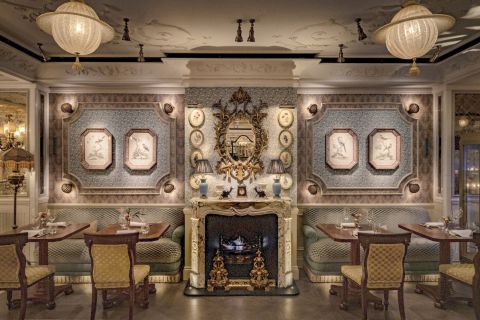
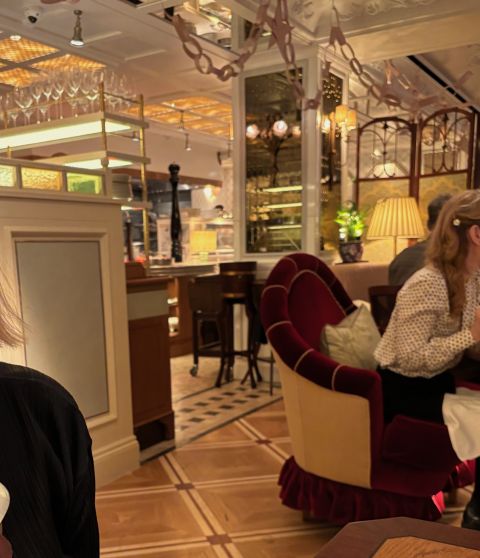
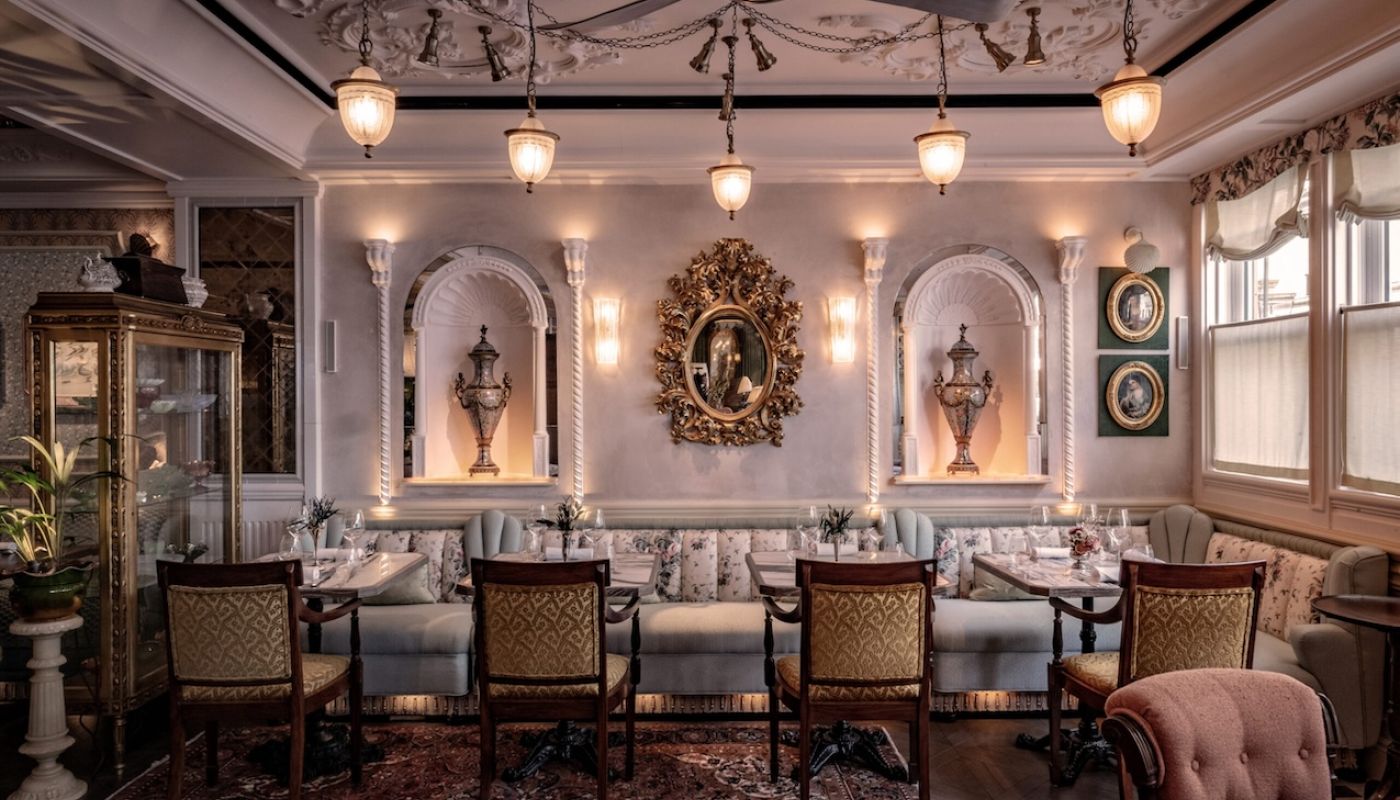
He has handed overall responsibility for the smart, extremely intricate redesign of the large interior to the Russell Sage Studio. They appear to have had lots of fun. No surface has been overlooked: tabletops are inlaid and the interior of the men’s lavatories has received the same treatment; green predominates but everywhere there is intricacy and detail. And that was excluding all those areas and surfaces that are not covered in Christmas decorations (one tree shone brightly while the other, strangely in this arguably over-decorated space, remained unlit). Below is the Oyster Bar where walk-ins are (so far) welcome.
The waiting staff have all been smartly dressed by Shonhan, their hierarchy obvious in the formal jackets the senior waiters and managers wear. There are anomalies and my eye was frequently caught by a French waiter, middle-aged and wearing only a white shirt and tie, whose job seemed to be to fillet the whole fish any table ordered. It was another waiter who brought our menu and wine list and we settled down to read the two smart tomes.
I tried to think back to the last time I had had to open the hard covers on a menu and wine list. The menu has a mere eight pages, the wine list 52. The menu prompted me to note what seems to be a major omission in the restaurant’s offer.
Halfway down page four of the menu, under the heading ‘Unsung Heroes’, it says, ‘We champion under-appreciated species of our oceans’ and goes on to list eight of them without prices, including some I like – sea urchins and hake heads – and one that I do not: sea cucumbers. It advises that the team will be happy to be asked about the day’s availability and their prices.
This I did, picking a young, enthusiastic, be-jacketed waiter. Which fish was the kitchen offering today and at what price? But for the rest of our meal, I heard nothing at all back from him. I saw him frequently as he walked the tables but he never returned. Did he not understand my question? Were no unsung heroes on offer last Saturday? I will never know.
Under the same heading is another offer of a ‘fish triptych,’ a clever idea of a three-course menu comprising a first course of a raw fillet; a second course of a fillet grilled with a mojo verde sauce (the Canarian sauce based on coriander); finishing with a fish soup and suggesting three fish: sea bass, sea bream or gurnard. But no price is mentioned.
The long wine list is priced. It has the distinction of being the first wine list I have come across where a glass of the English sparkling wine, from Roebuck Estates, is £1 a glass more expensive than the French champagne, Gosset NV. And it must be the wine list with the best-value red by the glass, Colterenzio’s St Magdalener Schiava 2024 (an Alto Adige varietal championed by Walter) which is only £10 for a 125-ml glass and is delicious in a very Italian, dry style. White burgundy, of which there are many pages in the list, is the most popular wine to date according to the restaurant’s sommelier during a brief conversation with JR (who chose a glass of Argyros Assyrtiko from Santorini followed by a Barolo served rather too warm).
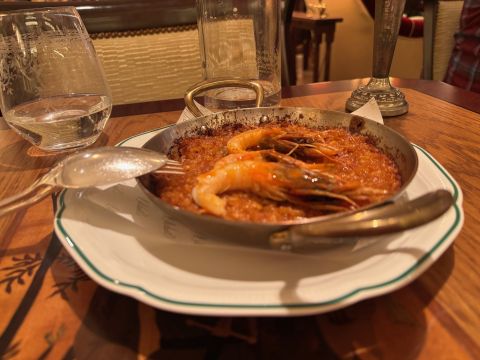
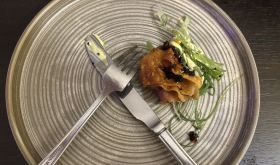
We ate well, both what we ordered and what the kitchen decided we should try. In the first category were two anchovy eclairs shown well above, topped with a creamy anchovy parfait; a fritto misto with two sauces (£18.40); an excellent and very chilli-spicy, lime-flavoured red prawn carpaccio served with lavosh (£23) shown immediately above; a plate of generously cut tuna carpaccio with gazpacho (£19); and a dish of baked rice with three Spanish prawns (below and, at £19, surely the bargain main course).
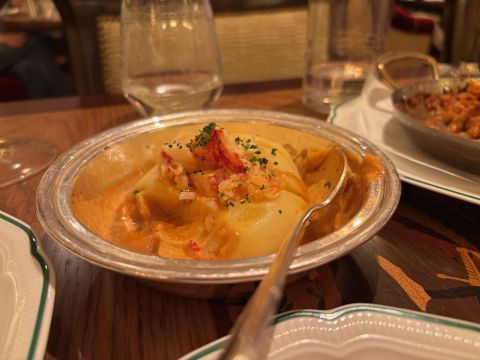
We were sent out – and enjoyed in moderate quantity – a plate of agnolotti stuffed with ricotta and, best of all and shown below, a dish simply described as Lilibet’s mash – mashed potato topped with slices of lobster surrounded in a rich lobster bisque.
Happily, none of them required a sprinkling of black pepper from the three-foot pepper mill that loomed over a corner of the kitchen that was well within view.
Shonhan has ambitious plans for Lilibet’s. ‘As one of the few independently owned restaurants, we plan to become Mayfair’s premier seafood destination’, he explained. Scott’s, almost equidistant from the other side of Berkeley Square, you have been warned!
Lilibet’s 17 Bruton Street, London W1J 6QB; tel: +44 (0)20 3828 8388. Open seven days from January.
Every Sunday, Nick writes about restaurants. To stay abreast of his reviews, sign up for our weekly newsletter.