
Last week, as the 2012 primeurs campaign got underway with rather more speed and sensible pricing than the previous year, I was given a demonstration of a scheme designed to kick the whole Bordeaux system where it hurts most.
I had been approached by a double-barrelled PR man and asked to report to Berkeley Square House, the swathe of offices and suites on top of the Jack Barclay car showroom in London’s Mayfair. As I approached Mr Velvet Lapels, who had been waiting for me on the pavement to escort me to a smart rented boardroom, I was amazed to see how many people were gazing at the shiny Bentleys therein, and with what naked cupidity. But that bodes well for the enterprise I was about to be exposed to.
Arnaud Christiaens is betting what I assume is a considerable chunk of his hedge-fund fortune on creating rivals to Bordeaux first growths, the famous handful of names in the top division of the classification of Bordeaux properties drawn up in 1855. Lafite, Latour, Margaux, Mouton and Haut-Brion now command three-digit prices per bottle – far more than even the most highly regarded and cunningly marketed second growths. In fact, last week Chateau Mouton-Rothschild earned plaudits for releasing the first tranche of its 2012 vintage, still in barrel, for ‘only’ about £200 a bottle.
Immaculately dressed in dark suit, open-necked white shirt and gold cufflinks, with luxuriant tawny locks, he confused me a little at first by declaring ‘my model is 1855'. I thought he was referring to the French-based online wine retailer 1855.com that has been notorious for its mismatch between what is paid for and what is delivered, but no. Like many lovers of red bordeaux and status, he is clearly a bit obsessed by the 1855 classification itself. ‘When I started studying Bordeaux seriously six years ago, I thought it was strange that it is only a tiny number of wines that we talk about.’ His scheme depends on finding vineyards that have the potential to perform as well or almost as well as the first growths and lavishing every attention on them. He says he started with ‘a neighbour of Château Latour that’s completely unknown. Latour want to buy it actually. The farmer produces only 7,000 bottles of wine a year [Latour produces more like 350,000 bottles]. It’s difficult for him to make a living. He also imports olive oil from Spain, for example. I thought, what if we help him to make great wine...?’
Since 2006, Christiaens has been assembling a wine production team and a handful of sites that he reckons are capable of making great wine, even if in tiny quantities. He now has not only the Pauillac vineyard but one in each of St-Émilion and Pomerol across the Gironde on the right bank, and one in the lowly appellation of Médoc. He is launching his 2009s in the UK and the point of my session in the Berkeley Square boardroom was to give me a blind tasting of them with no fewer than four first growths.
I am a veteran of ambitious wine producers and their blind comparisons with first growths – the first I can remember took place in the early 1980s, organised by a New Zealand producer who seems to have completely evaporated – so I approached the exercise with a fair degree of scepticism. In fact, only the presence of world-famous sommelier and fellow Master of Wine Gérard Basset, who has been appointed an advisor to Christiaens, persuaded me to accept the invitation. But even this hardened cynic has to admit that they may be on to something.
Christiaens, Basset, the sales director Frédéric Zantman and I solemnly tasted four 2006 first growths (cost approx £2,000 in total), Christiaens’s 2006 St-Émilion and his five 2009s, all swathed in crimson sheaths so that their identities were a mystery – although we all knew which wines were being served. I am not proud of the fact that my favourite wine of all was their Pomerol 2009 and my least favourite was the most expensive 2006 first growth. If one wanted to put an excusing gloss on this, one would point out that 2009 is a much flashier, more immediately appealing vintage than 2006, and that Pomerol is the most generous appellation of all. But perhaps the most impressive achievement of the Christiaens team is that they have managed to fashion a wine from the appellation Médoc that withstands comparison with first growths.
When its identity was revealed, I was dying to know exactly where in the Médoc the vineyard was. ‘That’s just what Michel said’, Christiaens beamed, referring to the French wine critic Michel Bettane. ‘We want to keep the secret as much as we can. We don’t want François Pinault or Bernard Arnault to come along and buy the vineyard.’ Christiaens, who is currently producing just over 40,000 bottles a year from these four properties, would like to add about three more (‘We don’t have a Margaux yet, for instance.’) so that total production is about 125,000 bottles. ‘Our first relationship was like a 50-year lease. We let professionals make the wine. Sometimes we have bought equipment for them. One of vineyards knew exactly what to do.’ Bordeaux is such a tight-knit, gossip-loving society, I cannot believe he can keep secret the location of these vineyards for very long, but the whole marketing plan relies on secrecy.
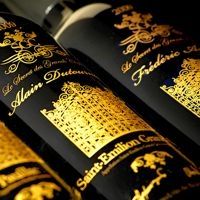
I take my hat off to the production values of this enterprise but I have severe doubts about the marketing. If they can’t carry vineyard names, this group of wines clearly need a brand name. The one that has been chosen is Le Secret des Grands Chefs (SGC). Each wine is packaged very similarly in a black and gold design eerily similar to Jade Jagger’s design for the second wine of Ch Ducru-Beaucaillou (they don’t yet have a vineyard in St-Julien either). So far so good – except for the ridiculous weight of the bottles. But to justify the name, each wine is associated with a French chef: Alain Dutournier, Bruno Ménard, Frédéric Anton and Yannick Alléno. The blessing conferred by these names may just work in France, but outside France, and particularly in the US and UK, chef sponsorship is more readily associated with supermarkets and sauces than wine connoisseurship. We certainly wouldn’t fall for the notion that a chef had gone out and found his own special vineyard.
Although I was very impressed by the wines, I have to look up those three letters every time. If I were asked, I would suggest a bit of that hedge-fund fortune, instead of offering delivery in central London within two hours of pointing your smartphone at the back label in one of the few restaurants that list SGC wines, was spent on better branding.
THE CHEFS’ SECRETS
These ambitious new red bordeaux are available from Hedonism Wines, the most luxurious wine retailer in London, and from www.sgcwine.com. Prices are per bottle.
St-Émilion Grand Cru 2006, £123.50
Pauillac, Bruno Ménard 2009, £291.70
St-Émilion Grand Cru, Alain Dutournier 2009, £246.00
Médoc, Frédéric Anton 2009, £207.80
Pomerol, Yannick Alléno, 2009, £266.70
Great Chefs' Secrets in a bottle?
• 5 min read
This is a longer version of an article also published in the Financial Times.


选择方案
会员
$135
/year
适合葡萄酒爱好者
- 存取 297,159 条葡萄酒点评 & 16,153 篇文章
- 存取《牛津葡萄酒指南》及《世界葡萄酒地图集》
- Access askJancis, our AI wine assistant


核心会员
$249
/year
适合收藏家
Everything in “Member”, plus:
- Early access to the latest wine reviews, 48 hours in advance
- Early access to the latest articles, 48 hours in advance
专业版
$299
/year
供个人葡萄酒专业人士使用
- 存取 297,159 条葡萄酒点评 & 16,153 篇文章
- 存取《牛津葡萄酒指南》及《世界葡萄酒地图集》
- Access askJancis, our AI wine assistant
- 提前 48 小时获取最新葡萄酒点评与文章
- 可将最多 25 条葡萄酒点评与评分 用于市场宣传(商业用途)
商务版
$399
/year
供葡萄酒行业企业使用
Everything in “Professional”, plus:
- 可将最多 250 条葡萄酒点评与评分 用于市场宣传(商业用途)
- Access to submit wines for review
- Offer memberships to your employees and manage them from a single place
- API access available for an additional fee
More Free for all

Free for all
这家领先的新浪潮南非葡萄酒生产商正在展望未来。本文的一个版本由金融时报 发表。另请参阅这篇 帕拉迪乌斯垂直品鉴,他杰出的白葡萄酒混酿。...

Free for all
杰西斯 (Jancis) 回忆她遇到过的最迷人的葡萄酒生产者。上图为尼尔 (Neill) 在他的双桨园 (Two Paddocks)...

Free for all
在第一轮评审之后,我们很高兴开始发布今年写作比赛参赛作品中的最佳作品。所有入选作品均未经编辑发布...

Free for all
非凡的海鲜和完美搭配的魔力在火箭仓库 (The Rocket Store)。上图为博斯卡斯尔港 (Boscastle harbour)。...
More from JancisRobinson.com

Tasting articles
Concluding Walter’s report on this notably accessible vintage. Today, reviews of wines from the southern and eastern villages of Castiglione...

Tasting articles
关于这个棘手年份的最终报告,如今展现出非凡的清新和易饮性。今天,我们将评鉴来自多个村庄以及北部和西部村庄凯拉斯科 (Cherasco)、罗迪...

Inside information
墨西哥的葡萄酒产业为应对气候挑战提供了经验教训,常驻墨西哥的记者兼侍酒师卡洛斯·博尔博亚 (Carlos Borboa) 如是说...

Vinomakase
理查德 (Richard) 的新专栏 Vinomakase 探讨专家如何将葡萄酒与日本料理搭配...

Bite-sized
位于圣奥尔本斯 (St Albans) 大教堂区的一家 15 世纪酒吧,提供最新潮的美食盛宴。 前厅酒吧仍然令人安心地保持着酒吧风格...

Wines of the week
来自法国中部的一款红葡萄酒,带来解渴的清新感。售价 £15.50, $26.95 起。 对于一个在过去七百年中饱受诟病的品种来说,佳美...

Book reviews
经典葡萄酒图书馆系列的三本新书,以及一本自行出版的葡萄牙葡萄酒指南。 以下四篇评论中,有三篇是关于葡萄酒学院 (Académie du...

Tasting articles
一场揭示性的垂直品鉴,追溯南非最受追捧白葡萄酒的演变。这些酒款由英国进口商贝瑞兄弟与路德 (Berry Bros & Rudd)...