Credit where credit is due. David Schildknecht is a wine writer of my vintage based in Ohio. Over the years we’ve spent a bit of time together in his beloved Germany and Austria, and also in California. What distinguishes him is how generous he has been in sharing tips. It was thanks to him that I first visited Spottswoode in St Helena, who to this day produce some of the finest Napa Valley Cabernets, never having wavered from their particularly gentle, terroir-driven style.
Another American wine producer he drew to my attention is Rutger de Vink’s RdV in Virginia, another producer of sophisticated Bordeaux blends, in this case with input from Eric Boissenot, one of Bordeaux’s most famous wine consultants. I would never have trekked to this cosseted estate off the world’s main wine routes without David having suggested it.
Five years ago he presented a special masterclass at the biennial wine fair in Vienna, Vie Vinum, devoted to expressing his admiration for a white wine grape that doesn’t get much airplay, Pinot Blanc, known in German-speaking countries as Weissburgunder, occasionally Weisser Burgunder, and in Italy as Pinot Bianco. I wasn’t completely convinced at the time but I have to admit that recent tastings have convinced me how good, and useful, wines made from this grape can be. (See Pinot Blanc – Austria shows its stuff and Schildknecht on Austrian Weissburgunder.)
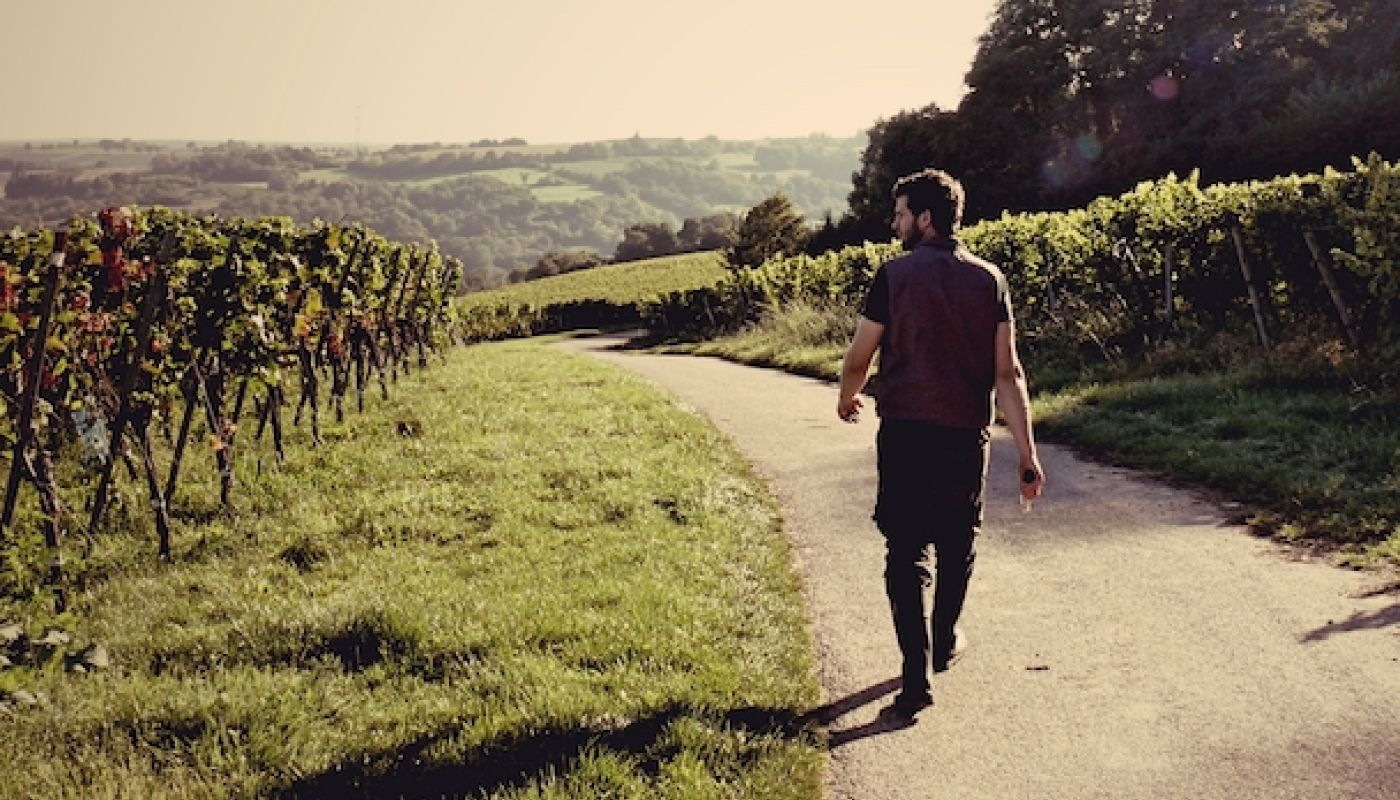
I was reminded forcefully of its fruity-yet-fresh charms recently when tasting a rather intriguing example that costs just £10.95 from The Wine Society, the popular and venerable British wine-buying co-operative (see my most recent collection of tasting notes on Wine Society wines). Jülg Weissburgunder 2018 Pfalz is made by a German vintner, from grapes that are actually grown over the border in France’s Alsace region. My tasting note includes the observation that it’s ‘arguably more fun than most white burgundies’. It’s the frankness, the vitality, and, perhaps, lack of oak that is so appealing. Perhaps, being German, Johannes Jülg, pictured here in his vines, was not afraid to lavish attention on these Pinot Blanc grapes.
The funny thing is how differently the grape is rated on either side of the Rhine. In Alsace growers regard it as a one of their lowlier grapes, several ranks below Pinot Gris, long seen as ‘noble’. In my experience Pinot Gris is generally more perfumed, spicier, deeper coloured and more potent than Pinot Blanc – especially in Alsace. But as Pinot Grigio, as Italians call Pinot Gris, the currency has become debased. Italy has exported oceans of anodyne inexpensive Pinot Grigio that seem closer to the consequence of bloated yields rather than a serious varietal expression. Friuli in the far north east of Italy provides an exception in being the source of some distinctly superior Pinot Grigio. The price is a clue.
In fact Pinot Blanc is a pale-skinned mutation of the great red burgundy grape Pinot Noir, just as Pinot Gris is pink-skinned one, so there is no genetic reason to see Pinot Blanc as the poor cousin. But few Alsace wines labelled Pinot Blanc are made with real ambition, and even fewer contain 100% Pinot Blanc grapes.
Auxerrois is a sort of cousin of Pinot Blanc that is commonly planted in Alsace and for some reason an Alsace wine labelled Pinot Blanc may contain as much Auxerrois as the producer likes – even 100% (See When Pinot Blanc isn't.) But Auxerrois can easily lack acidity, an increasing problem as summers warm up, so it’s probably better to head for an Alsace producer such as Josmeyer or Kreydenweiss who really takes trouble with their Pinot Blanc. Although among most Alsace wine producers, Pinot Blanc is regarded as a workhorse rather than a thoroughbred.
Across the Rhine in Germany, however, Weissburgunder is really taken seriously. Because the Germans have only recently had much fashionable Chardonnay planted in their vineyards, Weissburgunder (a relative of Chardonnay, also part of the massive Pinot family) was regarded as a sort of Chardonnay manqué for many years. Because of this, it was given the same full (and sometimes too much) oak treatment as a white burgundy, the quintessential Chardonnay. This led to some rather fat, oaky Weissburgunders in the early years of this century but things have changed, decidedly for the better.
Fortunately, most producers in the southern regions of Baden, Pfalz and Rheinhessen, where most German Weissburgunder is to be found, have outgrown their obsession with oak and today are producing a host of really fine, appetising, charming Weissburgunders, particularly in Baden and Pfalz, where those of Heger and Rebholz enjoy real prestige.
Austria is another very important source of vivaciously mouth-filling (but not sweet) examples, some of them labelled Weissburgunder and some Pinot Blanc. It was no surprise that Schildknecht chose to deliver his 2014 encomium to the grape in Vienna. His contention is that in youth Pinot Blanc/Weissburgunder can taste a bit like sweetcorn whereas with age it takes on a flavour reminiscent of shrimp shells. I can certainly see the sweetcorn but I’m not quite sure about the shrimp shells yet.
There are producers of fine examples of the grape all over Austria, especially in the south-east, even though the country’s very own white wine grape Grüner Veltliner and the famous Riesling often take precedence.
But the one wine region where Pinot Blanc really does get its due is one where it is more likely to be called Pinot Bianco. Alto Adige or the southern Tyrol, is the distinctive subalpine region that is an unlikely cocktail of Italian, Austrian and German influences. Here, as nowhere else in the wine world, a sizeable majority of the best wines are made by well-run wine co-operatives. The Cantina Terlano produces a superb array of different Pinot Biancos, some designed, as is the increasing trend worldwide no matter what the grape, to express the character of a particular vineyard, Here Pinot Bianco is typically fermented in stainless steel and aged in large old oak casks. These are wines that can continue to develop for five years or more in bottle – and can, like serious white burgundy, go superbly with food.
There is also some Pinot Blanc action outside Europe, although historically the variety has languished in the shadow of Chardonnay. For many years Chalone, in the mountains of the Monterey hinterland south of San Francisco, made a Pinot Blanc every bit as serious as a white burgundy and, further south, Au Bon Climat has continued the tradition in sensitively oaked Central Coast blends of Pinot Blanc and Pinot Gris.
And I was amazed by the quality of the Pinot Blanc produced, way outside the Australian norm, by Granite Hills in the chilly breezes of the Macedon Ranges outside Melbourne when I visited there a couple of years ago. Schildknecht is worth listening to.
Superior Pinot Blanc/Weissburgunder/Pinot Bianco producers
France
Josmeyer
Kreydenweiss
Martin Schaetzel
Germany
Battenfeld-Spanier, Rheinhessen
Brenneisen, Baden
Christmann, Pfalz
Ernst Dautel, Württemberg
Hanewald-Schwerdt, Pfalz
Heger, Baden
Heitlinger, Baden
Jülg, Pfalz
Knewitz, Rheinhessen
Rebholz, Pfalz
Stigler, Baden
Martin Wassmer, Baden
Wittmann, Rheinhessen
Ziereisen, Baden
Austria
Ebner-Ebenauer
Neumayer
Prieler
Herbert Zillinger
Italy
Cantina Kurtatsch, Alto Adige
Cantina Terlano, Alto Adige
Castel Juval, Alto Adige
Colterenzio, Alto Adige
Girlan, Alto Adige
Hofstätter, Alto Adige
Kränzelhof, Alto Adige
Alois Lageder, Alto Adige
Manincor, Alto Adige
Musella, Veneto
Tiefenbrunner, Alto Adige
Elsewhere
Au Bon Climat, Santa Maria Valley, California
Granite Hills, Macedon Ranges, Australia
You can find tasting notes on these producers' wine in our tasting notes database, and international stockists via Wine-Searcher.com.