
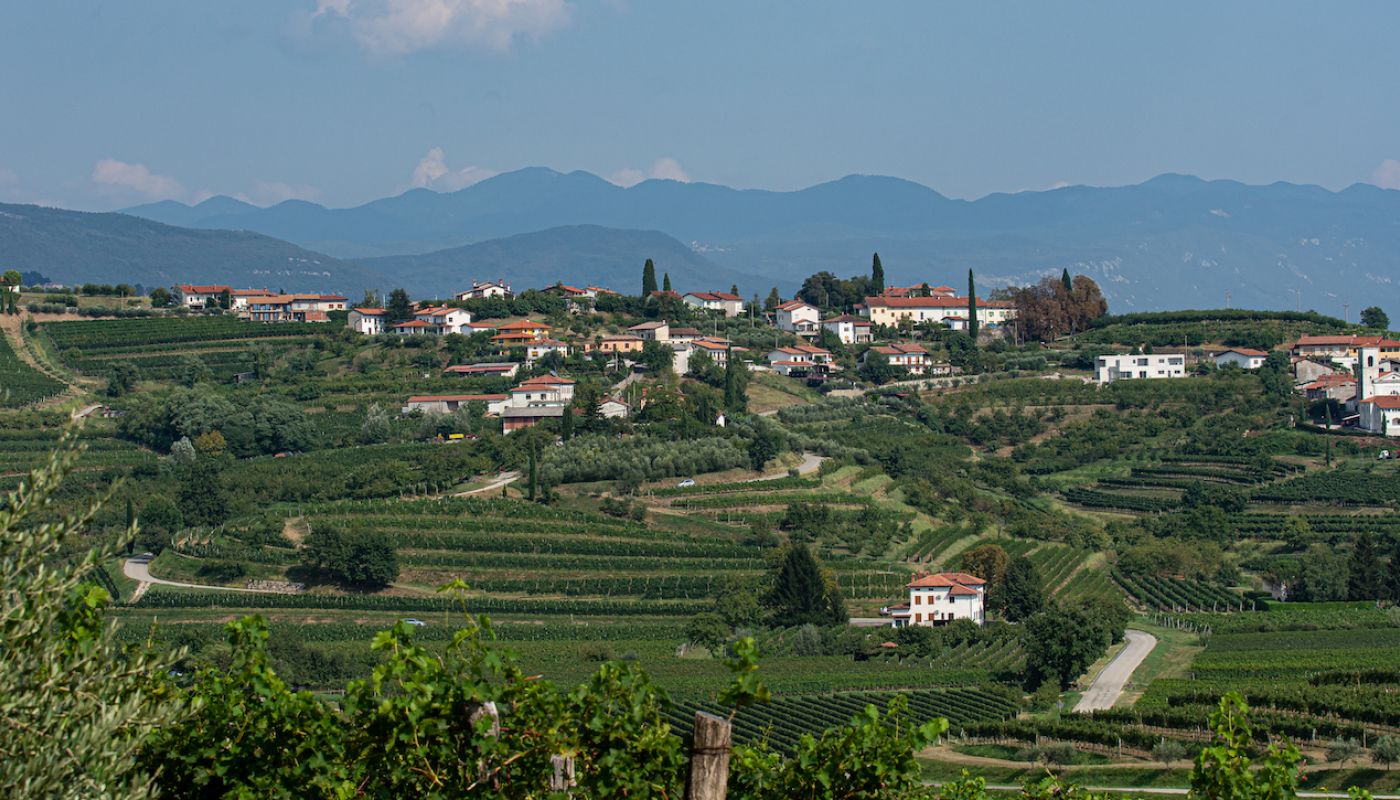
17 November 2020 Caroline Gilby MW surveys the world through the prism of a particularly local white wine grape. See also Julia’s Rebula – there’s gold in them thar hills. All pictures, including this view of Brda vineyards, are courtesy of D J W Bailey.
There are local grapes and local grapes, and even that global traveller Chardonnay was once someone's local grape. But why some grapes made it big and others remain confined to small areas of the wine world is a fascinating question. For some varieties, it's clear that the best it can do is be a good example of that particular variety. In other cases, there are grape varieties with real quality potential that have ended up confined to small corners of the wine world for reasons of politics, wars, pests and diseases, or simply being too finicky to deliver a commercial crop that met the needs of the time. In today's search for authenticity and originality in wine, some of these grapes are well worth exploring.
The back story
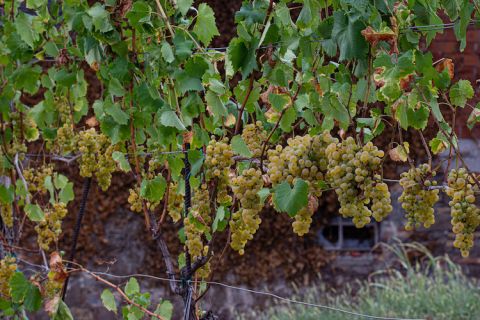
One of my personal favourites is the golden grape known variously as Rebula or Ribolla Gialla – a grape with a bit of a rebellious streak. It’s hung on in Slovenia’s western regions of Brda and the Vipava Valley in the face of natural and economic crises such as phylloxera, two world wars and the aftermath – Yugoslavia. In Slovenia at least, it has stood firm in the face of the global march of international varieties and today is planted on 371 ha (917 acres) in Brda (21% of the region) and 225 ha (556 acres) in the Vipava Valley (10% of the region). It also has a stubborn streak in its ability to deliver its best fruit when fighting for life on steep slopes and dry, rocky soils.
Its homeland is almost certainly the gorgeously beautiful, hilly, cross-border region of Italy’s Collio and Slovenia’s Brda. A group of like-minded producers in Slovenia and Friuli have recently joined forces under the tagline ‘Brda Home of Rebula’ to raise awareness of the grape through tastings and conferences. As part of that, they shortened the region’s name from Goriška Brda to simply Brda for closer comparison to Collio. Both names mean ‘hills’ and this was once a single region of ridges and valleys formed where a calcite sea met the base of the Julian Alps.
It was divided only after the Second World War, with 70% of the region allocated to what is Slovenia today. Remnants of border posts still stand sentry at the roadside, but otherwise there’s really nothing to tell you which nation you are in apart from the language of road signs. My first visit here was back in 2002. It was easy to go for a run round the vines and cross continents by accident (from outside to inside the EU – Slovenia joined in 2004) though in a car you had to drive 30 km to an official border crossing.
Grapes and wine have been known in this north-eastern corner of Italy and Western Slovenia since at least Roman times. The earliest credible references to the Rebula/Ribolla grape appear in ecclesiastical records from the 13th century. Like so many famous grapes that seem to have originated in the Middle Ages, it shares a parent in the prolific Heunisch Weiss (which has been identified growing in Slovenia under the name Rebula Stara), though the other parent remains unknown. There are reports that it was highly regarded and was a favourite of the aristocracy, as well as being used as payment in kind to settle debts.
In the 14th century, the Italian poet Giovanni Boccaccio even mentioned Ribolla in writings on the sin of gluttony. In Brda, the oldest known record mentioning production of Rebula is dated to 1336 with a vineyard sale document that declared production of six buckets of Rebula every year. In 1751 Empress Maria Theresa enforced a land tax that showed that Rebula vineyard land was valued highest, noting that it was the wine with the best bouquet.
The Brda region has been telling its story through Rebula as its flagship for several years although the Vipava Valley (or Vipavska Dolina) also has some strong claims on Rebula. A priest called Matija Vertovec wrote in 1844 about Rebula being the top variety in the Vipava Valley and noting six different biotypes. As with most of Europe, phylloxera hit in 1890 and the region’s only nursery for grafting was founded in Vipava in 1905. It probably supplied much of the plant material to Brda, though buying plants from Italy was also a possible route. Since the 1990s Slovenia has selected its own five clones of Rebula, which are different from the commercially available Italian selection.
Where it grows
Slovenia and Italy went different routes in the 1960s when Slovenia kept its Rebula and Friuli saw the spread of other varieties; according to Professor Angelo Costacurta there were only 60 ha (148 acres) of Ribolla/Rebula in Italy by 1976. He reported that Ribolla was widely cultivated throughout Collio until the 1900s, often in field blends, but that by the 1960s interest in the grape in the Italian part of Collio had declined. Other writers such as Walter Filiputti saw the decline in Ribolla’s fortunes earlier. He noted that Ribolla was the flagship wine of Friuli from 1300 until the appearance of Picolit around 1770.
Aspirations for quality, at least in Slovenia, largely disappeared under Yugoslav President Tito when growers were expected simply to grow grapes and deliver them to the state wineries. Rebula’s ability to deliver up to 42 kg (93 lb) per vine was attractive in a time of subsistence farming in Brda.
A strong supporter of Rebula in this era was Zvonimir Simčič who planned, and directed for 30 years, the Goriška Brda Co-operative Cellar that is Klet Brda today. (Its annual production of 1.5 million litres of the variety make it the single biggest producer of Rebula in the world.) He believed in Rebula as the region’s own, brought in the region’s first quality incentives and found ways to smuggle better winery equipment into Yugoslavia from Italy, having it labelled as dairy supplies.
Today, Slovenia is a significant grower of Rebula with close to 600 ha (1,480 acres) while Italian plantings were reported to have reached 435 ha (1,075 acres) by 2010. A recent paper published on Nature.com puts Italy’s plantings at 1,159 ha (2,864 acres) today – quite an increase, in part due to strong demand for alternative grapes for sparkling wines as competition to Prosecco. Much of this new vineyard area has been planted on flat land in the Veneto with high yields of up to 300 quintals/ha (roughly 210 hl/ha or 12 ton/acre) as the aim, a move that has sparked much concern from Slovenia and the better Collio producers.
For instance, Michele Jermann (Jermann’s Vintage Tunina and Vinnae wines include Ribolla) explained to me that they are firm believers in growing Ribolla on poor flysch soils and steep slopes. According to him, ‘it’s stupid style to grow Ribolla on the flat. It produces too much, arrives without quality or ripeness and with mould.’ No one really knows exactly why Ribolla/Rebula almost disappeared in Italy and credit for its revival as a good-quality grape should perhaps go to winemakers in the orange-wine hotspot of Oslavia, where the likes of Gravner and Radikon have done so much to put this wine style, based on Ribolla/Rebula, back on the wine map.
A fussy grape
One problem that seems to limit the spread of the grape is that Rebula/Ribolla is very fussy about where it grows if quality is the aim. Marjan Simčič in Brda says, ‘Rebula is born for this place, it survives here, copes with poor soil, keeps good acidity and there's no need for irrigation.’ In Brda 85% of the vineyards are on slopes of more than 20% and Rebula accounts for close to 21% of the region’s vines, most often on the highest, driest sites.
Its other Slovenian home, the dramatic Vipava Valley, is also defined by hills and surrounding mountains. Here Rebula accounted for 50% of the vineyards until the 1960s when international varieties arrived. Today it constitutes around 10% of the region’s plantings and is the fourth most planted variety, doing best on exposed hillside sites. The most favoured soil for Ribolla/Rebula is called ponca in Italy and opoka in Slovenia. It’s a complex mix of marl and sandstone on a calcium carbonate base that fractures easily, drains well and forces the roots down as far as 10–12 m (33–39 ft).
Many of the vineyards are on terraces made of soil rather than stone, and in Slovenia (Europe’s most forested country) producers are committed to protecting biodiversity around the vineyards. In the summer there are clouds of butterflies fluttering round carpets of wild flowers. Several producers would like ultimately to reunite Collio and Brda into a single denomination, though at present there are legal issues around labelling for cross-border wines. For instance, vineyards in Italy can only be PDO Brda if they were historically part of a Slovenian property before the 1947 border was imposed.
Wine styles
Rebula/Ribolla is a grape that carries a cultural load of many centuries in its homeland, though arguably more important is what it can offer to anyone opening a bottle today. It’s incredibly versatile, as well as capable of winning medals globally across its many styles. (For instance, at the 2020 Decanter World Wine Awards where I am a panel chair, it picked up 14 gold, silver or platinum medals.)
It’s a fairly aromatically neutral grape, typically high in acid in Slovenian/Friulian conditions, ripens late with only moderate alcohol and often with a saline, mineral texture. This makes good base material for its role in high-quality bottle-fermented fizz such as those from Medot. Medot’s owner Simon Simčič says, ‘We have always believed Rebula is an excellent base for top quality sparkling wine’. Rebula/Ribolla is also used in very good sparklers with a real sense of place from Bjana and the cross-border Sinefinis label from a joint venture by Ferdinand and Gradisciutta.

There are several different approaches to still winemaking. It reminds me rather of Albariño or Gruner Veltliner in its classic style, giving refreshing, vivid and pristine (usually tank-fermented) wines. Recommended wines in this style from Brda include Dolfo, Klet Brda’s Quercus and Krasno ranges, Benedetič, Emeran Reya, Medot and entry-level wines from Ferdinand, Ščurek, Edi Simčič and Marjan Simčič. With judicious use of oak and in some cases a little skin contact, it can offer more sumptuous burgundian or Rhône-like weight, with supple texture, spice and sapid richness rather than fruity notes. Wines I love in this style include the gorgeous Ščurek Up; the fantastic, silky, single-vineyard Fojana from Edi Simčič; Zanut’s sapid herb-scented version; Gašper’s refined white label; Klet Brda’s fine Bagueri range; Ferdinand’s beautifully balanced Epoca; and Moro’s Margherita, a unique supple take on the variety from partly dried grapes. There are some amazing Rebula-based blends too such as Movia’s long-lived Veliko Belo, Kristian Keber’s Brda and Jakončič Carolina. Rebula has thick skins and is also particularly suited to producing the orange wines that represent a local tradition revived, with long skin contact in barrels, concrete or even amphora, giving red-wine-like structure and the ability to match food with incredible depth and savoury, saline complexity.
Klet Brda Motnik (vinified in barrels smoked with local herbs), Erzetič Amfora (vinified in buried clay jars), Marjan Simčič’s Opoka (from 65-year-old vines fermented in concrete eggs) and Ferdinand Brutus with 12 months on skins are all notable. These wines can also be fabulously long-lived. Marjan Simčič’s 2003 was in excellent shape when I tasted it in late 2019, as was Edi Simčič’s stunning 2002 Rebula. To complete the picture, a few producers, most notably Marjan Simčič with Leonardo, even make wonderfully complex super-sweet Rebula from dried grapes, in which the sweetness is balanced by the variety’s hallmark freshness. UK agents/stockists of Brda wines include Berkmann Wine Cellars (Klet Brda), Liberty Wines (Gašper), Bancroft Wines (Edi Simčič), Stone Vine & Sun (Žanut) and Orbit Wines (Marjan Simčič).

In the Vipava Valley, producers such as Primoz Lavrenčič at Burja Estate see the grape’s best role in blends. He says, ‘Local grapes always have something missing, but a blend can offer it all’. His excellent Burja Bela (Les Caves de Pyrène) is Rebula, Malvazija and Laški Rizling with six days on skins and aged in concrete and large neutral oak. Martin Gruzovin of Guerila says, ‘We believe a lot in Rebula at Guerila. We planted more in our new vineyard this past spring. What I like with Rebula is that the aromatic profile is not too aggressive so we can really show terroir characteristics in the wine. Also, we do not have problems with too high alcohol or losing acidity, which is the main problem with some other, mostly international, varieties.’
He adds that it is the key variety for their Retro blend (UK agent is Alliance Wines) but admits that many producers are finding it harder to export blends, so a lot of producers are making it as a varietal wine with nice results. ‘I believe in its potential both ways’, he says. Other notable Vipava Rebula-based wines worth exploring include Lapor Belo from Vina Krapež, Pasji Rep Jebatschin (Stone Vine & Sun) and Mlečnik Ana Cuvée (Les Caves de Pyrène).
An outside perspective
Slovenians and Friulians are incredibly loyal to their flagship local grape but an argument for greatness gains validity if New World producers pick it up. There is actually a small group of enthusiastic winemakers around Napa in California who get together regularly to discuss and taste the variety (although of course it’s confined to online at present). As explained in Elaine’s 2015 article The return of Cal-Ital, Ribolla/Rebula arrived thanks to businessman and grower George Vare who went exploring in north-east Italy to learn about making better Pinot Grigio and fell in love with Ribolla/Rebula. He bought cuttings from Josko Gravner and planted a small vineyard which has subsequently supplied cuttings to other growers. Dan Petroski of Massican reckons there are about 15 acres (6 ha) in total in the USA, although the wines are rare and hard to track down and are rarely exported. Petroski, who vinifies around 25% of the Ribolla/Rebula in California using it in his Collio-inspired white blend, says, ‘Honestly it's not a very interesting grape’. But he reckons it's a shapeshifter that allows other grapes to flourish in a blend, finding a core of 40% Ribolla/Rebula to be ideal. Petroski also reports having a hard time growing it in California. He says the soil is high pH and the climate is too hot in California, adding that no one is going to give up great soils for a white grape in Napa where white grapes are being pulled up in favour of reds.
Even so, some other Napa winemakers are enthusiastic. Duncan Arnot Meyers of Arnot-Roberts described it as unique with ‘walnut birch bark zip and freshness from a touch of bitterness – like a good tonic’. Megan Glaab of Ryme Cellars finds it ‘savoury, with piney qualities – really engaging with food’. And Steve Matthiasson said, ‘wine is about consuming the passion’, describing Rebula/Ribolla as ‘a cool, ancient variety – there’s a timelessness to it. Humans have shepherded it along because it's so great.’
Perhaps most surprisingly there is also a small plot at Channing Daughters in their Bridgehampton vineyard on the South Fork of Long Island. The complex and sapid 2015 Ribolla Gialla is available in the UK at Wanderlust Wine and according to owner Richard Ellison, ‘somms go mad for the stuff’. Channing Daughters winemaker James Christopher Tracy says, ‘We love Ribolla Gialla. It is one of our last varieties to be harvested, after almost all the reds and significantly after the other whites, but it holds up extremely well. It is very high in acid. We like to skin-ferment Ribolla in small bins with ambient yeast and raise it in older oak barrels. We get more texture, aroma, flavour and expression that we believe results in a more complex and reflective wine than if we made in another style. We do believe it is a high-quality grape and makes world class wines.’
The Australian experience appears even more limited, exclusively with a clone called VCR 72, released from quarantine in 2015 and trialled by Chalmers in 2017 and 2018. They describe the finished wine as, ‘Light bodied, racy and with a lime/lemon nose, also a faint hazelnut or biscuit note on the nose. Perhaps lemon barley cordial aromas. The palate is lean and fresh.’
Whatever you call it, I’m convinced that Rebula/Ribolla is capable of exciting wines in all styles and it offers something unique with a sense of place. Its fussiness about where it is grown will always limit its spread, but that means its story will largely be of its authentic homeland in this small corner of Europe (Slovenia’s Brda, the Vipava Valley and across the hills in Friuli).
People increasingly want stories in their glass and Rebula/Ribolla can offer this in spades. Final words should go to Klet Brda’s Darinko Ribolica, the winemaker who makes more Rebula than anyone else in the world. He sums up, ‘Why Rebula? It is our oldest variety, our sleeping beauty, complex and simple. It gives me inspiration, it’s great as fresh and light wine, but is also great for aging in oak, for maceration and orange wines.’













