South Africa of course has had further to travel than most countries in any attempt at racial equality because it inherited the hangover from apartheid whereby all the menial jobs, including vineyard work, were done by poorly paid Blacks, a term which in South Africa officially includes the people once known as Cape Coloureds as well as Indians and, more recently, Chinese.
Since Mandela’s release in 1990 there have been laudable attempts to promote more racial equality, provide opportunities for the Black majority and to improve vineyard workers’ pay and conditions. Most of the early BEEs, Black Economic Empowerment enterprises, were poorly visualised and administered. Many of them shrivelled and died.
But according to Phil Bowes, enterprise development manager at the industry association Vinpro, ‘South Africans have learnt from the mistakes of the past. Sustainable development practices are now being implemented with significant support from the industry for Black-owned enterprises. Not only do people of colour have access to private sector and government-sponsored cash grants for business development, but also to free technical knowledge via industry bodies such as Vinpro, Winetech and the Wine Industry Transformation Unit. More recently established BEE models seem to work better than early attempts did. Revisions to BEE legislation have promoted inclusivity with less room for non-viable propositions.’
I asked wine writer and entrepreneur Michael Fridjhon, who has been explicitly critical in the past (see his 2017 excoriating assessment of Black opportunity in the wine business) how much progress he feels has been made since then.
‘On the surface very little real progress', was his reaction. ‘A few cosmetic schemes, and a few Black billionaires buying trophy properties. A dozen or so well-meaning operations, usually linked to grander white-owned properties (Thokozani, for example). None that I can think of which have grown in line with the ever-growing market for wine among Black middle and professional classes. It seems that there isn’t much support for the mom-and-pop operations that have come and gone. I think the largest (but strangely invisible) Black-owned business is M’Hudi, linked to Villiera but wholly independent.’ What concerns him most is that better-heeled Black South Africans seem more interested in international status symbol wines than in supporting local wine-producing effort.
But the statistics are quite impressive nowadays. Queen of the South African vines Rosa Kruger was kind enough to provide me with the following:
- At present there are 60 Black-owned brands in South Africa.
- The Vinpro board is 28.4% Black-controlled.
- The staff of SAWIS, which administers the Wine of Origin scheme and industry statistics, is 60% Black.
- Winetech, which provides expertise and technology, has a Black CEO.
- The Wine Industry Transformation Unit referred to above is 80% Black-controlled with a Black operations manager (not CEO).
- South Africa is the world’s biggest producer of Fair Trade wine.
But, Rosa adds, ‘the question for me is always: how has the life of the average worker on a wine farm changed over the last five years? I am very proud that several schools were founded and funded by individuals, by industry bodies or by private wine associations that are doing training and skills-development on farm level. Vinpro has trained 5,710 people of colour (out of a total of 40,000 workers on farm level or in cellars) during the last three years, and The Old Vine Project [that Rosa Kruger initiated] has been holding pruning courses, also for the last three years.’
South Africa may be short on racial equality but is certainly not short of organisations. WIETA is the wine industry’s ethical trade association. It was in 2012 that I first wrote about its attempt to designate with a prominent seal those wines produced on farms accredited for their ethical treatment of workers. It has not been a soaraway success but today more than 60% of grapes are harvested on farms that have signed up to WIETA’s Ethical Code of Best Practice, which outlines minimum employment standards. According to Rosa, this has made a big difference to farmworkers’ conditions and considerable progress has been made. Only 20% of farms had signed up to it five or six years ago. It is not mandatory for producers who export wine to be WIETA-accredited but head of Vinpro Rico Bisson estimates that about 75% of all the wine exported from South Africa is ethically certified, as indicated by the seal shown at the top of this article – and more than 95% carries the Wine of Origin and Sustainability seal. (Exporting is not easy at the moment, apparently, with a bit of a log jam in ports in the immediate aftermath of a pandemic-inspired complete ban on exports.)
As outlined in Vinpro's recent, very detailed list of questions and answers on transformation and labour relations in South African wine, the average wage for wine farm workers on wine farms is about R21.50 an hour, which has an equivalent buying power, using the latest purchasing power parity index, of just over £4 ($5) an hour. However, housing of increasing quality is also provided for many farmworkers, although in some cases workers are charged for it.
Rosa has been training Black ‘viticulturists that I am very proud of: Sheldon van Wyk (private viticultural consultant and contractor) and Deborah Isaacs (viticulturist at L'Ormarins Estate in Franschhoek).'
Another important training programme is the three-year Protegé programme run by the Cape Winemakers Guild, the association of some of the most prominent wine producers. According to Rosa again, it has so far ‘trained 24 people of colour, 16 of them with winemaker/viticulturist titles and/or making wine for their own brands at present. Five are assistant winemakers. Their Employee Enrichment Programme, to begin in mid 2021, is a new viticultural training programme that aims to train between 400 and 800 viticultural employees and/or contractors working with CWG members each year. I think this is a very positive initiative by the CWG and will be of great value to many an ambitious farm worker.’
Today about 20% of the wine students at Elsenburg College are Black. But to what extent do people of colour find decent jobs in wine production, I wondered? Rosa named Carmen Stevens, Ntsiki Biyela at Aslina Wines, Natasha Boks at Nederburg, Natasha Williams at Bosman Adama, Berene Sauls in Tesselaarsdal, Tariro Masayiti at Springfontein and Shawn Mathyse at Ken Forrester Vineyards as obvious examples of successful winemakers, some of them with their own operations.
Michael Fridjhon, needless to say, is gloomier about the current situation. ‘Black talent finds itself marginalised. It’s hard to get premium jobs, so many eventually give up.’ But he admits, ‘there are plenty more Black reps and even several senior Black sales managers, marketing managers, etc. The Distell Group [the country's biggest wine producer] has really taken quite a lead in terms of transformation at middle and senior management, and probably has the largest Black winemaking team of any business.’
Both Fridjhon and Erica Platter, co-founder of Platter’s South African Wine Guide who also mentioned Ntsiki Biyela and Berene Sauls as examples of role-model Black winemakers, were clearly very moved by The Colour of Wine, a documentary telling the stories of some Black winemakers in South Africa.
Rosa added that ‘more can be done, more programmes can be done in a shorter time to train more people to get to a level where they can be independent entrepreneurs in the industry'. But she is all too aware of how difficult life is for the South African wine industry in general regardless of colour, and training programmes can be offered only by an industry that is sustainable and profitable, which is currently questionable. See South Africa – the toughest country? for instance.
Interestingly, she thinks the coronavirus has in some ways brought people together. ‘The pandemic has had a huge influence on people in the wine industry. Some people have been retrenched, many have had their salaries slashed and many a seasonal worker has been without salary (but get Unemployment Insurance Fund grants) for the last three months. In a way the colour of your skin has become irrelevant. People of all colours have lost their jobs, are unemployed and feel threatened. All are standing together and supporting each other as much as they can. Some wine cellars or breweries have changed from wine or beer to soup kitchens and providing meals for the poor and hungry.’ Notable examples of this are initiatives by producers Black Oystercatcher Wines and Bruce Jack via his admirable Headstart Trust, who have been handing out food parcels to the needy.
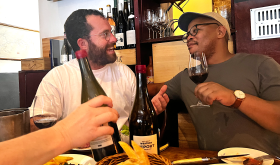
Anyone who has followed the story of the four Zimbabweans who became Cape Town’s top sommeliers on this website will know that the hospitality industry is the one that offers the most obvious opportunities for Black wine talent in South Africa. All of my respondents agreed with this. Half of the 203 members of the Sommeliers Association of South Africa are people of colour. But (Cassandra) Fridjhon claims, ‘they are a marginalised profession (always were, even pre-COVID)’. It’s true that when Tam and I spent time with the Zim somms as described in World Wine Tasting Championships 2017 they expressed their disappointment at how rarely they were invited to wine judging sessions in South Africa.
But there is good news. The captain of the Zimbabwean tasting team Tongai Joseph Dhafana of La Colombe, who now makes his own wine like his tasting teammate Tinashe Nyamudoka, reported to me the other day that ‘recently I received an invite for judging Veritas and Vinifera Wine and Spirit Awards with three other people of colour’. On the other hand, all is not sweetness and light. He could not be sweeter-natured but commented, ‘in restaurants it’s a bit unfair that even if you’re a qualified sommelier you still have to report to someone who doesn’t even have the same qualifications as yours. That to me shows a lack of trust and undermines people of colour.’
Tinashe has left his plum job at The Test Kitchen to join a public relations company. Teammate Marlvin Gwese is still in post at Cape Grace Hotel and the fourth member of the final tasting team, Pardon Taguzu, was lured to the Netherlands some time ago to sell South African wines there.
Things do seem to be going in the right direction, even if the pandemic, and South Africa’s ongoing economic woes, are unlikely to accelerate progress.