17 May 2012 – See this thread on our forum. I now wonder whether QR codes such as that illustrated here would not provide the ideal way of presenting this information to such consumers as would be interested in, and capable of interpreting, it.

6 Apr 2011 – The following interesting observation stimulated by this article is just in from Australia:
Read your article on disclosure on wine labels and add an area that I am passionate about: naming the owner of the winery, which is not compulsory in Australia. This is very misleading and in some cases downright dishonest, such as with Morris wines of Rutherglen, where the label waffles on about the traditions of the Morris family and never mentions Pernod Ricard (the owners for over 30 years). Similarly, Fosters' name doesn't appear on any wine they market in Australia, which is odd given that they control about 30% of wine in this country.
Add to this the incidences of winemakers' names being bought by another company and then used to promote the wine that they no longer have anything to do with – for example, Tim Knappstein Wines (owned by Hardys, formerly owned by Constellation, now owned by some private equity group) or David Traeger wine (now owned by Dromana Estate) and on it goes. As a seller of wine in a large store, I have first-hand experience of how confusing this is to customers. Many people are genuinely stunned when they find out who actually owns the wine they are buying. I am often told that customers would not purchase a particular wine if they knew the identity of the owner.
I don't expect everyone to agree with me on this but I would love wine labels to be a little bit less romantic. Actually, I'd like them to be brutally honest.
Nowadays we are all used to reading long lists of ingredients and additives on the labels of the foods we buy, so it seems illogical to me that wine has largely escaped the sort of legislation that requires complete transparency about what consumers of a product are about to consume.
In many countries wine labels have to admit to the presence of sulphur (as 'sulphites' or additive '220') because it is proven that asthmatics may react badly to the winemaker's all-purpose disinfectant and preservative. There is no such thing as a wine that is entirely without sulphur since it is a natural by-product of fermentation but in many countries, any level above 10 mg/litre must be spelt out.
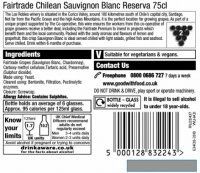
The illustration below shows a typical back label on a wine sold by the UK's Co-op chain of stores. This co-operative organisation has blazed a trail in wine labelling. In 1996, The Co-operative led the UK wine industry by adding alcohol units and what is euphemistically known as 'sensible drinking advice' to all their own-brand wines and spirits. Because this was technically against the law, they had to campaign for industry-wide change. In 1999, The Co-operative became the first retailer to include a full list of ingredients on all its own-brand wine labels in support of its commitment to open and honest labelling and they remain the only retailer I know of to do this. In 2002, they added calorie information to the labelling of all alcoholic drinks (about which I am less convinced). I am not, incidentally, suggesting that Ch Latour gives as much information as the Co-op does below, just the list of ingredients...

Australian and New Zealand wine regulations go further than those that pertain in the EU. They not only require that any addition of the antioxidant ascorbic acid (or '300') is signalled on wine labels, they also insist that any other potential allergens are spelt out. Thus an Australian label may warn that a wine contains traces of nuts (from some additives used to increase the tannin level of a wine), or fish (from the fining agent isinglass that is based on dried fish bladders), or milk products (casein being another fining agent), or egg whites (another, the most upmarket, fining agent). Of course only the most minute traces of these substances added to clarify wine should remain; in theory fining agents should be precipitated out of the final wine.
The laudable rationale for the requirements detailed above is to make life less hazardous for those who have particular allergies. But I would like to see wine labels (back labels probably) being even more specific, not least about additions that most definitely remain in the final wine – not for health reasons but because I think curious wine drinkers are justified in wanting to know how their wines were made.
Even for wines at quite exalted levels I'd like to know which of them had been chaptalised – ie which had their alcoholic strength boosted by the addition of fermentable sugar before fermentation. (My guess is that many non-Europeans would be surprised by how widespread this practice still is, even in an era of global warming.)
I'd definitely like to know which wines had acid added to them. The addition is usually tartaric acid that is present naturally in wine – in fact commercial tartaric acid, and cream of tartar used in baking, is derived from the crunchy deposits of tartaric acid that are routinely scraped off the inside of wine vats. In Europe it is theoretically illegal to add both sugar and acid to the same wine but Burgundians have explained to me that 'some people' simply add acid to one vat and sugar to the other and then blend them subsequently. Others argue that you can add sugar to the must and acid to the resulting wine without breaking the letter of the law.
I don't have a fundamental objection to the addition of sugar or acidity to grape must if it is done so as to make up for some deficiency of the weather and with such skill that you can't taste its effects in the wine. But I have certainly tasted French wines from the 1960s and 1970s that had a slightly unnatural sweetness that I feel sure was the result of over-enthusiastic chaptalisation – and I regularly come across wines today, typically from hotter climates but also European wines in some vintages, whose acidity seems uncomfortably jagged and unintegrated with the rest of the wine – surely because of careless acidification.
I do object to adding sugar or sweet grape concentrate to make wines sweet, however, just as I would object to adding flavouring. If a wine has been deliberately sweetened up before bottling (as is so very common with commercial blends) to make it more palatable or to disguise some winemaking fault, then I think we should be told about it. And if a winemaker had added oak flavourings such as oak chips, I would like that recorded on the label. (I have heard it argued that the use of oak barrels should be declared on the label because it alters the quality and style of a wine. That would be fine by me, but I would not regard such an expensive and time-consuming operation as a negative attribute if it is done well.)
Then there are the winemakers who add commercial tannins derived from wood, grape seeds or nuts to their wines, supposedly to improve the balance or stability. It can be easier to pour powder from a sack than to ensure that precisely the right level and sort of tannins are in the grapes in the first place and the right amounts are leeched into the wine during fermentation and maceration. I am less sanguine about added flavour and tannin than added sugar or acid. And I would certainly like to know when, as is so often the unacknowledged case, water has been added to reduce the alcohol level.
And perhaps most of all I am extremely suspicious of any wine containing a colouring extract such as the notorious Mega Purple that is based on the red-fleshed hybrid Rubired whose plantings have grown so significantly over the last decade or so in California and Australia. This is basically wine dye; it has no positive effect on flavour or quality. And, as Benjamin Lewin MW points out in his admirably provocative new book Wine Myths and Reality, wine giant Constellation, which produces Mega Purple at its plant in Madera in California's Central Valley, also sells a wide range of other grape-based concentrates to wine producers under the highly questionable brand name Mega Natural.
Of course, those who add less than wholesome products to wine are the least likely to confess to doing so on back labels. But as a purist, idealist wine lover, I would dearly love to know which wines had been most manipulated and reward the rest with my, perhaps naïve but extremely heartfelt, admiration.
Who knows? If ingredient labelling were to become mandatory for wine as well as food, it might just encourage winemakers to use fewer shortcuts and additives.