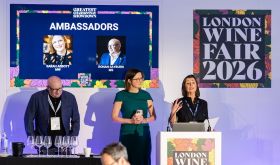
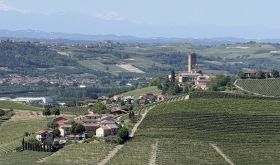
Here’s your chance to participate in this year’s Vinexpo, just over, without ever having to get in plane or sit in a traffic jam. There follow the speeches given at the dinner given at Mouton for international media, where all the pictures were taken. Interesting to read and read between the lines of these speeches, in which no mention is made of 2006.
Speech by Philippe Castéja, President, Conseil des Grands Crus Classés en 1855 Médoc & Sauternes
 What a pleasure it is for us to come together tonight at Mouton Rothschild, and before I begin, please allow me to express my great appreciation to our hostess, Baroness Philippine de Rothschild, and also to her two sons Philippe and Julien, without forgetting her husband Jean-Pierre de Beaumarchais. Thank you all for welcoming us to this superb estate which embodies the efforts of so many generations of your family, example of what we appreciate to see most.
Thank you also, Philippine, for your effective and continued support.
Thank you to Countess Nancy de Bournazel, who has given us the opportunity to enjoy such superb Sauternes this evening, and who has made such a great contribution these past years to unite the Médoc and Sauternes Great Classed Growths of 1855.
As always, our thanks go to (Maximilien) Riedel who has once again furnished us with these superb glasses which allow our wines to express themselves so fully.
And we can never fully express our appreciation to all the cellar masters, the artisans of our wines, who have come here this evening again to prepare these bottles so that you may discover their contents under the best conditions. Finally, a great thank you to the entire team at Château Mouton Rothschild who has made this evening possible, with the supervision of Mr Pierre Celeyron.
Recently Bordeaux has seen several legal challenges to its classifications, which have given rise to some legitimate questions.
The 1855 classification has been subject to no such challenges, and for good reason.
As we all know, the 1855 classification was a transcription made by the brokers of the period based on a century of continuous observations. The 150 years since then have only confirmed the relevance of their efforts. Thus, this monument of 1855 is not a temporary ranking to which periodic changes are made to satisfy a penchant for competition completely alien to its spirit.
Nor is the 1855 classification a work of art frozen in time. The title of classed growth is both a privilege and a duty, which imposes on our wines a constant commitment to justify their rank. It is therefore not surprising to see the extent of our investments in fundamental research; the extent of our use of the most modern techniques; the extent of our efforts to jealously preserve the environment which gives birth to wines of such great quality. Finally, it is important to remember that our growths have always been subject to an annual reevaluation, and the jury which acquits or condemns them is called the marketplace, a jury which has confirmed the value of our predecessors’ identification of properties where superlative wines may be created.
And since the watchword of the day is “sustainable development”, let us modestly observe that we have made sustainable development a key part of our vineyard operations for more than 150 years, and that we will continue to do so in the future.
Emile Peynaud constantly reminded us that “whatever level of quality is achieved, it is always possible to do better.” This is the guiding principle which inspires our excellence, and your continued confidence in our status.
I would also like to mention just a few of the many benefits that this classification has given our region since its origin.
First, during those periods which have been characterized by innumerable reforms, the classification has offered a timely reminder that the history of Bordeaux’s wines did not begin with the creation of the appellation system, but well before.
The pragmatism of our forebears as well as the eclecticism of our marketplace, both of which have been enriched over time by rewarding and continued foreign influences, are two prime virtues which must be faithfully preserved.
The codification of rules defining appellations of origin must not impinge on a producer’s ability to continually adapt to a demand that by nature is in constant evolution. The 1855 classification offers proof that freedom of action is always fruitful, offering a permanent condition for renewal which we jealously protect with heart and soul. The second benefit of this classification rests in its capacity for inspiration and aspiration: Inspiration which characterizes the search for perfection in our classed properties, and among today’s most dynamic proprietors;
Aspiration in Bordeaux’s collective spirit to reach ever greater heights. Regardless of the appellation, we see the same desire for improvement everywhere, both here and abroad. The 1855 classification is a spur to ambition.
Please don’t take my views for arrogance: as you are aware, Bordeaux’s techniques and know-how have spread far and wide with our blessing; if you will, we have modestly sought to share with the world as the world has shared with us.
Furthermore, I would add that in the view of the consumer this classification characterizes Bordeaux's “DNA” as strongly as the notion of “châteaux”. Here, at Mouton Rothschild this notion of château has had a special importance, and I am reminded of the veritable revolution the Bordeaux economy experienced with the adoption of château bottling: this was not only a means of diversifying Bordeaux’s offerings, but was also a deeper expression of the idea of “origine contrôlée”.
Paradoxically, this classification has also brought about a democratization of luxury. We know that luxury, by definition, is not available to everyone: rarity has its price. Nonetheless, from the most devoted connoisseur to the neophyte just discovering our region, all consumers of Bordeaux wine find some reflection of our great growths in their glass. It is in this complex alchemy between vibrant myth and solid reality that the modern success of our wines is to be found.
Because a wine’s enjoyment inspires the emotions, those which our 1855 Classed Growths evoke go far beyond the tasting experience: they are connected to the wine’s history, its temporal and cultural context; churches, châteaux, vineyards, towns and landscapes all contribute to the pleasure we cherish in this magic instant. And surely because “there is more philosophy in a bottle of wine than in all our books”, we have always found great pleasure in coming together, and so many good reasons to do so.
Ladies and gentlemen, Dear friends, you are all aware of the immense virtues of this classification. They have led me to impose upon your time and to delay the moment when you may philosophize, enjoy the company of your neighbors, and engage in endless discussion on the excellence of growths and the influence of vintages. As it has been said, once on the tongue the wine speaks.
I therefore leave you to these noble pursuits which are summed up in the phrase “in vino veritas”.
I wish you all an excellent evening.
Speech by Baroness Philippine de Rothschild
 This evening is the second time that Mouton has had the pleasure, at the opening of Vinexpo and under the highly efficient auspices of our president Philippe Castéja, of organising what I may call, with no fear of contradiction, a celebration of friendship. For true friendship has always prevailed between you, journalists, and us, owners of Crus Classés, a relationship of trust, fruitful and without indulgence.
 Our springtime humours depend not only on the heavens but also on your ratings which we await every year, impatient and fretful. A half-point or quarter-star less is enough to make us want to bite. But precisely because we trust you and your skill, and because you can appreciate our passion for work well done, that friendship endures and continues to be a terrific spur for us. I recently returned from Cannes, where I saw Roman Polanski insult critics and journalists: I can honestly say that there is no place for that kind of sourness in our region, still less in our hearts.
So here we are together this evening for the first time since the fabulous 2005 vintage was released, achieving price levels that would have been unimaginable a few years ago. Will those prices determine our future, and if so, how? Let us not forget that all of us here make a rare if not to say unique product, with our three trump cards that I believe will long remain so: terroir, know-how and prestige.
What exactly are we in this competitive, shifting, channel-hopping world, bereft of reference points? What are our Grands Crus Classés today? A luxury product or something to share with friends? Something to be drunk or a speculative investment? Should we fear that wine will one day quit the cellar for the strong-room, the table for the display case? And does the bottomless wealth spawned by globalisation promise a reassuring future for our wines or just a bubble of prosperity that could easily burst if one day those new buyers look elsewhere for the symbols of their success? Let us also remember the serious problems facing many winegrowers in our region, even though many of their vineyards are of good quality – and we know something about it because our company, Baron Philippe de Rothschild, sources its branded wines from them all year round.
Another matter on which our future depends is the fate of our family companies. While a certain number of Crus Classés are now entirely controlled and very well-managed by big French or foreign firms, many of us are proud still to be independent owners, backed by mainly family shareholders. A family business, as you all know, is first and foremost a certain number of added values, and they are values with which I am constantly in contact, alongside my friends from PFV (Primum Familiae Vini), our association of family firms of which my dear friend Piero Antinori, with us here tonight, is an eminent member. They include continuity of management, the force of a family spirit, strong links forged in the good times and the bad, the personal involvement of the shareholders in important decisions…
 But in the end how lucky we are, since there are no real châteaux without the families that occupy them – without us, in fact. For our châteaux are embodied in their owners and our houses are like the vines that surround them, they are alive. So long live our Crus Classés which are homes to their owners and not corporate head quarters! And, since family business is very much in the air this evening, it would be remiss of me not to introduce, somewhat solemnly, although that is not really my style, my two sons: Philippe, the elder, now Vice-Chairman of our Supervisory Board, and Julien, the younger, the cadet as we say in French, as my father was too; Cadet, a word which, thanks to him and the wine I hardly need mention, is known all over the world. One day they will take over the reins of Mouton and of our family company. They have been at home here since their earliest childhood, and have been involved in the family business for several years now. My father, the extraordinary and legendary Baron Philippe, had too much inculcated into me the idea that he was irreplaceable, for me to make the same mistake!
 An inheritance is something to be deserved. And in the end it passes quite quickly, for we are simply passers-by, or at best passers-on, from one generation to another. The real star here, as well you know, you journalists whom we honour this evening, is not the owner, perhaps not even the technical director (with my apologies, Mr. Dhalluin, and well done all the same!). No, the only star is the terroir. It is for us to serve it with all our hearts and with all our strength, to show ourselves worthy of Bertolt Brecht’s dictum, which will be my last word this evening: “Everything belongs to whoever betters it”.
Thank you all for being here tonight.