Fish seems to attract and then grip the attention of many chefs, and in many ways.
It captivated Mitch Tonks initially at The Seahorse in Dartmouth and then inspired him to open a dozen Rockfish restaurants across the south of England as well as a home delivery business. It inspired Josh Niland at Saint Peter in Sydney, Australia, to instigate a new approach to fish butchery. In Glasgow it led John Macleod, an architect, to open the two branches of the unmissable Crabshakk. And it inspired the late Gilbert and his sister Maguy Le Coze to transfer Le Bernardin initially from Brittany to Paris and then to New York, where it is now led by the equally passionate fish chef Eric Ripert.
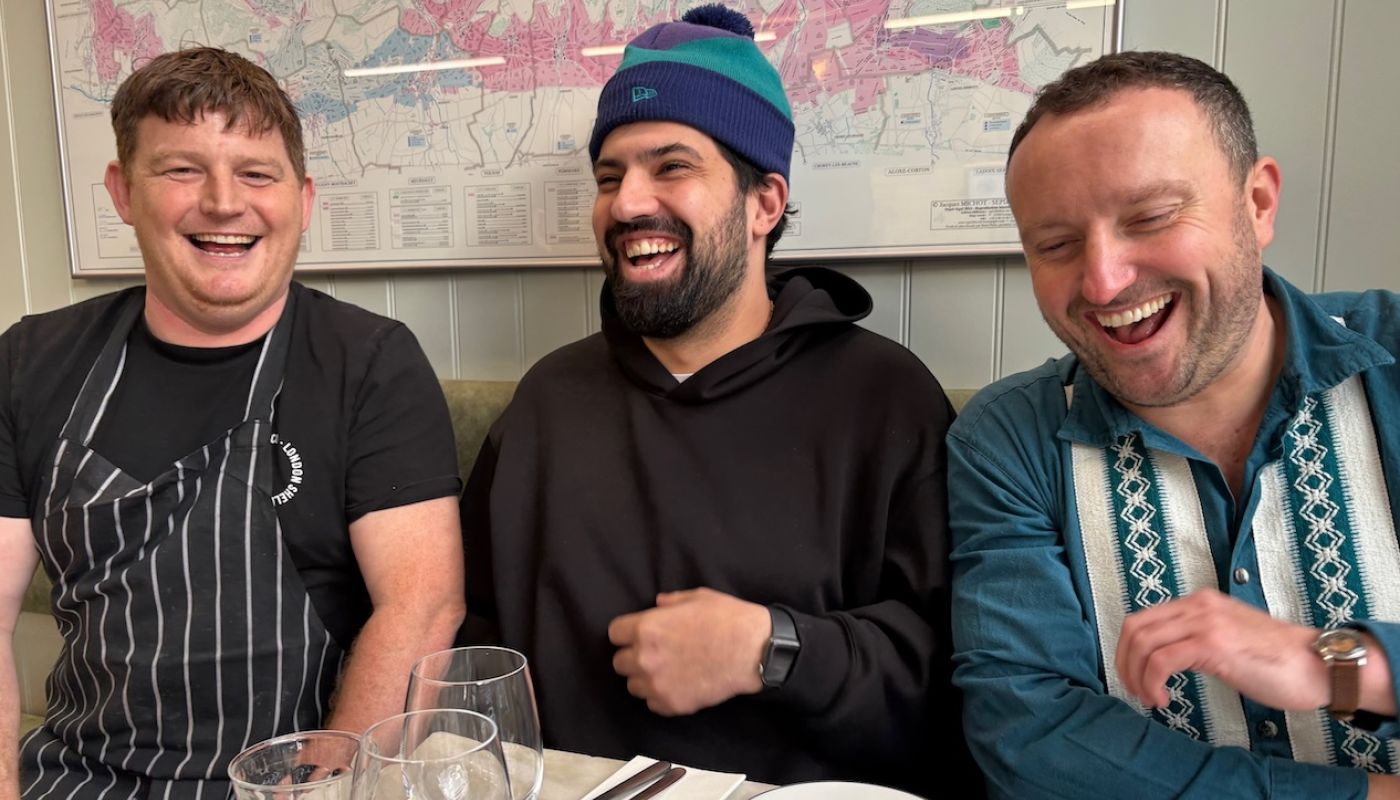
Closer to home, and on a somewhat smaller scale for the moment at least, a passion for cooking and selling the freshest fish has brought together Stuart Kilpatrick, Fede Pollame and Harry Lobek to open London Shell Company on Swain’s Lane in Highgate, North London. Kilpatrick, a trained chef, is now in charge of buying fish for the restaurant and shop; Pollame, who trained under Pierre Koffmann at The Berkeley, is chef, and Lobek is in charge of the front of house and the all-important wine selection.
This all began a decade ago with Lobek and his sister Leah when they opened the first of two small restaurants on boats moored on the Regents Canal and decided to concentrate their menus on fish. They befriended Kilpatrick as their chef who told me, ‘Once you’ve prepared fish, cooked it and washed everything up on a 40-foot barge, anywhere else is extremely comfortable.’
They decided on a more permanent future and spotted what was initially purely a fishmonger in their current location. They discovered that the premises also possessed a vital alcohol licence and reopened it as a fishmonger with restaurant attached two years ago. But it was a conversation with, it transpired, an old friend of mine from Cambridge University which truly made a difference to the business proposition. (He happened to walk by on the other side of the road as we were talking, which is why I was able to identify him.) He set them on the right path as a busy fishmonger serving the local community.
‘We began brandishing our principles’, Lobek confessed. ‘We weren’t going to offer farmed salmon – we would sell British trout instead – and we wouldn’t be selling prawns, either. But then this man came in, wielding his tennis racquet having just finished a game across the road, and told us not to be so stupid. If we want to succeed, he explained, we have to give the customers what they want to buy and choose to eat and not what we want to sell.
‘His comments made us all realise that a successful fishmonger is a community asset and if our customers want a few prawns for a fish curry or to cook some salmon, it was up to us to offer them. So now we sell prawns and Loch Duart salmon and in fact the salmon makes up about twenty per cent of our fresh-fish sales. But it is far better that they shop here rather than go off somewhere else. We are very grateful to him for that advice’, Lobek said.
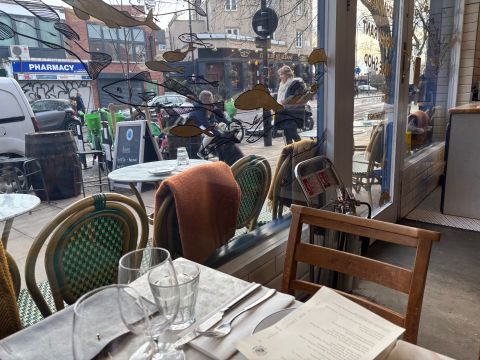
The premises are tiny, no more than 600 sq ft in total. There is a large fish counter immediately on the left as you walk in, with a fairly rudimentary kitchen beyond. Behind this is a small walk-in fridge. The rest of the space is taken up with tables and chairs. The restaurant seats 24 inside. There are also a couple of wine displays, one refrigerated the other not, and a single lavatory. There is no storage space; what you see is precisely what you get.
Above eye level are a series of blackboards that impart a great deal of information – the menu, the specials and their wine offers – while the right-hand wall is decorated with Burgundy vineyard maps that will be familiar to many wine lovers. The front is entirely glass which allows any customer sitting inside views of two different, further assets of their location.
The first is of half a dozen tables on the pavement which, when it is warm enough, ‘transforms the whole restaurant’ in Lobek’s opinion. ‘It’s a great place to sit, to have a glass of wine and some fish. It’s a wonderful advertisement.’ Beyond is a roundabout which conveniently slows down all the traffic, and beyond that is Parliament Hill Fields and Hampstead Heath. On the Sunday lunch I ate here for the second time, the number of families out walking, as well as the number of accompanying dogs, was simply staggering.
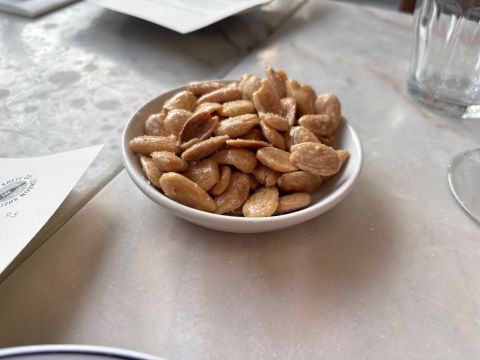
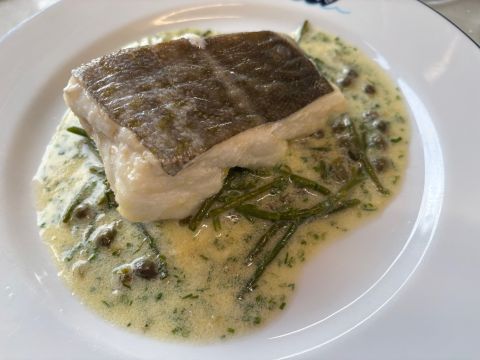
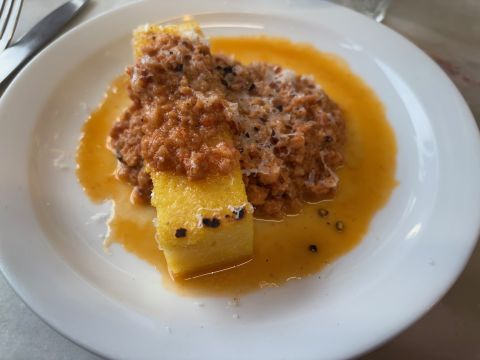
From the tiny kitchen, and without the appropriate extract for frying or grilling, Pollame and his team produced a succession of excellent dishes. A plate of irresistible salted almonds; delicious creamed cod’s roe; a fillet of cod on a creamy combination of samphire and capers; a grilled Dover sole. Only the somewhat under-seasoned risotto disappointed. Best of all was a dish described as polenta with squid ragu which comprised the crispness of the polenta with the richness of the squid meat. This is a dish whose recipe Pollame has shared (see below) and he said works even better with cuttlefish. I intend to return with a larger appetite for their ‘sardine empanada’ and their Basque cheesecake.
The wine selection is clearly Lobek’s domain. ‘I passed my WSET Level 2 while working for Charlie Young and Brett Woonton at Vinoteca, then I passed my Level 3 before I started working as a sommelier at Pollen Street Social restaurant where I sold a lot of expensive bottles. Since then my passion for wine has grown and I feel I have the whole world to choose from today. What excites me are wines that I can retail for £35 or £40 and go well with our food, so whites from Spain and the Loire are my particular fascination at the moment.’ We drank a Hidden Treasures 2020 dry Furmint from Tokaj that was fine but just starting to lose its fruit.
The combination of their choice of an excellent product – fish – to concentrate on; a location that has proved increasingly popular; and the compactness of the space has given this trio plenty to think about. Their turnover in 2025 was the best ever, up 20% on the previous year, and opens up various possibilities. As Lobek opined, ‘There must be plenty of small sites, 600 to 700 sq ft, where there is a need for a fishmonger and a restaurant alongside it’. If this trio can bottle their passion for fish and spread it to new sites, then their future looks very bright indeed.
Cuttlefish/squid ragu |
From Fede Pollame, The London Shell Co |
This recipe can be done with cuttlefish or squid. I personally prefer cuttlefish as I find it to have a deeper, more savoury flavour and the squid to be slightly sweeter. At the restaurant we mince down the cuttlefish, and for this you will need a decent-quality mincer. I would recommend buying an attachment for a stand mixer such as a KitchenAid or Kenwood kMix. You will need to double the recipe if using a mincer. Otherwise just chop the cuttlefish nice and small. Chopping it will take a while but it’s worth it at the end.
Starting with the cuttlefish, ask your fishmonger to clean it for you. You want 1 kg once it has been cleaned. If mincing, chop it into smaller pieces to help it go through the mincer. Finely chop all the vegetables; this is your sofrito. I usually grate the carrot on the fine side of a box grater. It saves time and helps it melt into the sauce. Alternatively place them all in a food processor and blend until fine.
Using a large, heavy pan start by frying off the cuttlefish in half the olive oil; it will release a lot of water. Let this reduce off. It will start to catch a little; at this point take the cuttlefish out and leave to one side. Add the second half of olive oil and the vegetables; these will deglaze the pan with their natural liquid.
Cook the veg until they start to caramelise slightly. At this point, add the tomato purée and thyme and cook for a further minute. Return the cuttlefish to the pan and add the wine. Allow the wine to reduce by half and then add the stock. Bring to the boil and turn down the heat to a simmer. Keep cooking until the cuttlefish is nice and tender and the sauce is as thick as a traditional Bolognese. This will take about an hour, and you may need to add a bit of water throughout the cooking process if the stock is reducing too quickly. If the cuttlefish is tender and there is still a lot of liquid, just continue to reduce it a bit further.
Season well with salt and a generous amount of black pepper; I like the warmth you get from black pepper so don’t hold back. Serve with toast, sticks of polenta or tagliatelle and plenty of parmesan. |
The London Shell Co Unit 4, Sonny Heights, Swain’s Lane, London N6 6AG; tel: +44 (0)20 4568 8586
Every Sunday, Nick writes about restaurants. To stay abreast of his reviews, sign up for our weekly newsletter.