This week – and with apologies to BBC’s The Fast Show – I have been mainly eating Vietnamese.
I have enjoyed this spicy, aromatic Asian style of cooking at lunches in west, north and east London. There were various reasons for these solo lunches. My usual dining companion was otherwise engaged with Burgundy Week tastings. It was a coldish few days which made the appeal of bowls of noodles, vegetables and protein especially enticing.
Having said that the three restaurants are in different quarters of London, I must qualify this statement as history, and particularly empire, play an important role. Vietnam was ruled by the French from the late 1850s until 1954, a period which left its culinary mark via, for example, noodle-filled baguettes. When Saigon fell in 1975, many Vietnamese fled to France, taking their recipes with them, most notably the parents of Robert and his brother the late Freddy Vifian who continue to cook, manage and write the extraordinary wine list at Tan Dinh in Paris.
The UK, by contrast, has found its culinary empire reflected in the vast number of Indian, Pakistani, Bangladeshi and Chinese restaurants. Vietnamese cuisine is still relatively rare in the UK.
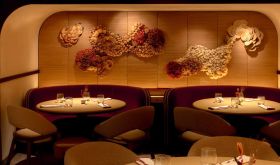
What unites the three restaurants I ate in are the circumstances of their founders. When they arrived in London without a great deal of capital but needing to make a living, their first thoughts were to open somewhere and cook. Hence none of these three places is glamorous and I would argue that currently the major lacuna in London’s enormous choice of restaurants is an upmarket restaurant with a bar attached that specialises in Vietnamese cooking. I believe it would and could be extremely successful.
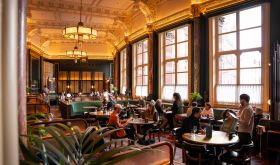
The three restaurants – Med Sallah in Chepstow Road, W2; Dzô Cafe in N1; and Viet Grill in E2 – share the same physical attributes. All are in Victorian buildings. All are on several floors with the kitchens in the basement connected to the main eating space by a dumbwaiter. And while this does not seem to affect the speed of delivery or the inherent heat of the plates, this does seem to me to be a missed opportunity. Watching a chef work a wok and seeing the flames has to be one of the integral charms of Vietnamese cooking that these restaurants deny their customers.
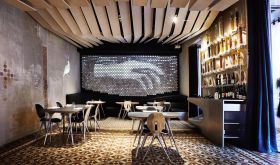
And their fixtures and fittings all appear to have seen better days, with marked and scuffed chairs; torn seat covers; poor lighting and walls in need of a lick of paint. All are common faults. Margins must be thin.
And what was also slightly disappointing was a lack of colour. The days I did my Vietnamese rounds were a mixture of cold, heavy rain and weak sunshine. But what these restaurants were offering was the cooking of a hot, colourful country with a long coastline. Perhaps I was expecting too much in a wild blotch of colour on the walls that gave the impression of heat? There was none, sadly.
The entry to Med Sallah, by a junction where the numbers 7 and 31 buses almost fall into the restaurant, is perfunctory, in contrast to the charms of the two members of the waiting staff. And, what was to become obvious, the generosity of the kitchen.
It was cold outside and I had got lost en route which made the chef’s special of beef brisket pho an immediate choice. (Pho, pictured at the top of this article, is the signature dish of Vietnam, a combination of broth, noodles, herbs and meat.) This came together with a mango salad (pictured below) and green tea, here served in a half pint glass. The pho was terrific. My bowl was crammed full of noodles, herbs, diced chillies, bean sprouts and broth but the best ingredient was undoubtedly the brisket which was soft and succulent with several cubes with the necessary piece of fat attached. It was a first-class introduction to my few days of Vietnamese food. (My bill was £36.70).
Med Sallah also reminded me of a previous encounter in Asia – in Singapore, in fact. At about 2.30 pm the chef came up from the kitchen and walked past the half-dozen customers in his restaurant. He never reappeared. When I left I turned right to see where he had disappeared to. And there he was, fast asleep in a secluded corner of the restaurant. I was reminded of my review of the New Ubin restaurant in Singapore in May 2014 which I ended by writing, ‘we left quietly. Several waiters were already asleep on chairs before their busy evening shift’.
The day I chose to visit Dzô (Vietnamese for cheers) Café, Islington’s busy Upper Street somewhat resembled downtown Ho Chi Minh City. It rained as though it were monsoon season. I had expected more of this restaurant from what I had read and from the breadth of its menu. But my fried tofu with a spring-onion sauce was insipid and the lemongrass and goat combination lacked oomph. I paid £31.84 for both and a pot of oolong tea.
Viet Grill sits at the beginning of the so-called Pho Mile, a run of maybe 10 Vietnamese restaurants that have come to populate Kingsland Road in East London, initially attracted, I have no doubt, by what were once inexpensive rents. It has a large cocktail menu, of which a £10 negroni made with makrut lime leaves has to be a reason to return after 6 pm, and it boasts a not-insignificant wine offer.
This was the restaurant whose interior gave me the strongest impression of being in Vietnam.
I began with the dish shown below described as ‘smoky aubergine’ which had been spiced up, topped with chilis, diced peanuts and lashings of fish sauce. It was impressive.
My main course was less so – a dish described as ‘sizzling seafood’ (below) but the prawns, squid and scallops tasted far less Vietnamese and more mainstream Chinese than I would have expected.
With charming service my bill came, with the glass of Saigon-style coffee that was ice cold and almost excessively sweet shown below, to £45.84.
I asked Robert Vifian in Paris who has been cooking Vietnamese food for 50 years for his view on this country’s cooking and he replied,
‘We commonly accept that Vietnamese cooking is based on the three main regions. The south where we grow a lot of vegetables and herbs and, thanks to the Mekong Delta, very good rice. The north where the climate is closer to the west, where there are four seasons, and there is a strong influence from China. Then there is the centre, the imperial city and the cuisine was sophisticated and a combination of other two regions, with more spices.
A lot of Vietnamese dishes are based on fish and the major seasoning is nuoc nam, fish sauce. Most dishes do not have a lot of ingredients, which makes them simple to match with wine. Whites are often more welcome and more useful because of the minimal amount of dairy and the preponderance of herbs and fish.’
And, he added in a postscript, ‘The Vietnamese rarely use chili when cooking and we always serve fresh chopped ones at the table’.
Fish, a preponderance of vegetables, white wines, cocktails – all the major ingredients for a sophisticated London restaurant which is currently missing from all that this city, and many others, have to offer. Rather than another Clare Smyth or Daniel Boulud restaurant, as are currently promised by the new Admiralty Arch hotel, or another Italian seafood restaurant to be unveiled at The OWO, a hotel less than half a mile away, wouldn’t a really good Vietnamese restaurant make an enticing proposition?
Med Sallah 108 Chepstow Road, London W2 5QS; tel: +44 (0)207 221 8031
Dzô Cafe 163 Upper St, London N1 1US; tel: +44 (0)20 7916 0348
Viet Grill 58 Kingsland Road, London E2 8DP; tel: +44 (0)20 7739 6686
Tan Dinh 60 Rue de Verneuil, 75007 Paris; tel: +33 (0)1 45 44 0484
Every Sunday, Nick writes about restaurants. To stay abreast of his reviews, sign up for our weekly newsletter.