You may be wondering why we sometimes publish one and sometimes both of the articles submitted in our hugely popular wine writing competition. We publish what we think is worth publishing, either because it is a brilliant read, or we think you would be interested in the content. Our fourth offering is the brace of articles written by Dr Matthew Horkey, who describes himself thus:
Vitals: Male age 34
Profession: Self-employed at The Blue Roster Private Limited (Exotic Wine Travel)
Location: Location-independent as I am always on the road with my partner. Currently we are in between Georgia and Armenia
Wine education: Enthusiast, but enrolling in the WSET Level 3 Programme this winter
Hello Purple Pages team. My name is Matthew and I make up half of the team at Exotic Wine Travel with my partner Charine Tan. We are both fairly new to the wine world but have taken a plunge after shaking up our lives a year and a half ago. I personally spent six years in private chiropractic practice in Singapore before diving into the wine world head first. In May of 2015 I left practice and Charine left her job as a management consultant at CEB to travel around the world and create a location-independent business.
The first three months of our travels consisted of tasting in Barolo, Barbaresco, Tuscany, Etna, Douro, Galicia and Rioja before choosing to go into wine full time. Since then, we have spent three months in the Caucasus (Turkey, Georgia and Armenia), three months in ex-Yugoslavia, and three months in Baja California, Mexico, tasting over 2,000 wines. In between those trips we also tasted in Virginia and spent a week tasting in Santa Barbara County.
We are just about to release our first wine book, Uncorking the Caucasus: Wine of Turkey, Armenia, and Georgia, and are planning on sending to Tamlyn for review. We also plan to publish work on Baja California, Croatia, and Serbia/Macedonia/Montenegro/Bosnia-Hercegovina in the very near future. In real time, we post information and articles on our website www.exoticwinetravel.com. We are also very active on YouTube, Instagram, Facebook and Twitter.
These are two articles I was planning to publish on the website but are not posted yet. We also have other examples of both Charine and my writing on Exotic Wine Travel. I hope you enjoy and thanks for taking the time to read them.
Montenegro’s state-run powerhouse
A bottle of Plantaže was the first wine we had during our trip to the Balkans. Our first meal in Belgrade was accompanied by a one-litre bottle at €3, enclosed by a metal cap which was removed with a beer-bottle opener. As awful as that sounds, the wine was good and tasted similar to a Salice Salentino from Puglia, Italy. Plantaže wines are ubiquitous throughout the entire Balkan region and are in every supermarket and local shop.
The winery is a partially state-owned operation in Montenegro. Plantaže produces over 95% of the country’s wine. Driving through this small country I couldn’t understand why there was not a plethora of small producers. Montenegro has a true Mediterranean climate, cool breezes from both the Adriatic and the towering mountains in the backdrop that make up most of the country.
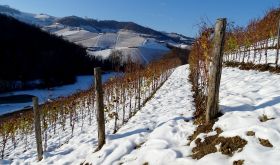
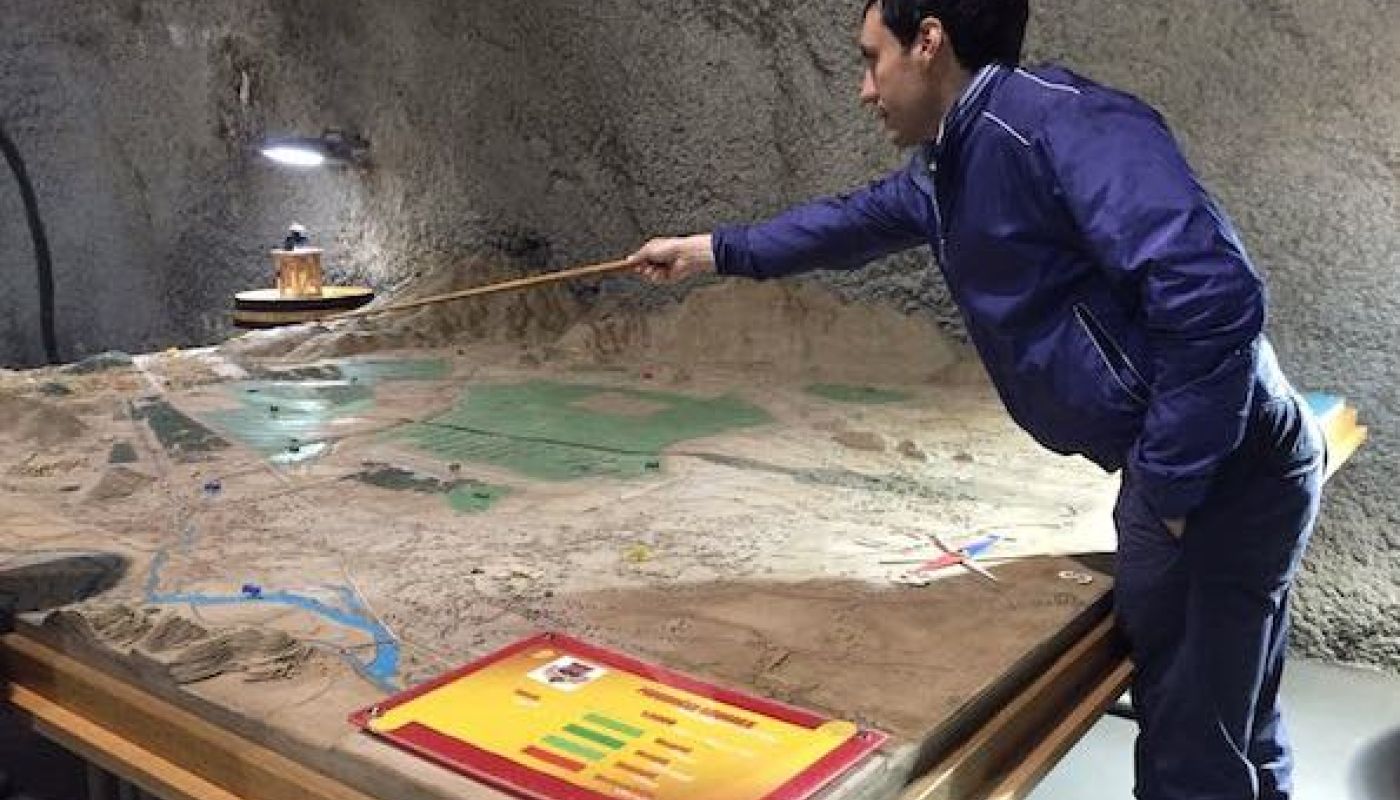
Plantaže pumps out a mind-boggling 16 to 17 million litres of wine every single year. They fuel this massive production entirely from their own vineyards, including one of the largest single-plot vineyards in Europe. Their largest vineyard is 2,300 hectares (5,685 acres) with 11.5 million plants (my main picture shows a topographic map of the local landscape, the picture below the reality). It was a lot bigger seeing it in person than we expected. They harvest most of their grapes manually except for their very low-end wines. They do not sell any bulk wine; all of their wine is sold in one-litre or 750-ml bottles.

After spending an entire day walking through their property holdings, it was time to try some wine. We passed through one of their cellars which was an old Yugoslavian air-force base that was heavily bombed in the 1990s, on the way to their ultra-premium wine production facility. We got a chance to taste through their basic wines all the way to their top-end offerings. Their basic wines are very serviceable, mid-range wines very good, and high-end wines show a surprising amount of character.
One of our favourites was the Stari Podrum 2011. The name Stari Podrum translates to ‘old cellar’ and this wine is 60% Vranac with 30% Merlot and 10% Petit Verdot. Vranac is indigenous to Montenegro and is a high-sugar, high-acid grape whose name translates to ‘black horse’. Everyone in the Balkan region says Vranac is hard to work with because of its acidity and they feel like they need to ‘tame’ the horse in the winemaking process. The grapes for this wine come from a smaller 60-hectare plot.
The Merlot was definitely added to make the wine more plush and Petit Verdot for a little more flavour and structure. The wine is aged two years in French barriques, one year in large oak casks, and an additional year in the bottle before release. The blend definitely works as the wine gives off wonderful dark berry, chocolate, coffee and caramel flavours. The wine is fruit-forward, feels rich and heavy on the palate, but is not jammy. The acidity is wonderful and the flavours are stretched over a long end-palate. This tastes a little New World, but with restraint – a wonderful wine that appeals to a very big base of wine drinkers.
Nebbiolo in Mexico?
Mexico is one of the few places in the world outside of Piemonte having success with Nebbiolo [although hold on for Walter’s forthcoming article about Nebbiolo in Australia – JR]. In the Valle de Guadalupe in Baja California nearly every winery has a top bottling of Nebbiolo varietal wine. Some producers here believe many should focus on making it the signature variety of the valley – in hopes of placing Baja wines on the world stage.

We are huge fans of Piemonte wines so we felt a huge draw to come to Baja California and taste these Mexican ‘Barolos’. After three months of on-the-ground tasting, we finally found ourselves comfortable with not only Mexican Nebbiolo but Mexican wine in general. What does the wine actually taste like? How can Nebbiolo thrive here? The answers took a little bit of digging but were very interesting.
For many years the signature wine from Mexico was the L A Cetto Private Reserve Nebbiolo. It seems odd that a grape that is suited to the hills, cool climate, and slow growing season of north-west Italy can flourish in the arid dessert of Baja California. While no DNA analysis has been performed on Mexican Nebbiolo as of now, there are some answers in Karen MacNeil’s Wine Bible:
‘Leading oenologists here believe that Mexican Nebbiolo is probably not a single variety, but several varieties that were brought from Italy after the Second World War by the Italian winemaker Esteban Ferro, then at Santo Tomás winery. Ferro’s cuttings were apparently stalled at the port of Veracruz for a long period of time, and the identification tags, wet and disintegrating, were eventually lost. But the cuttings were planted and collectively called Nebbiolo.’
Several winemakers confirmed this story with us and a few said that Mexican Nebbiolo is actually made up of two parts Piemontese Nebbiolo and one part Piedirosso. While this may or may not be true, the wines made from Mexican Nebbiolo can be delicious and share some flavours with the Piemontese clones – albeit with much darker colour. There are also a few producers here with small plantings of the original Italian Nebbiolo and are yielding some impressive results. Here are our favourite examples of both types of Nebbiolo.
Torres Alegre y Familia Cru Garage Nebbiolo 2013
Dr Victor Torres graduated from the University of Bordeaux. His PhD thesis is known to have redefined the way Bordeaux makes wine – which suggested that white wines should be fermented at 18 degrees Celsius to extract maximum flavours. This is a lesser-known fact because, to this date, Bordeaux still states that a student from the University of Bordeaux developed the methods and not a Latino from Baja, Mexico.
All of Dr Torres’ wines are fantastic, especially the Cru Garage line which is the premium line. They are wines that we would have no problem bringing to serious drinkers the world over. The Cru Garage Nebbiolo is made by Dr Torres, alongside his son Mr Leonardo Torres, this is the best Mexican Nebbiolo we found in Baja. The flavour profile is dominated by cherry, mint, blue fruit, rubber and peppercorn. This wine has a faultless structure and balance with flattering, sweet tannins. Absolutely ready to drink now if you like a fruit-forward, fresh Nebbiolo similar to the Langhe DOC.
Casa Magoni Nebbiolo 2011
Camillo Magoni (pictured below) is from Lombardy, Italy. He studied agronomy and winemaking in Alba and then moved to Baja California in the mid 1960s. After heading up the winemaking at the Mexican winemaking giant L A Cetto for many years, he started up his own commercial label at the ripe age of 73. Mr Magoni is still vibrant, funny and full of life. He loves to experiment and has an experimental vineyard in the valley with over 112 different varieties from Portugal to Greece.

This vintage is made from 100% of the Italian Nebbiolo (the 2013 was made up of 60% Mexican Nebbiolo and 40% Italian Nebbiolo) and blew our socks off. We have tasted several experimental barrel samples of Italian Nebbiolo from other producers but this is a complete product and the finest example we have found in Baja thus far. This nose is awesome and smells like an overripe, meatier Barolo from La Morra. The flavours include blue and red fruits, smoke, earth, clay and forest floor. The tannins are sweet but are still quite firm. This is a superb effort.