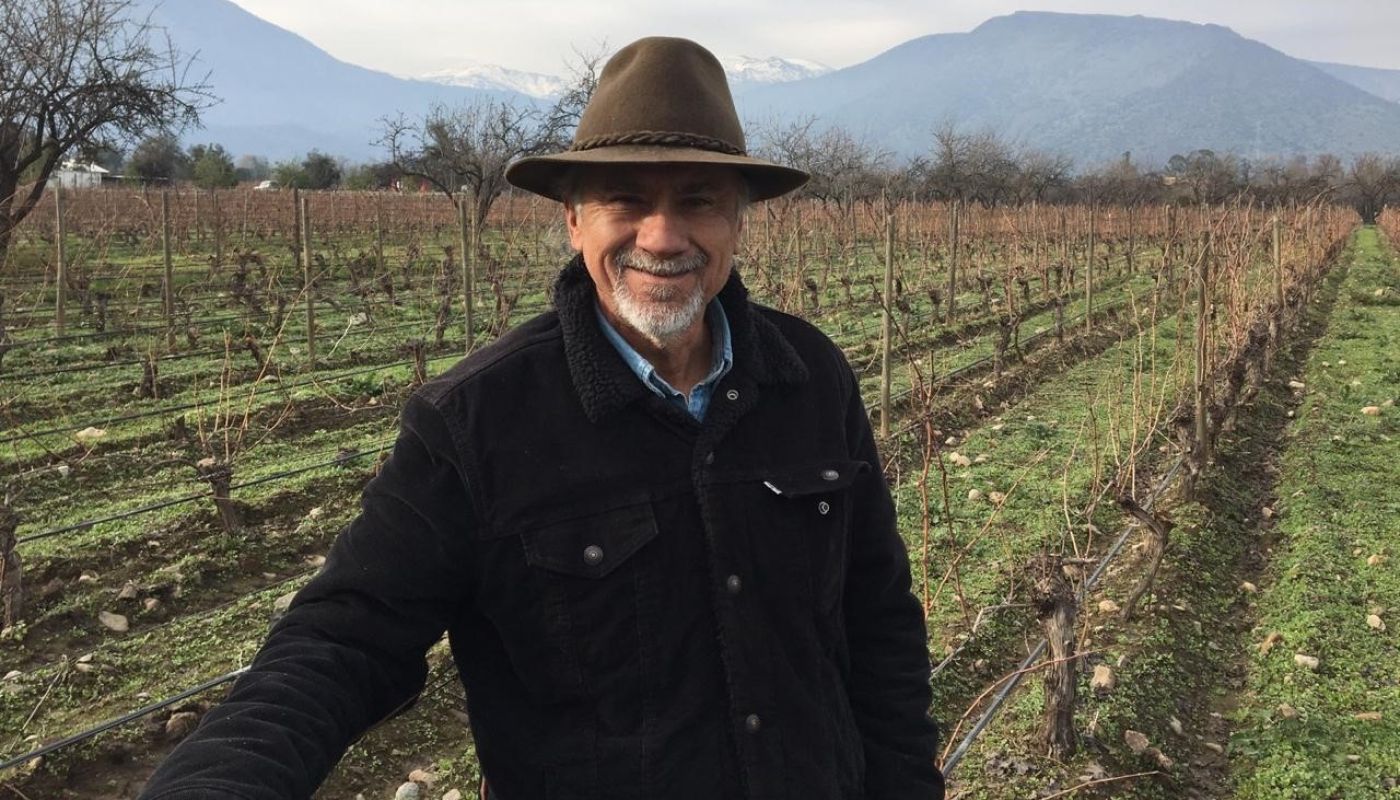
Alvaro Espinoza: A true pioneer in viticulture and winemaking in Chile and South America
I have always been passionately in love with wine. Since I was seven years old and was given by my parents a wee sip of Chilean red wine. I just loved the sense of flying out of the real world.
I graduated as DipWSET a couple of years ago and started delving into pruning late XIX century bush vines in my wife's family farm in the Maule Region in Chile. They surround an old adobe hacienda where the grapes upon maturity are crushed and its must slowly proceeds to capture the naughty alcohol.
While in deep contemplation of this glorious fermentation process the name of Alvaro Espinoza rung a bell. I had met Alvaro and his wife Marina Ashton several years ago and was captivated by his maverick approach to life, to viticulture and to wine making.
Biodynamics is the key word. Rudolf Steiner 100 years ago in his lectures given at Silesia on June 1924 gave us a glimpse on how we can take a fresh look a viticulture by loving and caring about nature in a spiritual way. Thus, he laid the foundations for Biodynamic viticulture. An approach that Alvaro, and many others, believe that will enable them in the near future to give us the privilege to a far better tasting experience of wines that will be fully capable to truly express their terroir.
I am now driving south from Santiago early in the morning of a cold late autumn day in June. The snow-capped Andes on my left and passing Don Melchor and Chadwick vineyards on my right. A bit further south east Santa Rita and Carmen vineyards by the Andes foothills. I am right in the middle of the heart of the Alto Maipo wine region. Antiyal vineyards and winery just a few minutes further south.
The vineyards
Antiyal has only has ten hectares of vineyards of which 3.17 ha are Cabernet Sauvignon, 3.35 ha Carmenere, 2 ha Syrah, 0.17 ha Petit Verdot and 0.7 ha Grenache. Surrounding the vineyards, he has planted 7 ha of Chilean native trees, 0.5 ha of almond trees and the remaining 2.5 ha with alfalfa and annual crops to achieve biodiversity. Cows, ducks, chickens and horses roam in the vineyards and among the trees that total the 20 hectares.
The soil is complex with a mix of volcanic, basaltic alluvial and co alluvial with excellent drainage located at the foothill slopes of the Andes at 500 meters altitude.
The vineyards are irrigated with clear crystal water from the nearby melting snow in the Andes using drip irrigation to save valuable and scarce hydric resources so that neighbors further down can also access to water for their fields. Five of the ten vineyard hectares at this time rely on solar panels to propel the water.
As we wander through the vineyards with the leave colors fully reflecting the beautiful autumn we just had, I ask Alvaro about how all this biodiversity of crops contributes to his wines. He replies. ‘These grapes grown in this Biodynamic environment truly expresses in a cup of wine all the beauty you see around you at the foothills of the majestic Andes Mountain range. There is a sense of vitality in my wines. There is an intense violet color that you can see from the emerging crushed grape juice. I love the colors. The colors are alive. Brilliant and captivating your eye all the time’. He adds ‘We have been handcrafting these wines since 1998’.
Jamie Goode tells us in his book Wine Science printed in 2005 ‘Espinoza is a true pioneer, and has been single-handedly responsible for introducing Biodynamic viticulture in South America’.
Jamie adds ‘It is clear from the outset that Espinoza isn't your average Chilean winemaker’. Alvaro Espinoza tells him ‘Traditional viticulture artificializes the vineyards, creating an artificial medium. The result is that the wines are similar to the ones from other places’.
Alvaro is concerned about climatic change. He has complied with all the advice given by carbon foot print experts. They tell him that his carbon foot print is neutral and could even be negative.
The bodega
After walking for nearly an hour around the vineyards we head towards his small underground bodega which is on the left hand as you enter his plot. Fully equipped to make and age wines it is buried in the ground to maintain a cool climate minimizing energy costs during the hot Alto Maipo summer days.
He contracts the bottling services with a moving bottling plant which comes to his bodega with the latest available technology to ensure that minimal oxygen is trapped inside the bottle after corked in low weight eco wine bottles.
Antiyal
We then wander among the vines to his home where he lives with his wife in the middle of the vineyards with a lovely terrace with a 360° view of the Maipo Valley and Andes. A truly gorgeous setting.
There are several bins outside at the entrance of his home, similar to the ones that I saw at his bodega to capture the waste separately and have the organic materials go to compost while paper, glass and other materials are sent off to recycling centers.
We walk up the stairs parallel to the western wall of his house to his terrace overlooking the vineyards.
He says: ‘We make six red wines from our own grapes and from organic certified grapes bought from vineyards in the Maipo Valley for our Pura Fe wines.
Top of our tier of wines are our two Antiyal wines, of which one is a red blend made from Carmenère, Cabernet Sauvignon and Syrah. The other Antiyal wine is 100% Carmenère. Our second label is the red blend Kuyen, or Moon, whose cycles are venerated by Biodynamic people. Finally, we make three lower priced Pura Fe (Pure Faith) wines to give you pleasure every day with your food’. He smiles ‘You need a lot of faith to be always innovating and addressing new challenges. A lot of Pura Fe.’
He opens a bottle of his highly acclaimed 2016 Carmenere Viñedo Escorial D.O. Maipo Andes. Made from 100% Carmenere grapes from his Block 7. The grapes were fermented and aged in concrete eggs with native yeasts. Tim Atkins MW gave it 95 points in his Chile 2019 Special Report ranking it amongst the best Chilean red wines together with Almaviva. Furthermore, Tim Atkins MW ranks Antiyal as one of the few Chilean First Growths.
Alvaro pours me some Antiyal Carmenere and tells me, ‘For me, this is a style of life. It makes me very happy making these wines. Maybe, it could be more profitable to grow the grapes as a mono cultivars and plant all our land with grapes. But the spiritual pleasure and enjoyment that I get out of making this wine that we are tasting far exceeds any material reward.’
The color is deep ruby. I have not yet swirled the wine inside the cup and fresh black fruit aromas are waking my nose buds. A touch of fine herbal notes.
Alvaro says: ‘There is an intensity in the aromas where several layers want to express themselves. The wine is happy. There is complexity. Acids, tannins, fruits, alcohol all together marvelously balanced’. I place the cup with wine on the table. The aftertaste lingers and urges you to pick up the cup of wine again.
The moon is rising over the Andes and a soft cold breeze is blowing from the Pacific Ocean at about 100 miles west making its way up the Maipo Valley. ‘I am in love with Bio. I love the way we treat the soil around us. No pesticides no herbicides, no fungicides, no fertilizers, only our manure preparations.
The earth is very healthy and can truly protect herself.
Full of worms. In our last study more than 4% of the top soil is organic material. It is the feeling you get when you caress you dog, or you caress lavender flower beds. The dog looks at you and licks your hands. The lavender gives a lovely fragrance after you caress them. After all, at one time we were all stones.’
Ecocert certifies Antiyal as an Organic vineyard. Demeter provides the Biodynamic certification. Both first attained in 2004.
‘The costs of Biodynamic agriculture are much higher. I have to allocate space to biodiversity. We are small and it is a great challenge to survive in the highly competitive wine business. A large percentage of my wines are exported. I make ends meet with my consulting work to other wineries in organic and biodynamic viticulture and in wine making. We sell about 50,000 bottles of wine per year’.
‘My wife Marina helps me with the administrative chores, my son Clemente in the manure preparations and my other son Vicente in the winery. We have a staff of three people deeply imbedded in our Biodynamic Antropophosy or Spiritual Science. During harvest, when we hand pick the grapes, I get help from our neighbors here in Escorial’.
After having a taste of his wine, he continues, ‘I had a great challenge in the beginning making the manure preparations. I did not even know where to get the cow horns, getting yarrow, which isn’t native to the wine growing areas in Chile. There were no red deer bladders at that time. Now we have enough to sell to others’.
When I ask him about the cosmology surrounding Bio he replies. ‘I do follow the cycles of the moons and the planets. However, I do not fully understand them. But they work well for me. I think that I was very lucky to have the opportunity to learn the organic and Biodynamic concepts during a sabbatical with Bonterra owned by Fetzer in California during the late 90's. I also had the privilege of meeting Alan York, a key figure in converting me to Biodynamics. Before that I was the chief winemaker at Carmen winery, part of the Santa Rita Wine Estates’.
Alvaro did an outstanding job at Carmen developing a state-of-the-art winery incorporating all the latest technology available in the market. After Carmen in 2000 Alvaro joined Viñedos Organicos Emiliana (VOE) as chief winemaker and general manager working directly with Jose Guilisasti one on the owners of Concha y Toro. Teaming up together they developed one of the world largest organic vineyards with over 230 hectares.
‘Peter, you know, Chile is extremely well endowed to proactive organic viticulture. After all, we are one of the very few countries where phylloxera never managed to set foot. We have a great Mediterranean dry climate, with tremendous day night temperature amplitude which allows our grapes to mature slowly till harvest time’
‘We have an amazing variety of soils and climates. We have wonderful people. Plus, I am blessed with the opportunity to be free as an entrepreneur to search new wine frontiers together with my family in this magic place where I live’.
It is getting late. The Antiyal Carmenere wine has long vanished from my cup in company with lovely cheese and warm homemade crusty bread.
Time to head north back to Santiago with my mind spinning off to new ideas on how I should relate to Mother Earth: the Pachamama.
Thank you, Alvaro and Marina, for the wonderful experience.
















