
Sue Bell gave me my first taste of Cristal.
It was at the wine judges’ dinner on the penultimate evening of the Royal Adelaide Wine Show, 2018. She was chairing a panel, donating her time and knowledge to the future of Australian wine, and generously contributing to the wines being served at the dinner. I was there fiercely treading water in my first year as an associate judge.
I withdrew slightly to focus on the wine, my palate fatigued by an afternoon spent with a flight of 37 South Australian Cabernet Sauvignons. The Cristal was 2006, a good year for a wine I had read so much about. Sue noticed my reverie and splashed a little more into my glass. We spoke about the house of Louis Roederer – its commitment to sustainability and what that meant to the region. It was an important moment for me – a highly reputed and awarded winemaker taking the time to connect. I soon learned, that’s a fundamental part of who Sue is.
‘Sustainability’ is, perhaps, an overused word,’ Jancis Robinson wrote in the announcement of her summer writing competition. But what does it really mean? For many, the word quickly translates to organic and biodynamic viticulture. For Sue Bell and Bellwether, the boutique winery she runs out of an old shearing shed in Coonawarra, true sustainability is far more holistic. Yes, it’s about power and environmental impact, but Bell also talks about social, economic and personal sustainability. ‘Achieving all of those is really hard you know, and just when you think you are getting there, a pandemic kicks you,’ she says with trademark Aussie candour.
COVID-19 restrictions in Australia this year saw wineries close for three months, alongside many of the restaurants that support them. When I spoke to Bell via Zoom, she had been open again for a month and was enjoying the influx of local travellers and the change in values. ‘There’s a part of me that is loving how people are being forced to localise and slow down,’ she says.
Connection is an important part of Bell’s outlook. She has Aboriginal heritage, but was adopted and so doesn’t know her history. She describes how fortunate she is to have been accepted and included by Aboriginal people throughout her life. In ‘some really cool Aboriginal meetings’ she has learned ways of approaching situations differently, with an increased sensitivity. Working with and learning from Aboriginal people, she finds, has more impact.
In 2016, Bell presented a session at the Australian Wine Industry Technical Conference (AWITC) titled ‘How Can We Enhance The Uniqueness Of Australian Wine?’ One of the important concepts explored was a very Australian approach to terroir. ‘Connection to country is a fundamental pillar of Indigenous identity’, she says. ‘Whenever I have had to explain the word terroir to a room of people in New York, Melbourne, or Penola, they listen and they kind of like the sound of it. If they are really into wine they probably have a better grasp of it, but if you explain that word to Aboriginal people they get it immediately.’ She speaks of the spiritual connection to the land and the way that cultural practices are handed down through generations – living with the land, not off it.
Bell thinks a lot about how we can utilise Indigenous knowledge to improve the way we work with the land. In many ways she believes that by caring for the country we are already adopting some of those practices. She muses that many of the techniques described as being innovative are often re-adoption of ancient practices. ‘Like the use of natural yeast so it’s a better representation of place; then if it’s a representation of place it’s respecting those places and so straightaway you get into an indigenous mindset which is all about respect for country.’
Bellwether is in the process of going ‘off the grid’, a long-term goal which she hopes to realise by Christmas this year. In 2017, she spoke to Australian wine writer, Huon Hooke of The Real Review, about crowdfunding for solar panels; people were rewarded for donating money with winery experiences ranging from a ferment tasting to a week-long vintage experience. Relationships were built with her supporters and the money raised went towards a 10-kilowatt solar system. The next step is buying a battery to store the energy.
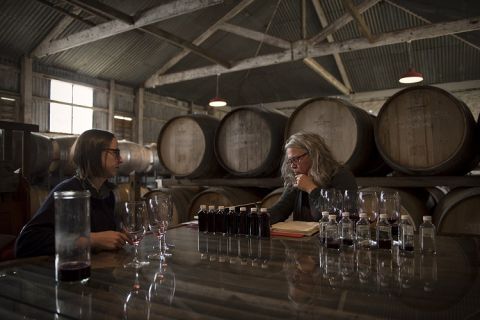
Bell is also working on ways to use less power. In 2008 she was senior winemaker at a 15,000 tonne winery. There was a heatwave in March, the middle of vintage. The 10 year-old, ‘very modern, sophisticated winery’ was pushed beyond capacity, and half the refrigeration went down during their busiest week. ‘That really blew my mind to see that happen and to realise that this wasn’t going to be an isolated incident, it was going to continue and possibly get worse,’ she says. In planning Bellwether, reducing the need for refrigeration was high on her list of priorities. She wanted to work with small ferments, allowing for small parcels of high quality fruit, but also to reduce power consumption. By keeping her ferments to less than a tonne she is able to keep the thermal mass down and does not require refrigeration, ‘which is the single largest energy requirement of any winery, especially as we get hotter.’
Authenticity goes hand in hand with sustainability. Bell bought the Glenroy Woolshed with the help of her business partner in 2009. It’s a gold rush era building crafted of local stone by Chinese immigrants in 1868 (positively antique by Australia’s standards), and sensitively renovated to accommodate a winery. The cellar door and kitchen are tastefully decorated with upcycled furniture. Set amongst the gum trees are camping grounds, including the option of ‘glamping’. Guests can cook ‘proper eggs straight from a chook,’ and forage for fresh herbs and vegetables in the kitchen garden.
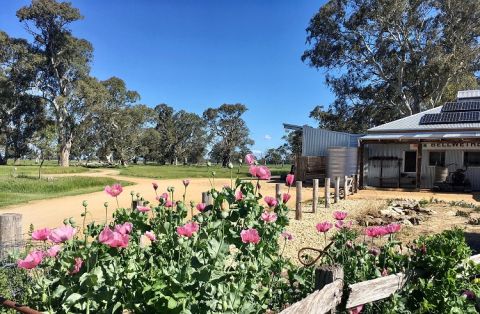
What you won’t see is vineyards. ‘I’ve never pretended it’s estate grown,’ Bell says of the wines she produces. ‘I often say to people in the cellar door, ‘Well, I wasn’t born with a vineyard, or my parents weren’t rich enough to buy me one.’ Instead, she puts her energy into strong relationships with her growers. Her focus is quality – selecting premium sites owned by people with the right approach. By paying good prices for the fruit she sources, she is able to encourage growers to move towards sustainable practices. Additionally she works with local industry groups to educate young viticulturists about the benefits of working more closely with the land. This includes learning the Aboriginal story of the region, delving into geology and looking at ways to better represent the land they are working with. The benefit of sourcing fruit from different areas is that helps to overcome one of the biggest impacts of climate change in Australia; vintage compression.
‘I have vintages that sometimes go for two-and-a-half months,’ she says. ‘I have had one that went for six weeks and that’s across those regions.’ However, this does bring freight into the equation. Bell acknowledges the lack of efficiency and addresses this by reducing transport elsewhere in the chain. ‘When I buy something from Tasmania, it comes to me, I make it here, and I bottle it in Adelaide and then it goes to customers. It tends to travel in one path.’
The other benefit of sourcing fruit is the diversity it offers. She works with Cabernet Sauvignon from Coonawarra, Chardonnay and Riesling from Tasmania, and a host of Spanish and Italian varieties such as Vermentino from Heathcote and Bianco d’Alessano from the Riverland (an area not traditionally associated with quality viticulture). Bell thinks that alternative varieties are an essential part of winemaking in Australia. She describes them as ‘appropriate’ varieties, rather than alternative. Diversity is important to her, as is a respect for our climate and soils. Italian, Spanish and Portuguese varieties are a good start ‘When you place a map of Europe on Australia, it doesn’t scratch the surface,’ she says.
Sue Bell is a shining example of the difference one person can make to sustainability.
She contributes knowledge and passion through her work, her genuine interest in people, and her willingness to challenge people to connect more to others, to the land, and to the traditional owners of the land. With a curriculum vitae that includes winemaker at Australian industry heavyweights Penfolds and Hardys, it was a brave move to buy a shearing shed and start again. ‘First vintage, I thought do I know how to do this? Do I actually know how to make wine without 50 staff and all of those resources?’.
She did, and the results speak for themselves. ‘Now it’s hand on heart, it’s like an artist with a painting: this is what I think and how I feel.’
















