It had drizzled that May morning in Priorat. That afternoon, you could sense a frisson of excitement among the winemakers assembled at the historic 12th century Cartoixa d’Escaladei for the unveiling of the DOQ Priorat’s ambitious Els Noms de la Terra classification project. Rainfall, a precious resource in the dry, almost arid region was to be celebrated, always.
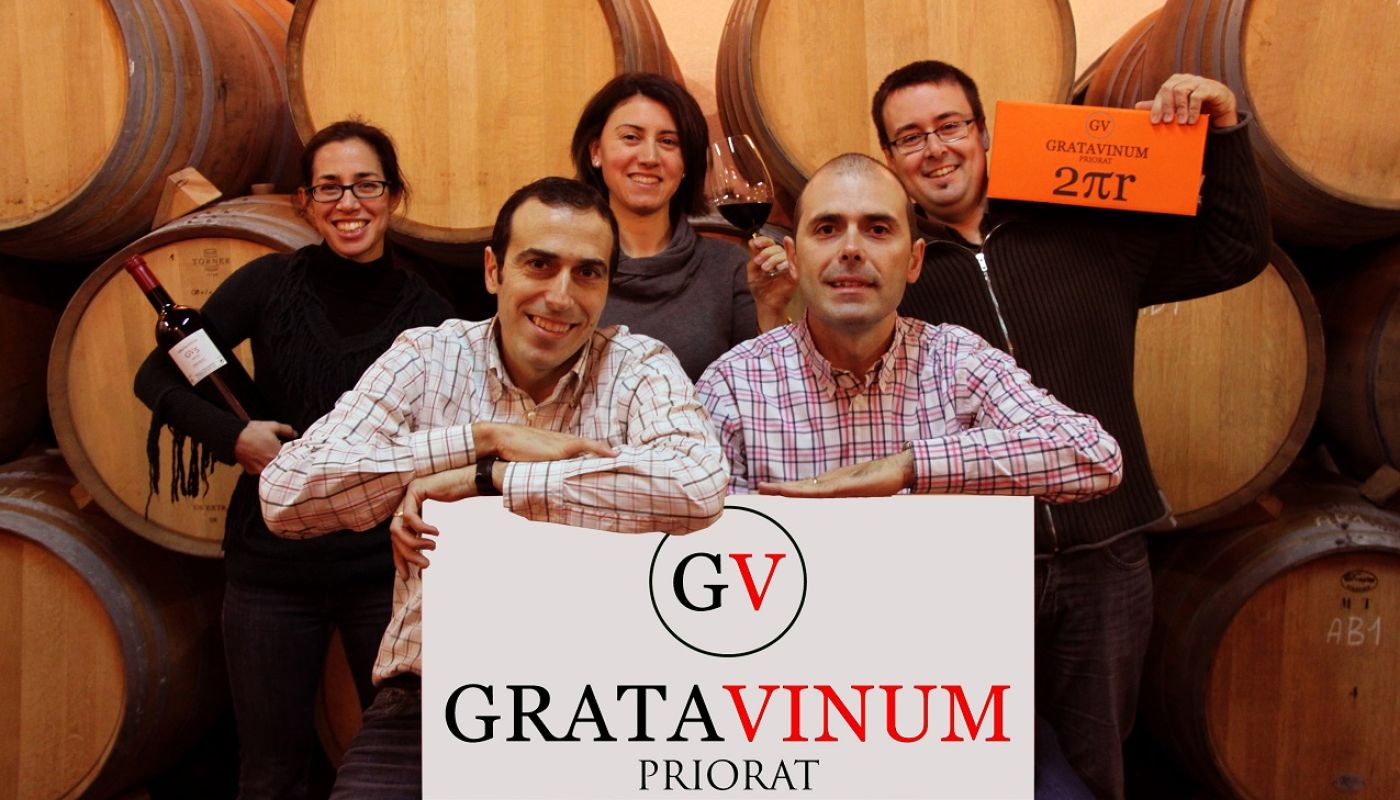
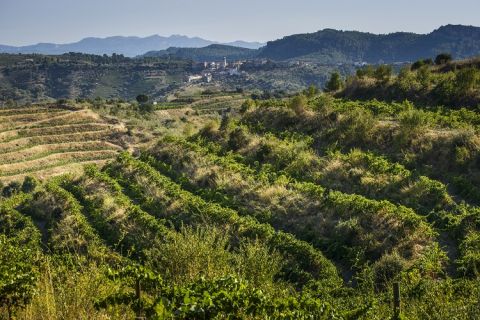
No one looked happier than Jordi Fernandez (pictured above, far right, wearing spectacles). The winemaker-owner of Gratavinum could barely hide his excitement that day as he drove our little group of journalists and sommeliers to visit his vineyards beyond Gratallops, one of the 12 village ‘zones’ of DOQ Priorat. We could smell the dampness in the air as we whizzed down long winding roads carved into the stark terrain, past steep terraced vineyards streaked with the grey-and-black quartz-rich slate soil unique to Priorat known as llicorella. ‘Gratallops has 250 inhabitants, seven restaurants and 25 wineries – literally one winery for every 10 inhabitants,’ Fernandez told us. That summed up Priorat in a nutshell: wine production was the region’s mainstay.
Soon we were standing in the paratge (vineyard) named Guinarderes, listening to Fernandez’ passionate discourse on biodynamics and sipping a glass of Silvestris 2017, the Garnacha-dominated natural wine made by the 17-year-old Gratavinum, one of only two Demeter certified producers in Priorat. ‘There is no better place to taste wine than in the vineyard,’ declared Fernandez, as we raised a toast to the rain. The pronounced intensity of ripe plum and blackberry was underpinned by earthy, savoury notes and lifted by high acidity and generous tannins. It was young and completely delicious.
Raining troubles
Things have changed dramatically in Priorat since my visit last May, as I discovered. After a blisteringly hot summer it had started raining and didn’t stop. Initially, it seemed a blessing. ‘We received 800 mm of rain between November 2019 and March 2020. That is two year’s worth!’ exclaims Fernandez during a Zoom call last month. Then Covid struck. While it was barely visible in sparely populated Priorat, with more vines than masked tourists to show, the dwindling sales of wine hurt the region.
Fernandez confirmed that work was now carrying on in the vineyards but the crop was down 20%, no thanks to the ‘unwanted guest’ – mildew – that attacked the vines after the rains. ‘Of course we can’t use systemic pesticides so we used a very low dose of copper mixed with a horsetail decoction. This was the first time we needed to do this.’
The friendship project
Gratavinum was started in 2001 by a group of university friends. Fernandez was studying oenology at Rovira Virgili University in Tarragona and became firm friends with fellow students Marta Casas and Maria Elena Jimenez and later, their husbands, brothers Josep and Joan Cusine of the Parés Baltà winery in the Penedès (see main picture above). [By sheer coincidence, these two winemakers feature in last Friday's wine of the week – JH] The young group, about 25 at the time, bonded over environment concerns and wine travel (Burgundy, Bordeaux) and on an impulse, decided to make wine together in Priorat. They managed to find adjacent plots of land beyond the village of Gratallops, and today are proud owners of 12 hectares, including the terraced vineyards (costers) and the winery.
‘Before I finished studying I knew I wanted to make wine in Priorat. It’s a land you love or hate – it is too hot, too dry, too laborious to grow vines in – but for me the bond is deeply emotional,’ says Fernandez who heads Gratavinum, which they built from scratch. The others focus on Parés Baltà in the Penedès, but all five come together to decide on the final blends. Gratavinum makes 20,000 bottles of biodynamic annually, split over 5 labels.
The group’s curiosity about biodynamics lingered long after they finished studying oenology, and in 2010 they found themselves attending a workshop by certification agency Demeter. ‘After several years of organic viticulture in both Penedès and Priorat, we had understood the link between the environment and the vines. We did the course in biodynamics with a ‘let’s see’ attitude, but it changed our lives – here was a whole new world.’ The group began preparing to go biodynamic – the Cusines at their winery, Fernandez in Gratavinum. Certified organic in 2003, Gratavinum got its biodynamic certification from Demeter in 2014.
There can be few wine regions better suited to biodynamics than Priorat. The warm continental climate, low rainfall and deep pockets of llicorella ensure the vine roots burrow deep in search of water, and diseases of the vineyard are rare. Yields are naturally low and the vines must be tended to by hand in the steep vineyards. DOQ Priorat covers only 2000 ha, most of it small holdings. Yet, the region’s resurgence led by the group that included René Barbier and Álvaro Palacios in the 1990s has seen vastly improved vineyard management practices and renewed focus on grape varieties Garnacha and Cariñena leading to new appreciation of their richly structured wines.
Homeopathy for the soil
Sustainable viticulture has come recently to Priorat, where many producers say they follow biodynamic principles but are wary of the irrevocability of certification. Not so Gratavinum. Gratavinum uses Steiner’s biodynamic preparations, including Preparation 500, a compost which uses fermented fresh manure from organically-fed cows buried underground in cow’s horns, which ‘acts like homeopathy’ for the soil says Fernandez, recounting hilarious encounters of the bovine kind. ‘We found two brothers who rear organically-fed cows and we told them if you let us come and pick their manure, we will repay you with bottles of wine! So we have spent days chasing cows in their fields, picking up fresh manure, much to their owners’ amusement. But this ensured the manure we use has no chemicals added.’ Another tale is of the time he drove back from Extremadura with 500 cow horns in his car: never a dull moment when you are biodynamic.
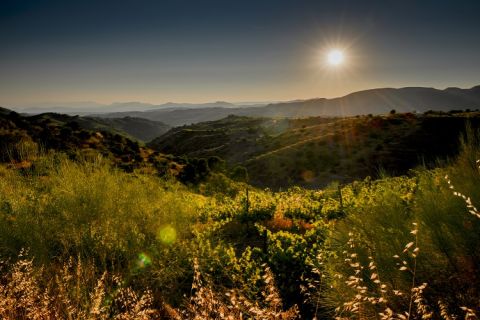
Everything they do is mandated by biodynamic regulations (during our visit, we were asked to leave our mobiles outside so their electromagnetic waves wouldn’t affect the preparations stored in the winery shed.) ‘We don’t use pesticides, herbicides, fungicides, but medicinal plants we collect ourselves, like nettle (rich in iron) and horsetail (used for mildew). For the microbial health of the soil, it’s Preparation 500 and Maria Thun biodynamic preparations. We maintain vegetation in the rows between vines, leguminous plants and even including trees, which work as a reservoir of nutrition for insects, birds, fungus. I like to think we have created an ecosystem that invites wild animals into our estate – we often see snakes, rabbits, fox, wild boar, even deer and wolves.’
Community support
Priorat is small, and community feeling is naturally strong. Fernandez has two young assistants, Josep and Jordi, who work with him in the vineyards and winery. ‘We work as a team and do everything from pruning to wine tourism,’ he says, ‘Last year we rented two small vineyards from villagers who were too old to work their vines anymore.’ These are presently undergoing conversion to biodynamism. Transport is simple, even minimal: a hybrid car for sales calls and a small van to transport grapes to the winery.
‘As a winemaker, I love the chance to do everything, from working in the vineyards to helping to sell the wine. Visiting winemakers cannot go deep into a winery’s daily routine. That, to me, misses a big part of the secret to producing great wine.’
‘Water, like gold’
Despite the usual low rainfall, Gratavinum does not irrigate their vines. Besides forcing the vines to seek nutrition from the soil, it just seems wrong to do so, says Fernandez. ‘Water is like gold in Priorat. To spend thousands of litres of water for the plants while in the people in the villages struggle is bizarre. Our consumption is as low as possible, even during harvest.’ Early in 2020 they harvested rainwater manually from the winery roof for use in their biodynamic preparations. As for waste, ‘All the biodegradable waste is used for composting in the vineyards. Other waste – paper, glass – is sent for recycling to the village.’
Carbon credit
There is growing concern about carbon costs from use of heavy glass bottles, but this is something they have already addressed: ten years ago, they reduced the bottle weight for their best selling wine to 430 grams. ‘Last year, we reduced bottle weight for our top cuvée Coster by 40%. By next year, we will change the bottle of GV5 too.’ Their labels, capsules, crates and cartons are produced an hour’s drive from the winery, while corks are produced in Catalunya.
Conservation of energy sources is currently their weakest point, admits Fernandez. ‘We are still using fuel to generate our own electricity because the winery is located far from the village with no electricity supply.’ Gratavinum’s ongoing project to place solar panels at the winery has suffered a setback due to the pandemic. When things normalise, the solar project will be completed after which is planned a complete carbon audit.
Barrels, amphorae, demijohns
Winemaking remains uncomplicated: a basket press ensures gentle pressing (‘we all take turns at the press’) even if it is longer, more laborious. Clay amphorae are used in addition to their 400 litre barrels, and Gratavinum’s latest acquisition has been a clutch of 40-year-old demijohns found in the backyard of an old Penedès farm. This is used for reductive ageing for specific wines: ‘In a way, we are stopping time – a year later we find the wines in demijohns still have the intense flavours of fresh fruit they did at the start.’ Individual parcels are aged separately in barrels, amphorae and demijohns before the final blending.
The wines
Gratavinum’s portfolio includes 2πr, a blend of Cariñena and Garnacha with Cabernet Sauvignon and Syrah; Coster, a 100% Cariñena from 105 year old vines, aged 12 months in amphorae; GV5, a Cariñena-dominant blend, and Dolç d’en Piqué, a late harvest blend of Garnacha and Cariñena. But the wine closest to Fernandez’ heart is their natural wine Silvestris (4000 bottles), 85% Carinena and 15% Syrah aged in new French oak (40%), amphorae (40%) and glass demijohns (20%). ‘We were the first winery to produce a wine without added sulfites – always a challenge – but every vintage of Silvestris has surprised me. So yes, Silvestris is a little more special. People who taste it can’t believe it is a natural wine – it has no funkiness or impurities.’ They are getting set to launch their newest label Gratavinum Paratge Rocaforts 2019, a 100 % Garnacha fermented with 20% whole bunches and aged in 600 litre oak barrels (80%) and demijohn (20%).
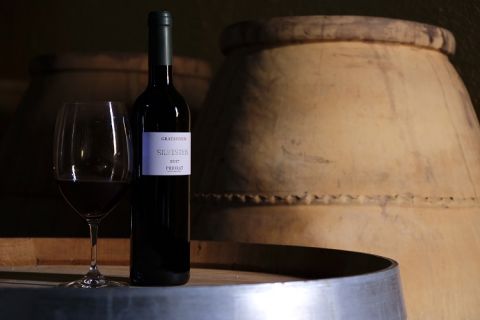
Wines made sustainably are true ambassadors of their terroir, he adds. ‘You can taste the unique footprint of Priorat in the wines. Beyond the fruit, there’s minerality – smoke, graphite, wet leaves and forest floor – the kind of earthy smell you get when it rains in Priorat. Each time I taste my wine, I can taste the terroir.’
Present challenges however daunting, have not changed the passionate mindset I observed last year when I walked the vineyards with Fernandez. ‘We are giving life back to the soil – enhancing life in every form, above and below the ground,’ he says, ‘Does that make the wine taste better? I think so. I do know one thing: it will be better for your body.’