All change for sustainability
For a short four-letter word ‘hero’ packs a punch, but so does another four-letter word that I’ve been muttering under my breath a lot lately. Something to do with the ups and downs of recent months; not being able to hang out with friends, visit family abroad, or travel freely to wine regions, but at least I’ve discovered a whole bunch of new emoticons. Welcome to the coronacoaster!
The last few months have been weird. Wittingly or not, we’ve had to press pause on our lives as we adjust to a new normal. Many of us have had to rethink the way we live, work and consume, all the while wondering about the planet situation. This had me thinking about another word that has been bandied about like there’s no tomorrow – sustainability, and how far removed we are to achieving it.
It has been a slow burn. From the latter part of the 20th century to the present day, we have prioritised economic growth, as we silently witness its insidious advance towards an unsustainable place. But the excessive speed at which it now moves, with policies insisting on a perpetual skyward trajectory, like a giraffe straining to reach the ever-higher tip of the acacia tree, has come at a heavy cost to society and to the environment. Ironic then that it took an invisible virus to grind Earth’s treadmill to a halt and, in so doing, revealed a fundamental truth:
We need each other and we need nature.
That’s why it’s important to shine a light on those who seek to achieve sustainability in their work and in their lives; the sustainability heroes and heroines that the world so desperately needs right now. But the truth is, we all need to consider and show greater respect for one another and in our interactions with our natural and physical environment. Imagine if 7 billion of us could do just a teeny bit, how much closer we would be to reaching the sustainability goal. If we are to bequeath a healthy planet to future generations, this is not just a wish list. It’s a must-do list. Les petits ruisseaux font les grandes rivières (small streams make large rivers). So let’s go bust some dams.
As an importer of expressive terroir-driven wines with a philosophy of minimal intervention, I’m always on the lookout for wine producers who work sustainably with integrity and passion, who have a strong sense of community and purpose, and who regard themselves as custodians of the land, often with a strong appreciation for the traditions of the past but with a watchful eye to the future. So earlier this year, I visited Italy to find out for myself why the wine world is abuzz for Sicilian wine, especially those from Mount Etna that happen to produce the kind of wines I love. Mount Etna is particularly interesting because it is Europe’s most active volcano, yet despite its seemingly inhospitable environment, viticulture has been practised here for centuries, providing the kind of range in elevation (3,350 m) and thermal amplitude (as much as 20°C) that benefits Etna’s ancient varieties to produce top quality grapes, while offering the much needed respite from the hot climate this far south. A boon for vine growers, particularly as they adapt to the vagaries of a changing climate.
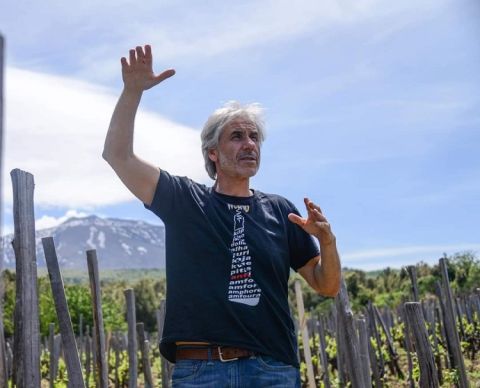
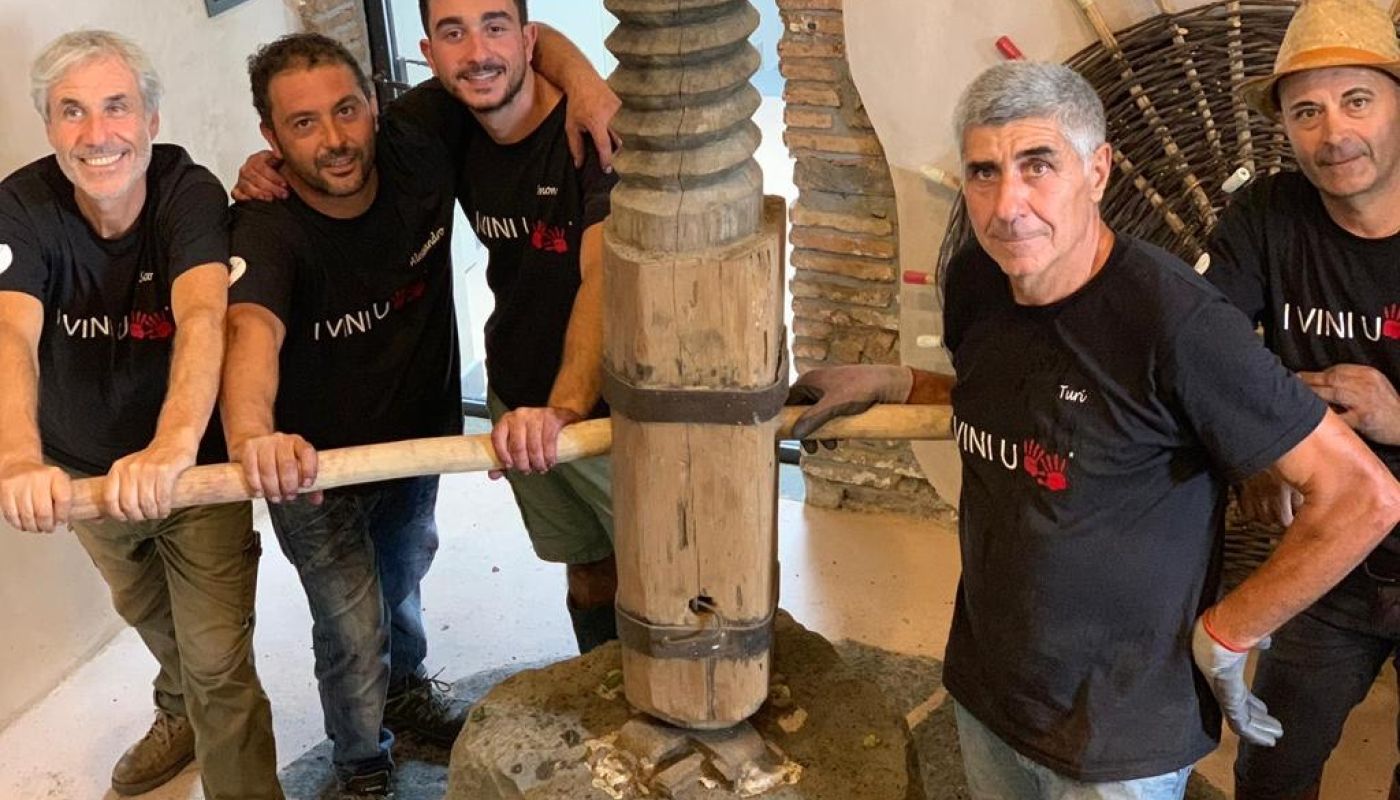
I knew I wanted to discover the wines of Salvo Foti, the force behind I Vigneri, an association of Etna vine cultivators and wine producers (photographed at the top of this article) who have resurrected the philosophy of the ‘Maestranza dei Vigneri’; a vine-growers guild that was established in Catania in 1435. Salvo is widely considered the godfather of Etna wine, so I was particularly excited to meet his son, Simone Foti, at their winery in Milo on Etna’s eastern contrada. It took a scary drive along a winding mountain road, cloaked in dense fog and a colossal downpour of ice-bucket challenge proportions to reach the winery; a reminder – if one was needed – of the extreme, unforgiving nature of Etna, and why vine cultivation here is notoriously challenging and hard, but you quickly get a sense of place.
I was greeted by Simone at the entrance of what looked like an old stone farmhouse but is more accurately described as a palmento, a traditional multi-level stone building that was constructed especially for winemaking before the advent of electricity, pumps or other energy-saving devices. Walking into the high-vaulted timbered structure and onto the upper deck, a kind of stone lagar hewn from Etna’s volcanic rock, I was immediately impressed by the ingenuity and craftmanship of it all. I think I’m in a museum, but I’m surprised to learn that this is very much a working winery albeit the only one in operation on Etna and therefore the world.
Simone explains that harvested grapes arriving at the winery tumble directly onto the stone floor where they are foot-pressed using a round wicker accessory the size of a wagon wheel on which three or four people stomp together to crush the grapes underfoot. Stone spouts (together with some shovel work) direct the must and matter to the large lava stone receptacles below. From here, the must descends a further level to stone holding tanks as it passes through a wicker filter that looks like a giant loose leaf tea strainer. Once drained, the remaining skins and stems are assembled into a giant cake upon which heavy beams are placed Jenga-style on top of each other. It then takes an army of workers to prepare the press, which is not unlike a Medieval trebuchet with its giant wooden fulcrum and hulking 12 metre beam whose weight, with every turn of the screw, presses hard on the caked tower, which not surprisingly offers little resistance.
I can only imagine the extraordinary scenes that play out here during the harvest, and I begin to understand how important this ancestral method of winemaking is for Salvo and the vigneri, fulfilling a fundamental part of their vision: to instil a sense of community and identity, and to restore dignity, pride and a duty of responsibility to safeguard the ancient traditions of their ancestors. You see, it almost doesn’t matter that the small amount of wine made in the palmento (of the 20,000 bottles produced) is considered illegal by the EU, for supposed hygiene reasons, because it doesn’t exist for the sole purpose of commercialising wine but to make wine, preserving the essence of Etna’s winemaking tradition alive, bringing together the local community in a show of unity and solidarity, which is at the heart of I Vigneri. As one of the pillars of sustainability, the social component is too often ignored in favour of quick economic gains. Yet, to restore balance in the sustainability equation requires more – not less – social interaction and cooperation, and a greater focus on people, not profit. How presciently pre-COVID.
On the slopes, the vigneri seek to restore ecological balance to Etna by returning to past wisdom through an ecosystem approach to viticulture, which involves the use of non-invasive techniques and practices, ancient native varieties, and local knowledge of the mountain gleaned over centuries. It’s a well understood fact that great wine requires healthy grapes. It therefore follows that the vine grower’s role is fundamental, and we must recognise and appreciate the high-value of their work. In the case of Mount Etna, this is crucial for the continuity and sustainability of their livelihood. Their dedication, experience and know-how should be rewarded, and building respect and an appreciation for their work is key to achieving a sustainable system.
Producing high quality grapes on Etna is never straight-forward. It takes incalculable hours of toil and an intimate knowledge of this harsh terrain to work the 22ha vineyards owned by I Vigneri, which are all worked organically by hand with no chemical short-cuts, as well as some biodynamic principles, such as pruning that is carried out in phase with the moon. Here, the ecosystem is seen within a holistic whole, encompassing Etna’s biodiversity, its volcanic soil, its changing climatic and weather conditions, and altitude; all of which determines what Salvo describes as its bio-compatibilities that work together towards achieving harmony. In wine-speak, this is Etna’s terroir.
To respect the terroir, the vigneri apply ancestral practices, such as maintaining albarello (gobelet) bush vines rather than the more recently adopted trellising systems, as well as the traditional planting technique of quinconce or settonce, which is an ancient grid arrangement that allows for a high density of vines (up to 10,000) with just enough space for the vine to thrive, but leaves no room for mechanisation. The vines are dry-farmed, the roots piercing the soil layers to draw the water they need aided by the dry stone walls that enclose the terraces, which were constructed by the many generations of vigneri who came before. By being true to tradition and eschewing adopted systems that come from elsewhere, the vigneri make wine that is honest and true to the wine of Etna’s past. It is said that I Vigneri make ‘Etna wine’ not wine from Mount Etna, and I get what that means. These are expressive wines, full of vitality which Salvo calls ‘wines of humanity’.
This is not a folkloric vision of Mount Etna. This is the living, breathing part of Etna’s history and wine culture – much like the mountain itself.
Salvo’s wines hold sway among the cognoscenti of the natural wine world, but they are not flash in the pan wines for glou glou moments. They are contemplative wines with real character and a strong sense of place. Rooted in the mineral-rich volcanic soil are the indigenous varieties Carricante, Minella Bianca, Inzolia, and the better known Nerello Mascalese that have evolved over centuries here under difficult climatic and growing conditions, but which have also nurtured a unique wine culture that I Vigneri is determined to defend. When we think of sustainability, we often turn to the vast body of scientific knowledge that has been amassed from experimentation, innovation and progress, but what if some of the answers we’re looking for can be found in the past and that the best way forward is by looking back. Maybe that’s the future.
The photos of Salvo Foti and the vigneri in the palmento were taken by Simone Foti. Also, I have no commercial relationship to Salvo Foti or I Vigneri.
















