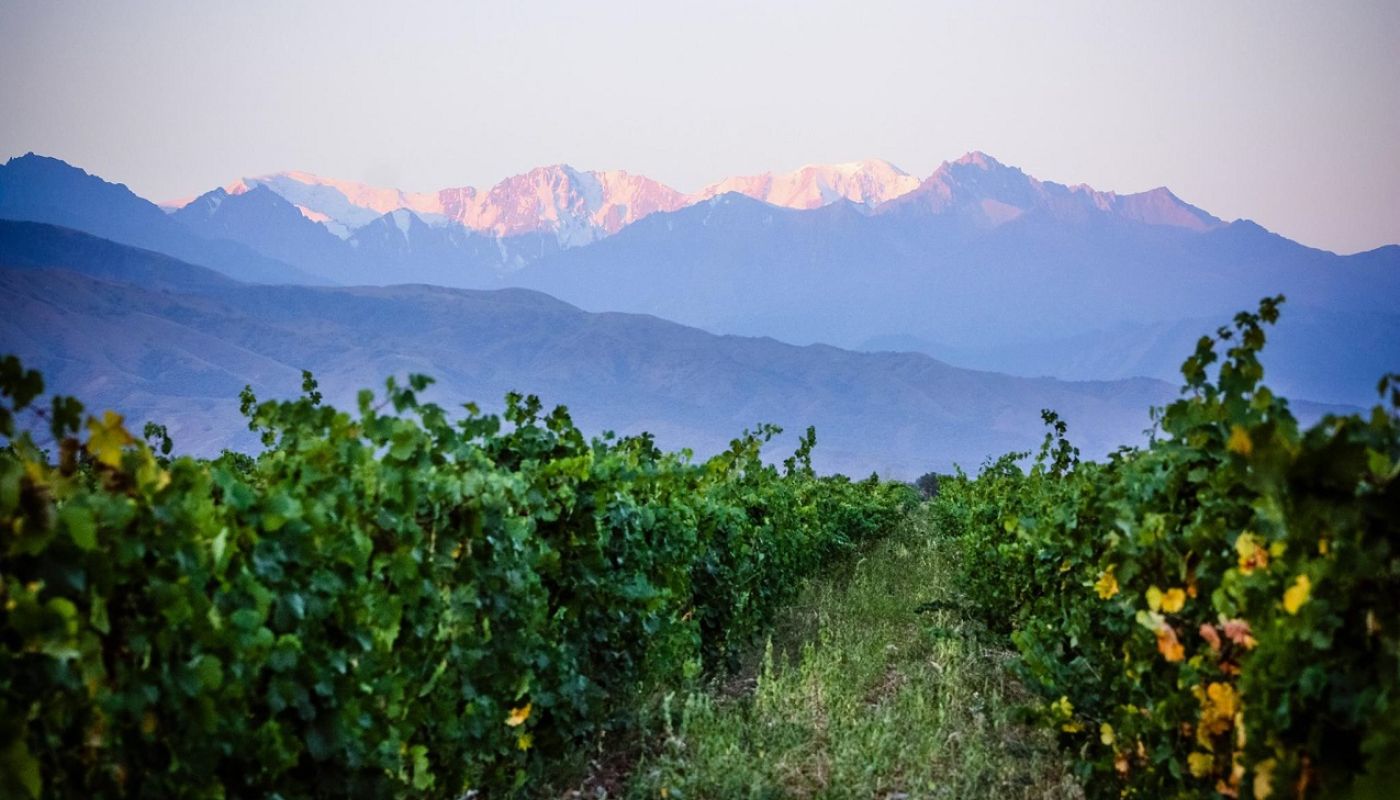
Grape growing and winemaking were blooming and vast vineyards were common in Soviet times, in the south of Russia, most part of Ukraine and Georgia, and as far east as the southeast of Kazakhstan, you can still find old and sometimes abandoned vineyards planted in the 1950-1960s. The total number of hectares under vines in Kazakhstan was around 28 000 ha in the 1980s, just before Mikhail Gorbachev, leader of the USSR at that time, launched an Anti-Alcohol Campaign in 1985 (which people call ‘dry law’ similar to the Prohibition in the USA in the early 20th century), which partially banned alcohol consumption. It was a big blow for the wine growing regions and many vineyards were pulled out so that the fields could be replanted with cereals and fruit trees. Currently it is very difficult to say the number of total area under vines in Kazakhstan, as it is not part of the OIV (International Organisation of Vine and Wine), and the majority of the grapes are table grapes, not destined for winemaking, but you can come across such numbers as 4000 or 8000 ha in different sources, so the consequences of the campaign for the wine industry are obvious.

Kazakhstan declared its independence from the Soviet Union in late 1991. Though an event awaited by many, it brought a lot of difficulties and uncertainties to the young state. Due to the economic situation in the 1990s many industries suffered a financial crisis, including the agricultural sector. Many factories and producers, nationalized in the Soviet era, did not make it through the first years of capitalism and had to close down. That led to a lot of people losing their jobs and many fields and facilities were abandoned for many decades. This was the fate of the Fruit and wine collective state farm, located near the city of Almaty in the south of Kazakhstan, once very famous for its fortified ‘port-style’ wine in the Soviet Union. The collective state farm ceased to exist in the early 1990s, and the vineyards were split among the local population who often did not have the necessary resources and experience to manage the vineyards.
Kazakhstan is a new and exotic name on the global wine map, it has never been at the top of grape producing or consumption countries’ ratings. Even more interesting is the fact that there are archaeological findings, including remains of fermented grape seeds of vitis vinifera species, found at the current site of Arba Wine vineyards (former collective farm sites), dating back 2500 years. Kazakhstan’s geographical location, between Europe and Asia, allowed it to be part of the Silk Road, and many believe that the grape seeds were brought here from Caucasus, and then later on also from Persia, so viticulture is not an entirely new phenomenon for the country.
Many centuries later it was the turn of the scientists from the Soviet Union to carefully select grape varieties suitable for the terroir of this area, at some point there were close to 500 different technical grape varieties tested in the nurseries in Kazakhstan to identify which ones would triumph in the local climate. Finally, such varieties as Saperavi and Rkatsiteli (both originally from Georgia) were selected due to their ability to adapt to local climate and produce high yields, as well as such prominent European vitis vinifera cultivars like Pinot Noir, Riesling and Cabernet Franc among others, also suitable for the local cool continental climate.
The terroir of Assa Valley (the name of the valley in Tian Shan mountain chain, formed by the Turgen river running down from the mountain peaks to the valley floor) is quite distinct, because of long years of influence of the river it has a very high content of rocks in the soil, making machine work in the vineyards almost impossible. High continentality of the region’s climate and the soil structure both played a part in the conservation of this vineyard, phylloxera was never present in the region, so the old vines all have their own rootstock, whereas the modern plantings are grafted.
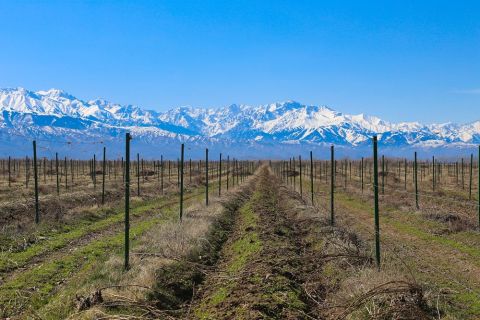
Due to extremely harsh winters the vineyards are managed in a very particular way - first, there is a very distinctive form of pruning when there is no permanent wood left above the ground level, so only 2-3 year old canes are left to grow directly from the roots. Second, each year, before the winter frosts hit, the vines are manually bent down and hidden under reed mats until spring, the moment when they are dug out and pruned - leaving last year's cane and cutting off the older ones. This has been done for decades in the same manner and cannot be mechanized, also explaining the 100% hand harvest. The height of the vineyards is 1000 m above the sea level, with winter temperatures sometimes falling as low as -42 Degrees celsius, and summer ones reaching +35 degrees, but moderated by cooling breezes from the mountains influence the night temperatures to drop to +15 degrees and help the grapes to retain acidity.
For more than 20 years the vines were left untouched, called by the locals ‘a sleeping vineyard’, it grew to be so wild that the vines were crawling up the trees competing for sunlight. The roots are so deep that even when the upper part of the vines were cut to make space to plant wheat or apple trees, in a couple years new shoots would emerge in the very same spots. It is thought that the vineyard survived only due to the poverty and economic crisis, when nobody had money or resources to take care of that plot of land. Others believe that it is also due to the vitality and persistence of the vines, waiting to be spotted by the right person, who could see the potential of such vineyards and be ready to invest time and resources in reviving it. This is what happened to this sleeping vineyard when it was discovered by Zeinulla Kakimzhanov in the early 2000s. Zeinulla is an economist and former minister and advisor to the President of Kazakhstan. Wine has always been an interest and hobby for him, he has travelled to numerous wine regions and acquired a profound knowledge together with exquisite taste in wines over the years. He himself says that winemaking was never his life goal, his plan was to buy a small plot of land, grow grapes and make some wines from it as a retirement hobby.
When he came across the abandoned Soviet vineyard he was told it would be better and more efficient to pull out the old vines and replant with new rootstocks from the European nurseries, but the resilience of the vineyard throughout all these years inspired Zeinulla, who often says that nature knows what is best for the earth, so the vineyard got its second chance. That was the start of the Arba wine company with its first parcels of old vines, all planted on own roots and dating back to more than 40 years with Rkatsiteli planted in 1978, Riesling in 1977 and 1978, Saperavi in 1978 and Pinot Noir in 1982.

The wines from the abandoned Soviet vineyards were produced starting from 2010, as it took several years to restore the vineyards, cut down the trees, introduce trellising, and dig out water channels for irrigation. Already the first vintage from these vines after restoration proved to be remarkable. Zeinulla soon understood that something special was born on the Kazakh soil, so the wines were immediately sent to multiple competitions and foreign experts in order to evaluate their level.

The wines from Arba Wine, produced from the old abandoned Soviet vineyard, were noticed and highly appraised by many international wine awards and competitions, among others are International Wine Challenge, Decanter World Wine Awards, UK’s Sommelier Wine Awards, China Wines & Spirits Awards, they were also included in the ‘Russian Wine Guide’ by Artur Sarkisyan.
Though the old vines are often seen as a marketing tool to increase price and sales, and not everyone believes that they actually contribute anything special to the wine itself, we cannot argue with the fact that they are in many ways a token of resilience and heritage, a reminder to all of us that man must always reckon with nature.
All pictures by Asem Tussupbayeva, reproduced here with her permission and not previously published.
















