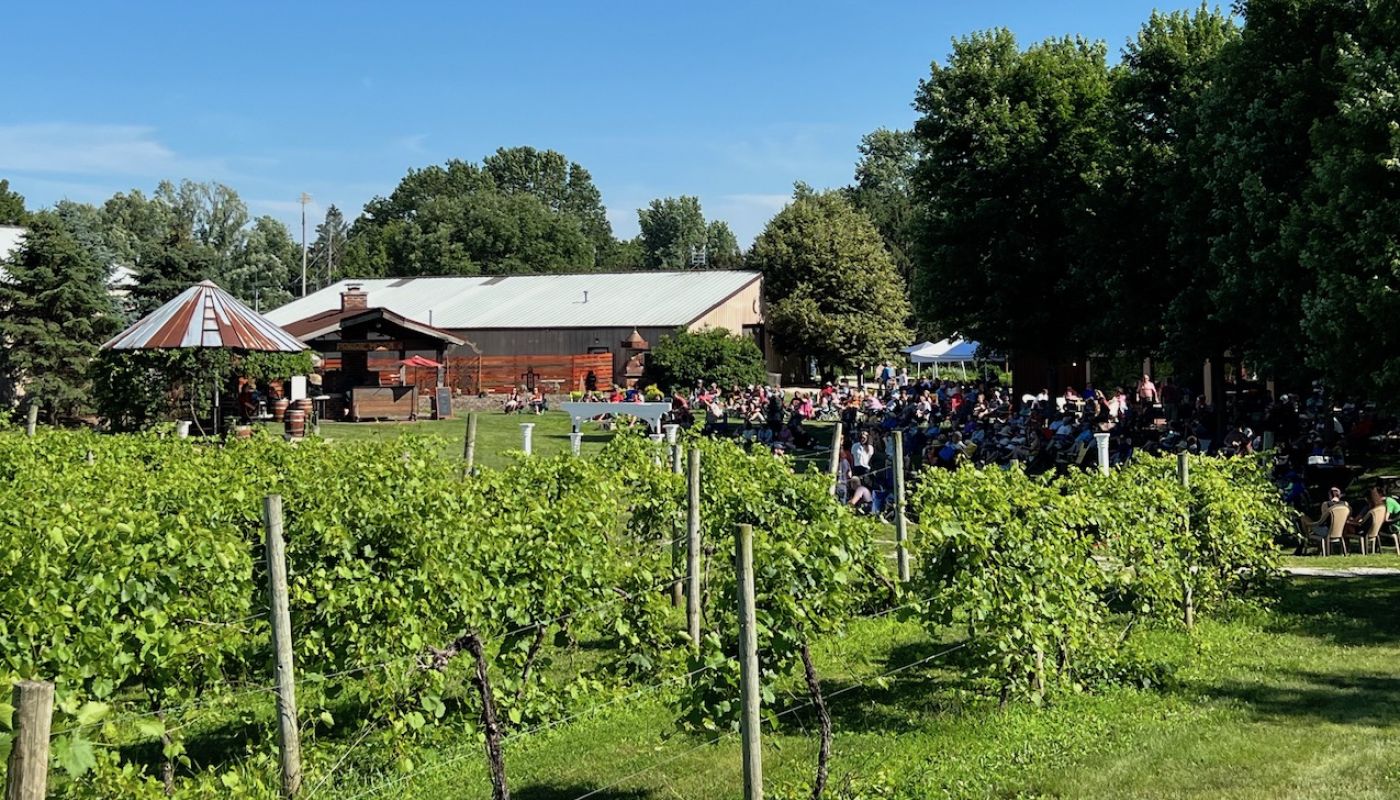
Donna Moyer writes Donna Moyer is a wine professional recently relocated from the US west coast to its midwest, a current WSET Diploma candidate, FWS, and CS.
Regeneration in the Most Unlikely of Places
This is what I knew about Iowa when I decided to move here a year ago:
It’s relatively flat, having driven through it a decade earlier, thinking that I could never live in a place with no mountains (oh Life - you’re funny, you); It has been turned into a monoculture by the corn industry; 160 plus years of relentless cultivation has eroded its famously fertile topsoil by an estimated 30%; It is in the middle of my very large country of origin.
As I made the usual plans for relocation, packed my home and searched through Zillow listings for a new one, I began to catalogue wine industry opportunities: shops, distributors, restaurants; low and behold I discovered wineries. About 100, scattered across the state. In fact, part of eastern Iowa falls within the largest American Viticulture Area (AVA) (by land size, not area under vine), the Upper Mississippi River Valley (UMRV). Prairie Moon Winery, my first outing after settling in, offered a great introduction to the community aspect of Iowa’s wine culture. At Santa Maria Vineyard and Winery, John & Rose Guinan gave me my first lesson on Iowa Viticulture and introduced me to favored hybrid varieties for the region: Brianna, Edelweiss, Frontenac & St. Croix.

My journey to becoming a wine professional has not led me to also becoming a wine snob. Understanding the intricacies and hard labor involved in wine growing and production gives me a sense of awe for anyone who makes it their life work. Exploring wine in all its forms has made me appreciate them all, and curious about how/why a wine becomes what it is. I have approached midwest wine with this mindset, and set a goal for my time here: to explore the development and current state of US wine industry within the bookends of our acclaimed coastal regions.
Why, in fact, is the West Coast and New York the only place European vitis vinifera, aka quality wine, has thrived in a country as vast as the US?
I am actively engaged - right here in the midwest, a place my coastal colleagues and friends rolled their eyes at and said what ever will you do there - pursuing this endless wine curiosity, and yet.
And yet, after eagerly opening JR’s email notification for this years summers writing topic, my enthusiasm thumped somewhere near my feet. Regeneration? Here? That topsoil stat blinked like a neon in my left lobe. I pondered who I might contact in Seattle for a Pacific Northwest subject, perhaps via zoom chats, or better yet, justification for a weekend trip…home.
However, that philosophy of approaching a wine for what it is and where it’s from is also how I prefer to approach life - and home is here now - in Iowa. And, if there is anywhere in this country that needs regeneration, the midwestern plains states top that list. Surely this concept has its proponents here. That proved true!
This is what I learned when I let go of what I thought I knew, and researched my new home state:
Immigrants to this region faced great obstacles to establishing the wine cultures they carried with them from their homes in Europe. But we humans are resourceful, and we will ferment. If what was utilized in the past doesn’t translate to a new circumstance, alternatives will be found. What the newcomers found in this new land were grapes aplenty. American vitis didn’t produce the styles of wine they were used to, but they went gang-busters nevertheless - and a booming industry developed: By the 1900 census, resulting in 7,403,900 pounds of grapes, 76,301 gallons of wine, and 300 grower/producers. This, of course, included table grapes and raisins, and the wines of this era, not something anyone is nostalgic about, have stubbornly colored the reputation of middle American wine efforts. By 1909, the state of Iowa was the US’ 6th largest producer of grapes; a vitis cultural epicenter.
In my research, I found the midwest as epicenter to be a recurring theme: silently, until science sorted it out, of the late 19th century European phylloxera disaster; of the early 20th century Temperance Movement (Iowa passed its own statewide prohibition in 1916, three years before the US Congress made it national); of the growth of ‘conventional’ chemical agriculture between the two world wars - a death knell for the grape industry as vitis development is stunted, within an already perilously short growing season, by the herbicide 2,4-D targeting broad leaf weeds, which is delivered over cornfields via small planes, and then unfortunately ‘drifts’ wherever the breeze dictates. Each factor a significant hindrance to the development of commercial wine industry (piled on top of destruction wrought by regular extreme weather events). Most surprisingly, I found reference to the midwest as a potential epicenter of regeneration for US agriculture.
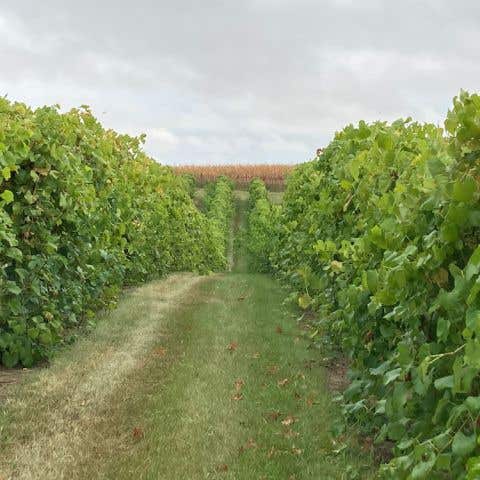
And, why not? Revolutionary movements take hold where they are needed most. When, one-by-one, individuals of a larger group acknowledge the elephant in the room and quietly seek solutions, in the interest of their own survival.
Farmers are not clueless to their situation, and in 1985 a collective from diverse camps of agricultural management came together and created Practical Farmers of Iowa; The common ground? An understanding that nature must be the role model, and changes must be made to insure sustainability of what they do.
The ensuing decades have proven the complexity of this task. It almost seems impossible up against a backdrop of ‘big Ag’ (literally in every direction you look) and the powerful, politically connected corporations built upon the chemicals and modified seeds of ‘conventional agriculture.’
Organization like Sustainable Iowa Land Trust (SILT) and Continuum Ag, both founded in 2015, are rising to this challenge to create resources and provide support.
I spoke with Randall Vos, Ph.D., Extension Fruit Crop Field Specialist at Iowa State University Extension Midwest Grape & Wine Industry Institute. He believes the perception that conventional farming favors yield over sustainability, and works against nature is a mischaracterization and a formula for failure. He points to an overall trend to reducing herbicide usage, and that cover crops are increasingly the norm, as is increasing soil organic matter. At the same time he acknowledged that pesticide drift was increasing due to recent changes to soybean spraying.
Mitchell Hora, founder and CEO of Continuum Ag, counters this perspective, acknowledging such trends exist but with ultra low adoption rates, and that conventional farmers simply focus on yield, mistaking cash flow for profitability.
The conversation is happening, and Regenerative Agriculture is an established topic in Iowa. The ripples of change will inevitably reach its viticulture community. In fact, Continuum Ag is currently in conversation with a consultant to revamp their agriculture TopSoil tool to assist with grape growing.
Phylloxera came from the central US, but so did the solution to the disaster, and the innovative work that evolved from the discovery of that solution can definitely be added to that midwest epicenter list. New hybrid varieties from this continued work are at the core of the regeneration of wine industry in the midwest.
From 1999 to present, Iowas’ wine industry has grown (more accurately, recovered) 400% - from 12 wineries and 30 acres of vines to 1200 acres and 101 wineries. This is no fluke.
The University of Iowa established its Midwest Grape and Wine Institute in 2006. It provides resources, conducts research, and connects those with the will to resources that help pave the way. ISU’s Leopold Center for Sustainable Agriculture funded a sustainable viticulture study from 2002-2005 for the reestablishment of Iowa’s grape industry. The study found that vineyards managed in a sustainable manner using best management practices allowed for excellent grapevine growth and development. The Leopold Center also held open forums during this time on viticulture. Iowans showed up, and questioned, and left with intentions.
One such person was Mark Newman, owner/operator of 99 Bottles Winery & Vineyard in north central Iowa. Mark attended a 2005 informational event. With a grandfather who immigrated from Alsace, France, he grew up with family winemaking being the norm. After a stint in the military, Mark worked at California winery for a time, but was eventually drawn back home to Iowa. The farm he returned to had a small vineyard with 70 year old vines which he tends with some organic practices, such as a brood of Rhode Island Red chickens that manage weeds and pests. But this is retained for it charm only, popular with visitors, and the fruit is not harvested for wine. Mark chose higher, less fertile ground for a vineyard, planted in 2007 exclusively with the hybrid varieties developed by University of Minnesota and Iowa State University. These varieties both thrive in the difficult midwest climate and produce pleasing aroma profiles, that well known ‘foxy’ Labrusca nature bred out. The ‘hill’ (it is a relative term in Iowa) has soil suitable for vines, glacial deposits of sand and gravel. It also has the advantage of consistent breezes which greatly reduces the fungal pressure (usually a primary threat in Iowa’s hot humid summers). His thoughtful site selection allows him to use fewer inputs.
On that same hill, Mark runs a ‘Camping in the Vineyard’ business that draws international visitors to his winery along with locals who are enthusiastic supporters of the tasting and music events. He also manages a small herd of free range cattle for beef. Diversification is the key for profitability for small wineries, and it also helps that Iowa has made it legal for them to not only sell DTC, but also self distribute (illegal in most US states under the 3 tier system).
Mark identifies the greatest threat to this dream he has made real as pesticide drift, which stunts vine production in an already short season, ‘If anything ever causes me to quit, it would be that.’ Drift is illegal, and subject to serious fines and monetary damages awards - if the source can be identified, but that’s rare.
Pesticide Drift is less of an issue for Kevin and Lisa Miller, who like Mark Newman, had the option of carefully thought out site selection for their Crimson Sunset Vineyards. Kevin’s family owns 600 acres of Iowa farmland in the central eastern side of the state. Their farm and vineyard, planted in 2005, is situated with a wide buffer between them and the surrounding soy and corn farms. While many growers are including organic and sometimes biodynamic principles in their farming, the Millers are the only Iowa winery to achieve certified organic status. After establishing the vineyard, they experimented with different varieties, selected 10 that do well on their 7.5 acre farm. Kevin states, ‘organic farming requires 3 times the work, but results in 5 times the quality.’
Kevin and Lisa are shifting and pivoting as life circumstances require: among other factors, a bout with Lyme disease, drought in 2012, and the arrival of the japanese beetle, led them to close the winery tasting room (difficult to run out of ones home with a new family to tend) in 2017. As much as they love the community that embraced them, the biggest challenge they face is labor labor shortage in their particular corner of the state; Organic farming requires substantially more labor, as does running a tasting room and event venue. They have shifted their focus to hard cider, which they self distribute, but are still farming the vineyard as well as maintaining the organic certification, with plans to expand the farm and return to wine production in the years to come. For the Millers, diversification and flexibility has been the key to success.
On the south eastern border Iowa shares with Illinois, which is the Mississippi River, you will find Wide River Winery on an east facing bluff. The views of the river are exceptional, as is the woman who planted the vines overlooking it. Dorothy O’Brien, an employment law attorney, had planted the vines and been making wine for family and friends since 1997. With the support of her sisters and her daughter, the winery was bonded in 2005. This female tour de force has grown their business to include two additional tasting rooms in towns along the the river. Dorothy has explored the potential of her farm with a range of cold hardy grape varieties, and growing methods. She still utilizes principles of organic and biodynamic learned along the way, but finds the battle against weeds in Iowas fertile soil to be the greatest challenge. With more than 20 years under her belt, there is nothing formulaic in her work ethic. She continues to explore, matching methods and varieties to her particular plot of land.

Like most small wineries, a great deal of the success of Wide Rivers Winery lies in offering the surrounding community a place to gather. Their website qualifies their intentions as ‘adding value to the area and sharing wine made from the goodness of the earth.’ If there is one overriding theme to Iowa’s small but determined collective of wine growers, I would say this sums it up.
I’ve had dark moments researching the topic of regeneration in relationship to my new home. That collective theme, of giving to the community and the joyful support these communities give back, is the greatest strength balancing the seemingly unsurmountable threats to this nascent industry. If the individuals of these communities can translate their appreciation for the value the winery in their backyard adds to their lives, to their priorities when they vote at the polls, perhaps there is hope. As Dr. Randall Voss reminded me, consumer demand drives production decisions. Reinvention might best describe what brought immigrants to the midwest in the first place, a new start, tabula rasa - but now there is no where to go. Regeneration is what sets humans apart form other animals - recognizing when something isn’t working - reframing - reinventing - revisioning. Regeneration is not leaving a mess behind and starting fresh. It is utilizing all our intelligence and creativity to clean up after ourselves.
All photos are the author's own.
















