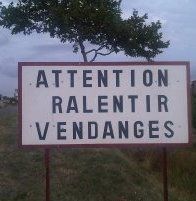
People often ask me whether I'd like to make wine myself. No thank you. Not only would there be the potential conflicts of interest, I'm afraid that the passion for gardening that is supposed to infect so many Englishwomen of a certain age has completely passed me by.
I grew up in a house with a large garden maintained diligently by my parents, who consequently seemed to me to spend a quite unwarranted amount of time hoeing, mowing, sowing, pruning, picking and weeding. Throughout my childhood, I saw gardening and plants as the enemy, competitors for my parents' attention, and I suspect this is a factor in why I now have no interest in growing vines.
Another major reason is that I am a control freak, and control freakism sits uneasily with being in thrall to nature as all farmers, including vignerons, have to be. The idea that an entire year's work could be negated by a hailstorm or ill-timed frost is far from attractive. Weather is the one uncontrollable variable in wine production. It is what keeps wine producers awake at night – and what provides us wine writers with much of our material. If every vintage were the same, we would have little to report.
Wine is one of the very few things we buy that is clearly labelled with its year of production, and is also one of the commodities most obviously affected by meteorological minutiae. If the grapes experience too much sun or too little water, or if a grower is panicked into picking early by threatened rains or frost, we can taste its very precise effect in the resulting wine.
Northern hemisphere wine has, so far, generally benefitted from global warming which, while blighting some of Australia's warmer wine districts, seems to have conferred useful heat and sunshine on the classic European wine regions where traditionally grapes would only just reach full ripeness. But the 2011 growing season just drawing to a close has been very different, a complete climatological rollercoaster in both hemispheres and on both sides of the Atlantic. Piero Lanza of Poggerino in Chianti calls it 'one of the strangest in the last 25 years.' Go, stop, go and a heck of a lot of work vaguely sums it up.
Arguably, after the relatively easy vintages of 2009 and 2010, the French were due a year that is already being called 'complicated', 'challenging', (mathematically incorrectly) 'average' and, with superbly inventive hyperbole from the St-Émilion growers organisation, 'the master craftsmen's vintage'.
In the first half of the year it seemed as though there'd been a transatlantic mix-up. The Californians were desperate for summer, or even spring, to arrive. Wine producers in northern California have never known such a succession of cool, wet days and some of them are yet to start picking any grapes at all, even though towards the end of the season there have at last been a few heat spikes. (But vines prefer slow, gentle warmth and can stop the ripening process altogether if temperatures suddenly soar.)
Meanwhile in Europe, after a long, cold winter, spring was quite exceptionally warm and dry and kidded the vines that summer had arrived. Vines started to suffer from the drought with leaves even turning yellow and shrivelling. Grape skins usually soften and start to change colour in August but in 2011 some of them started this process called veraison as early as the end of June. At this point Europe's vine growers cancelled their August holiday plans and started to prepare for an exceptionally early harvest.
Then, suddenly, things went into reverse. A miserable July and August arrived, which Brits and other northern Europeans still remember grimly – while many southern European growers experienced an unusually hot summer (see, for example, Italy authorises must enrichment – in 2011!). Cool, damp weather in the north put a stop to the ripening process and in many cases ushered in ideal circumstances for the spread of the fungal diseases to which the vine, particularly Pinot Noir, is so prone. Several Burgundian producers were panicked by the threat of early September storms and rot into picking at the end of August, even though sugar levels in the grapes were relatively low. Others risked hanging on. A hailstorm in St-Estèphe forced early picking on certain properties in Bordeaux too.
Those who were able to wait to benefit from the return of high temperatures towards the end of September, either because they grow later-ripening grape varieties or because of their cooler site, have been rewarded – although 2011 was generally marked by very uneven ripening and grape sorting was vital. Virtually all European vine growers have had to sort the grapes coming into their winery with much more care than usual. As the wine business is increasingly dependent on casual labour that cannot necessarily be relied upon to eliminate every single damaged or unripe grape, many better-funded enterprises, especially in Bordeaux, have invested in optical sorting equipment designed to do automatically what the most meticulously devoted, quality-conscious winemaker would by hand. Germany is traditionally one of the last countries to complete its grape harvest and may be rewarded by the recent Indian summer after some truly terrible storms (see our more detailed report on Monday). Producers of sweet white bordeaux have not found the growing season easy but have been rewarded by the early development of the vines and combinations of heat and humidity that have favoured the development of their crucial and benign noble rot (as opposed to the ignoble grey rot so inimical to red wine production).
If Europe's vintners have found 2011 much more trying than any other recent vintage, six months earlier, while picking their 2011s, the Australians experienced the vintage from hell. Harvest time in the supposedly sunny wine state of South Australia was quite exceptionally sodden. Winemakers have had to work extremely hard in some areas to fashion drinkable wine out of bloated, rotten grapes. The vintage in New Zealand was bloated too, thanks to frenzied recent planting of vines there, fuelled by a belief that the world is in love with New Zealand Sauvignon Blanc. Argentine growers were also afflicted by rain at harvest time in 2011, as well as the usual hail, and unusually late frost in November last year.
Presumably sales of the agrochemical sprays generally used to ward off rot and mildew were at record levels in 2011. I wondered how Bordeaux's biodynamic champion, Alfred Tesseron of Château Pontet Canet in Pauillac fared in such a trying, humid year? He admitted, 'Yes, this year our sorting tables are really useful,' but added, 'rot sorting is a price to pay to harvest ripe when rain comes close to the harvest as was the case this year. But while unripe grapes make a wine that will keep this lack of maturity during decades, a sorted berry is forgotten as soon as it has left the table…'
The 2011 vintage will not be prolific, and will truly have sorted out who exactly are those master craftsmen.