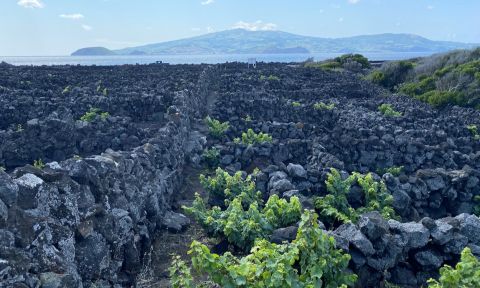
Azores Many a mid-Atlantic island has a long winegrowing history; sailors were a thirsty lot. The wines of Madeira enjoyed enormous popularity in the 18th century. Much more recently, the wines of the Spanish Canary Islands have been a staple of trend-conscious somms’ wine lists with those of Suertes del Marqués being some of the most rewarding and easiest to find. But now we can take advantage of the uniquely sleek, saline, whites of the Portuguese Azores hundreds of miles west of Madeira. The Azores, Açores in Portuguese, represent that rarity, an entirely new source of wine. Well, not that new. Azores wine was extremely popular in North America in the 18th century, before powdery mildew and then phylloxera almost wiped out the islands’ vineyards – just as they did on Madeira. The main producer, the Azores Wine Company based on Pico, the chief wine-growing island, was formed as recently as 2014, taking advantage of government and EU subsidies to recuperate abandoned vineyards and build a stylish winery and small hotel. (Total plantings had shrunk to 120 ha/297 by 2004.) These are the craziest-looking vineyards in the world, tiny plots of vines trained low and sheltered from the wind by a honeycomb of dry-stone walls made from the local volcanic rocks. See our five articles about the Azores.
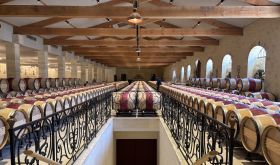
Brett or Brettanomyces, a sort of spoilage yeast, was first identified more than a century ago and has probably been around for as long as wine has. But what makes it a 21st-century phenomenon is the sharp age divide between those who recognise it and those who can’t. Younger or more recent wine students are taught to identify brett’s odours, variously described as Band-Aid, sweaty saddle or decidedly animal, and to see them as a wine fault (Australian tasters are particularly unforgiving about a whiff of brett) whereas in my experience most older tasters either tolerate or ignore it. Some wine professionals, even wine producers, actually like and encourage a low level of brett. Bo Barrett, 72, of Chateau Montelena in Napa Valley, for example, freely admits to being one of the few American wineries who still ‘use a little brett – with great care because it spreads like wildfire. But we think it really does add a little layer of complexity.’ (It’s more common in reds than whites.) Oak barrels provide a perfect hangout for this controversial yeast (regarded as an integral part of some Belgian beers). Once a cellar is seriously infected, a complete replacement of cooperage is generally required.
Celebrity wine is truly a 21st-century phenomenon. Wine traditionalists tend to be snooty about Kylie’s rosé, Graham Norton’s New Zealand Sauvignon Blanc and Snoop Dogg’s California project with 19 Crimes but, with the total number of wine consumers contracting, I don’t think we can afford to be. If it requires the sanction of a famous name to encourage someone to try wine for the first time, that’s fine by me. The wines I personally admire are more likely to be those made by celebrities who don’t use their names mercilessly to sell the wine. I’ve consistently been impressed by Porte Noire range of champagnes from Idris Elba (pictured below) and have much enjoyed Sam Neill’s Pinot Noirs from his Two Paddocks estate in Central Otago. I’ve yet to taste Pink’s Two Wolves wines from Santa Barbara County but many years ago I was impressed to find her sitting meekly in the audience at a tasting. She also took the trouble to study winemaking at the University of California at Davis. I hear, incidentally, that even Queen are getting in on the (wine) act.

Diam, launched in 2003, is the leading brand of so-called technical corks, a sister company to Seguin Moreau cooperage. Tiny particles of natural cork are treated to eliminate the risk of cork taint, in Diam’s case by their much-vaunted ‘super-critical’ carbon dioxide, and then bound together into a cork shape. (But see this recent article about all forms of halo taint.) Diam and their competitors offer different levels of oxygen ingress. The most expensive still-wine stopper Diam 30, for instance, allows in very little oxygen so is recommended for wines designed for a long life, whereas Diam 2, 3 and 5 are more suitable for earlier-maturing wines. Diam 10 is increasingly popular. When I visited their plant in Céret, Roussillon, in 2017, I had no idea how important Diam would become. Today two billion of the approximately 30 billion bottles of wine stoppered each year boast a Diam.
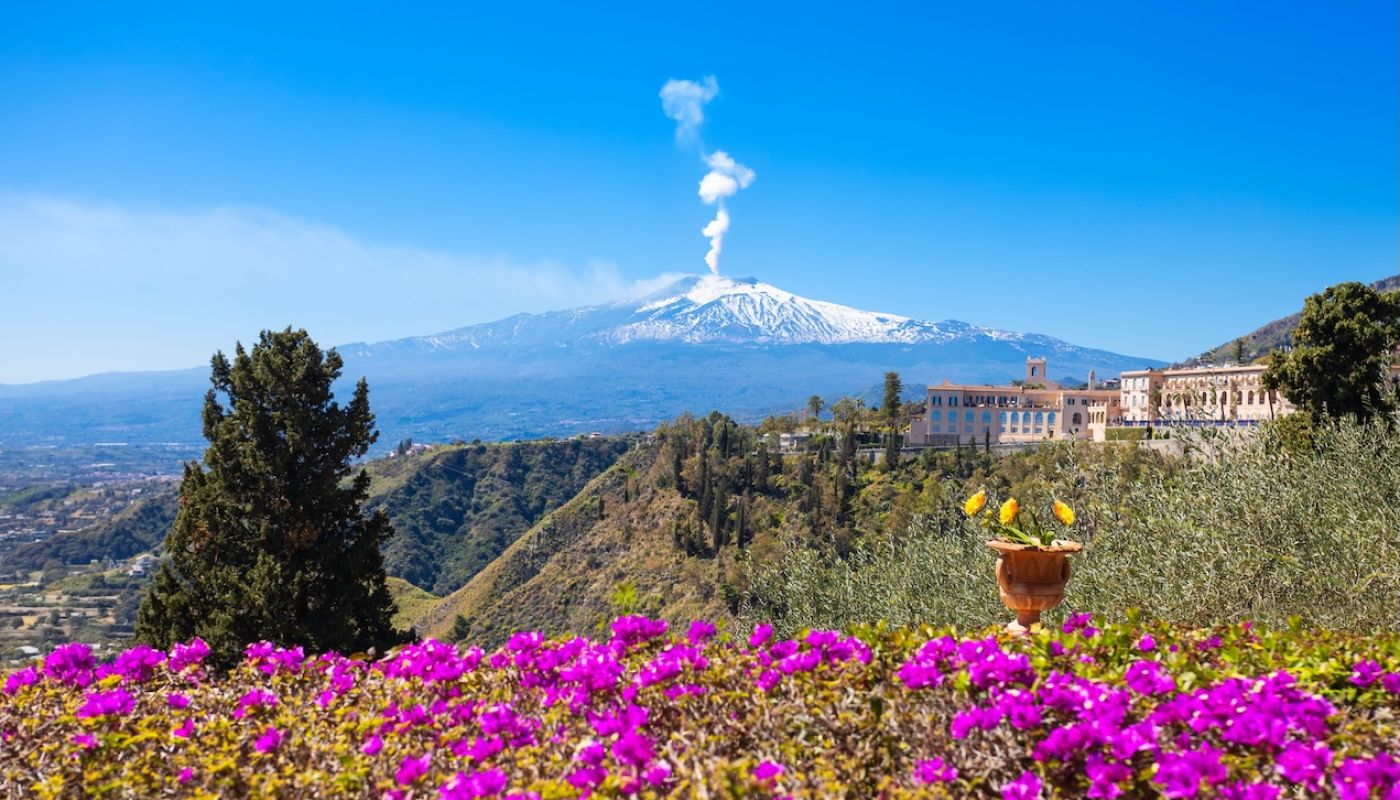
Etna The first Etna wine I tasted was a 2005. By 2008 I was able to write in Etna – the Burgundy of the Mediterranean, soon after waxing lyrical about the wines of the upper Agly Valley in Roussillon (a region which still hasn’t really settled on a name, possibly thereby hampering its recognition and progression), ‘Last month in Sicily I had the thrill of witnessing the launch of another new-old wine region, on the slopes of the decidedly active volcano Mount Etna.’ The late Andrea Franchetti of Tenuta di Trinoro in southern Tuscany was not the first outsider to recognise the special qualities of the nervy, haunting, pale reds based on the indigenous Nerello Mascalese and Nerello Cappuccio vines grown in ancient lava flows on the flanks of the volcano. The first was Belgian Frank Cornelissen, quickly followed by Italo-American Marc de Grazia of Terre Nere. But Franchetti was the first to organise an event that gathered together local producers to showcase just how special the wines were. The Contrade dell’Etna event is now a much bigger annual fixture – not least because so many high-profile producers from the mainland, and the rest of the island, have flocked to invest there. At the first event in 2008, which I attended, 40 producers showed their wines. Last year there were 100. There is now interest in Etna whites, too. The local Carricante grape, pioneered by Benanti, can make exciting wines well worth ageing. This truly is a unique wine region.
Films In the last century, wine drinking was still too peripheral an activity to be a central theme in mainstream films but ever since Sideways promoted Pinot Noir as infinitely superior to Merlot in 2004, wine has featured in a plethora of them. A Good Year in 2006, loosely based on Peter Mayle’s book of the same name, was surely one of the weaker films by director Ridley Scott (Alien, Blade Runner, Thelma & Louise, Gladiator et al) but it eventually inspired him to produce wine himself on his Mas des Infermières estate in the Luberon. Bottleshock in 2008 was a very loose reconstruction of the Judgment of Paris California v France blind tasting in 1976, centred on the late organiser Steven Spurrier and the Barrett family of Chateau Montelena (see above). But perhaps one of the most popular wine-themed dramas is Drops of God, based on the Japanese manga of the same name and now in its second series on Apple TV.
But wine has lent itself more easily to documentaries than to dramas. Launched soon after Sideways, Mondovino was a tendentious diatribe against the globalisation of wine. More recently, an independent Australian company was responsible for both Red Obsession about the Chinese love affair with wine and Blind Ambition that followed a team of untrained Zimbabwean sommeliers (seen below) in an international blind-tasting competition. Somms have proved a rich seam for film producers. The first Somm series followed four would-be Master Sommeliers on their gruelling blind-tasting path (inspiring the Netflix drama Uncorked on a similar theme) and has been followed by Somm 2 and Somm 3. Sour Grapes told the story of jailed wine counterfeiter Rudy Kurniawan, now apparently exhibiting his skills in Singapore. Darren Star of Sex and the City and Emily in Paris fame is just one of the big names behind a forthcoming Netflix romantic comedy set in Napa Valley to be called (once more) Uncorked. See our 18 articles tagged films.

Glou-glou French term for wines high in easy-to-appreciate fruit and low in tannin, typically red, often relatively high in acidity and sometimes natural. The nearest English translation would be glug glug. The term emerged in relation to wine in the early years of this century to signal wines that were a reaction to the potent, oaky, high-octane reds fashionable towards the end of the last century. Glou-glou wines are designed to be drunk young and with relish rather than obsessed about by wine buyers concerned with prices and scores and are therefore quintessentially wines for the 21st century in which freshness and refreshment are virtues. There are wine bars called Glou Glou in Shrewsbury in the west of England, in Amsterdam and in Madison, Wisconsin.
Hybrids Until recently only vine varieties that were fully paid-up members of the European vine species Vitis vinifera were regarded as respectable for wine production. Some American varieties such as Concord were accepted as suitable for grape juice and jelly. When in the late 19th century mildew then phylloxera imported from the United States threatened to wipe out European vines altogether there was frantic hybridising of American varieties with European ones in the hope of producing a variety which had the resistance to phylloxera and mildew that was presumed an attribute of American vines. In the 1950s as many as 30% of French grapevines were hybrids but their produce, typically copious but very unlike vinifera wine, was generally scorned.
Today, however, vine-growers can choose from an array of hybrids specifically bred to produce wines that taste reassuringly like vinifera but can boast such qualities as early ripening (for cool climates), resistance to cold winters (incorporating genes from the Asian vine species Vitis amurensis) and needing no or very little spraying. There is a particularly tight-knit hybrid wine-producing community in the US. Those still fearful of the h-word sometimes call them interspecific crosses. See our 18 articles tagged hybrid vines.
Influencers Wine writers are on the wane while online influencers are ever more powerful – or at least noticed. I’m probably not their target market and am woefully ignorant of what they say, but I realise how difficult it would be today to be starting out as a wine writer without an online presence. Those listed below have been recommended to me.
Next week – J–R
Suggestions
Azores
António Maçanita, O Original Verdelho 2024 Azores 12.5%
£41 Amathus
Brett
Chateau Montelena, Estate Cabernet Sauvignon 2021 Calistoga 14%
£785 for six bottles in bond Bancroft
Celebrity wine
Porte Noire, La Petite Porte Blanc de Blancs Grand Cru NV Champagne 12%
£45.50 Amathus, £59.80 Porte Noire King’s Cross
Diam
Check the number after the ‘Diam’ on the cork to see how long the producer expects the wine to last.
Etna
Mecori, Duo 2021 Etna Rosso 14%
£268.95 for six The Fine Wine Co
Films
Blind Ambition
Glou-glou
Morandé, One to One Reserva País 2023 Maule 13.5%
£10.50 Majestic
Gérard Bertrand, Le Chouchou 2024 Vin de France 11%
£13 Waitrose
Arquils, Natural Syrah/Cinsault/Mourvèdre 2024 Sierra Foothills 13%
$50 producer’s website (but drink this natural wine soon after opening)
Hybrids
Breaky Bottom, Cuvée Koizumi Yakumo Seyval Blanc 2010 English Sparkling 12%
£80 Vagabond
Influencers
Vince Anter, Libby Brodie, Cokie, Tom Gilbey, André Hueston Mack, Amelia Singer
For tasting notes, scores and suggested drinking dates of the wines above, see our tasting notes database. For international stockists, see Wine-Searcher.com.
Etna image by saiko3p via Shutterstock. Image of Idris Elba is courtesy of Porte Noire.