It’s an ill wind that blows nobody any good. The devastating wildfires of 2020 that covered Napa Valley in a pall of smoke tainted many (not all) of that season’s wines and left brand owners horribly short of wine to sell. Many of them looked south to fill the gap and the wines of Santa Barbara County were suddenly in demand. They are typically lighter, fresher, and often less expensive, than those of Sonoma and, especially, Napa Valley – so are very much in the Zeitgeist.
These two northern California wine regions attract a disproportionate amount of attention in a state that constitutes the fourth most important producer in the wine world, where, today, a cool climate is associated with refined wines. A cursory look at a map – such as this overview of California in The World Atlas of Wine – suggests that the land north of San Francisco would have a much cooler climate than Santa Barbara, 300 miles south and not far north of Los Angeles, but that would be misleading.
Because, unusually, there is no coastal range separating it from the ocean to the west, the western extreme of Santa Barbara County’s wine country is cooler than almost anywhere in California other than the wilds of the Sonoma Coast, which can, admittedly, make some very fine Chardonnay and Pinot Noir, but you might break the axle of your car reaching the isolated vineyards there. The vineyards of Santa Barbara County, on the other hand, are all within easy each of the balmy university city of Santa Barbara and its neighbour Montecito.
The westernmost appellation of Santa Barbara County, Sta Rita Hills, is routinely cooled by incursions from the Pacific Ocean, which here is not what benignly bathes the beaches of Hawaii and Tahiti, but an ice bath. Every morning Sta Rita Hills is cold and foggy. The ‘marine layer’, as it is called locally (fog to outsiders), lasts until lunch time. In the afternoon the sun comes out, but is reliably accompanied by a stiff ocean breeze that slows ripening. Then by 5 pm the fog starts to roll in again. Latitude is no guide to the climate of Santa Barbara County.
When well-known wine producer Étienne de Montille wanted to expand outside Burgundy, he checked out the entire west coast of the US and, after investigating Oregon and Sonoma Coast, finally plumped for Sta Rita Hills for his Racines label of sophisticated Pinot Noirs and Chardonnays.
It should be said, however, that Sta Rita Hills, in its westernmost portion, is by no means the full story of southern Santa Barbara County wine. Average temperatures rise by a degree Fahrenheit for every mile travelled inland. So within the 35-mile west-to-east span of vineyards one travels from Pinot Noir and Chardonnay country to the Happy Canyon appellation that is warm enough to produce late-ripening Cabernet Sauvignon.
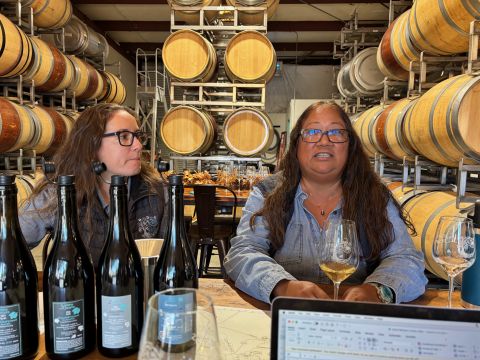
Tara Gomez wa the first native American Indian to make wine for her own tribe, the Santa Ynez Band of Chumash Indians, until they pulled out of wine production (the returns from running casinos are so much swifter). With her wife Mireia Taribó, she is one half of the team making Camins 2 Dreams wines from, like most producers here, bought-in grapes. She told me during my few days there recently that she felt like ‘a kid in a candy store’ because the climate and possible grape varieties are so varied in Santa Barbara County.
The vine may be happy here but vintners have their travails in an unusually restrictive environment. Wine producers are hit with a uniquely low ethanol-emissions threshold which, once exceeded, subjects them to fees and penalties. This has historically encouraged bigger producers to do their vinifying out of the county. And there are such strict requirements on the acres of vines a winery must plant to even exist, that wineries without attached vineyards tend to cluster in unromantic warehouses in industrial parks within city limits, where the County restrictions do not apply.

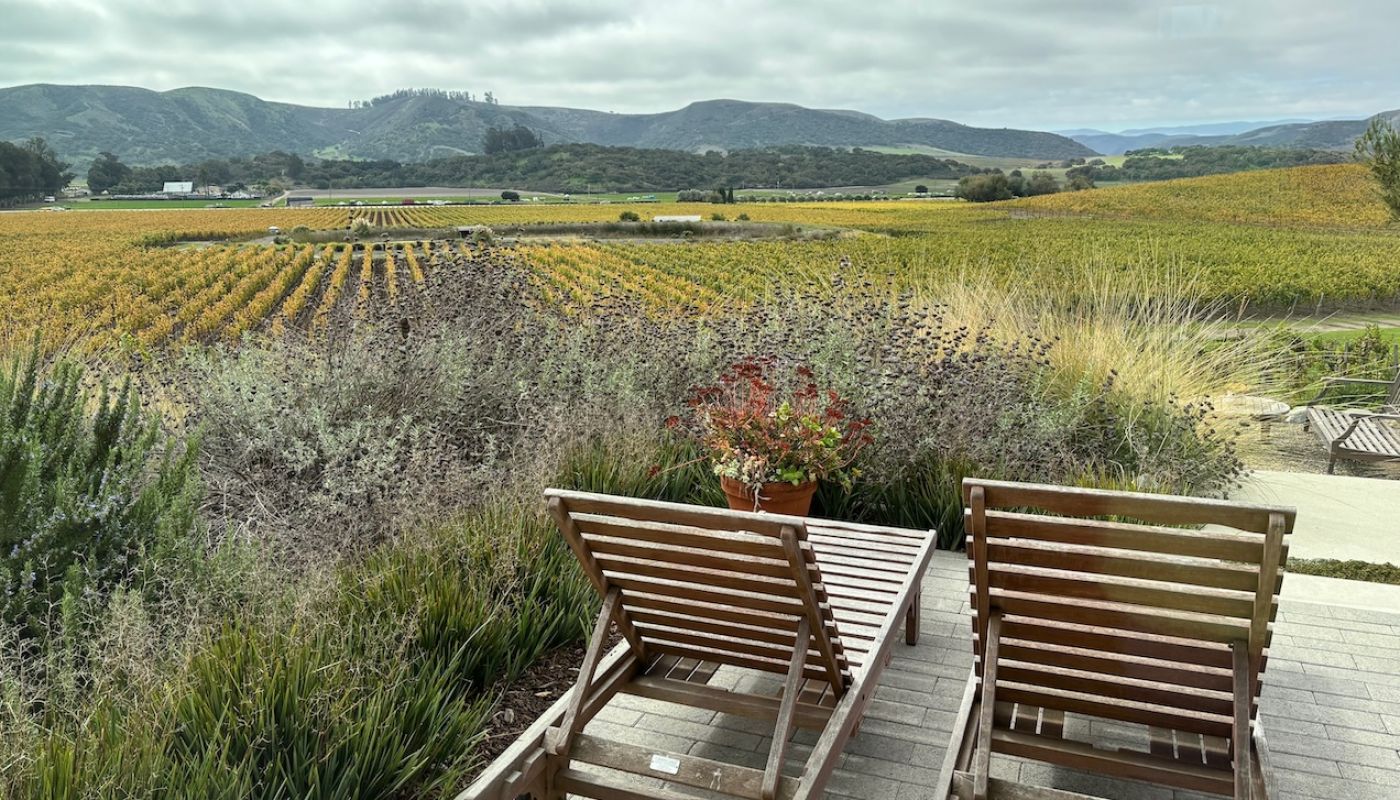
The first winery I visited this time was the estimable Story of Soil on the outskirts of Buellton (whose rather well-worn sign boasts it is the world’s pea-soup capital) in one such warehouse. Today Jessica Gasca’s workmanlike winery is at the end of a long row of workshops and, fortunately, faces Santa Barbara’s rolling hillsides, as shown above. But her previous site was apparently opposite a smelly car repair shop.
The county’s greatest concentration of wineries is a cluster of windowless sheds on the outskirts of Lompoc at the Pacific end of the Sta Rta Hills where the whoosh of space-rocket launches from the nearby Vandenberg airbase punctuate winemaking.

Tasting rooms, vital for sales, are also corralled into urban environments. The pretty town of Los Olivos (population roughly 1,000), for example, is home to about 50 tasting rooms. Santa Barbara itself boasts a cluster of tasting rooms and restaurants in its so-called Funk Zone. Wine is omnipresent here at least. The sign below is in the zone’s most popular bakery.

The county stretches as far north as Au Bon Climat winery established in Santa Maria Valley by the late Jim Clendenen, who made friends throughout the wine world, and successfully refused to bend to the fashion for big, bold wines. His children Isabelle and Knox still carry the torch but if, during my short stay in Santa Barbara, I had a penny for every time his name was mentioned as patron saint of the county’s wine culture, I would have done well.
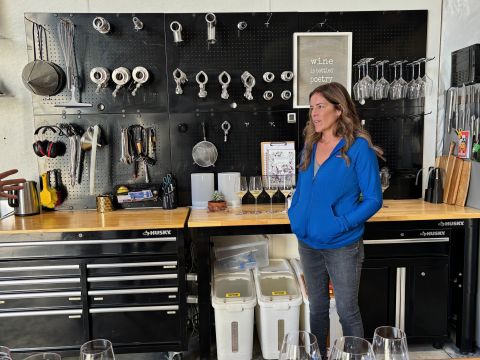
According to Gasca, below, who makes the exceptionally pure Story of Soil wines and is presumably comparing Santa Barbara County to the current state and prices of Napa Valley, ‘We’re farmers and cowboys here – we don’t have millionaires.’ That may be her treasured idea of the original local ethos – her uncle worked at Au Bon Climat and she perpetuates that winery’s custom of a proper sit-down lunch for all winery workers – but Stan Kronke owns The Hilt, Jonata and the particularly desirable Bentrock vineyard and there is now serious money behind the Sandhi and Domaine de la Côte brands as well as Peake Ranch, Alma Rosa and Presqu’ile wineries – a compliment, presumably, to the potential of this wine region.
Not that Santa Barbara County is immune to the serious problems currently besetting wine production in the world’s largest wine market. Bien Nacido vineyard in Santa Maria Valley, for instance, is currently a fraction of its original extent. Vines have been pulled out with vigour by the Miller family who own it – perhaps because of vine disease, perhaps because of market shrinkage, probably because of both.
Santa Barbara wines look attractive when compared with the sky-high prices of Napa Valley wines, although in this region of relatively small producers, the wines are several notches above grocery bottom shelf. As Gavin Chanin, who makes admirable Pinot and Chardonnay, puts it, ‘Our wines are school-night wines for serious burgundy collectors.’
I also found especially fine Syrah in northern-Rhône style that the locals find frustratingly difficult to sell.
But there is much more here than the classic international grape varieties. Picpoul is surprisingly fashionable, as are Gamay, Grenache, Grüner Veltliner, Riesling and a range of white Rhône varieties.
Unlike several other California wine regions which have tried and failed, Santa Barbara County has recently managed to achieve Wine Improvement District status whereby 1% of all sales of bottled wine will go towards a regional marketing fund. So perhaps we will hear more about this promising wine region with its relative bargains in future. According to Chanin, Santa Barbara County with its direct exposure to the Pacific is more protected than most wine regions from climate change, and is ‘entering its heyday’.
Some impressive Santa Barbara County wine producers
With standout wines, and UK retailer or importer where relevant, although importers won’t necessarily carry the full range.
A Tribute to Grace
Grenache
Lea & Sandeman
Au Bon Climat
Pinot Noir and Chardonnay
Berry Bros & Rudd
Âmevive
Grenache, red and white
Indigo
Camins 2 Dreams
Grüner Veltliner and Hines Mail Road Syrah
The Wine Society
Chanin
Pinot Noir and Chardonnay
Flint Wines
Clendenen Family
Nebbiolo
Wanderlust Wines
Domaine de la Côte
Pinot Noir
Flint Wines
Donnachadh
Pinot Noir
Majestic and Roberson
Folded Hills
Grace White Blend, Grenache, Syrah
Holus Bolus
Syrah
Wanderlust Wines
Racines
Pinot Noir and Chardonnay
Liberty Wines
Story of Soil
Anything red, and Riesling
Tatomer
Riesling
Roberson
Joey Tensley
Syrah
Berry Bros & Rudd
The Joy Fantastic
Chardonnay and Pinot Noir
Wanderlust Wines
Tyler
Blanc de Noirs Extra Brut, Syrah, Pinot Noir and Chardonnay
Flint Wines
Whitcraft
Pinot Noir and Chardonnay
For specific tasting notes, scores and suggested drinking dates, see The wines of Santa Barbara County and our tasting notes database. For international stockists, see Wine-Searcher.com.
Back to basics
Wine regions south of San Francisco |
|
Immediately south of the Bay Area is Santa Cruz Mountains, between Silicon Valley and the Pacific, where aspects and elevations vary so much, well above the fog line, that top-quality producers Ridge (for Cabernet) and Rhys (for, very different, Pinot Noir) can just about see each other. Across the Bay is the equally historic wine region of Livermore Valley, dominated by the Wente family, whose name is perpetuated by California’s most famous clone of Chardonnay. Like several other less important wine regions, Santa Clara Valley is fighting a losing battle against tech sprawl. Monterey is home to more row crops (strawberries and veg) than vines but there are still hundreds of acres of wind-cooled vineyard on the valley floor, above which the Santa Lucia Highlands have proved ideal for Burgundy grapes. There are isolated spots in the mountains of San Benito inland for producers as famous as Calera and Chalone. To the south is fashionable, tourist-friendly Paso Robles with its east–west contrast and reputation for sturdy reds. Even further south is San Luis Obispo (SLO), running out of water but still able to make some fine Pinot and Chardonnay, as is, across the Santa Barbara County line, Santa Maria Valley. The other notable appellations of Santa Barbara County are, west to east, Sta Rita Hills, Ballard Canyon, Los Olivos District and Happy Canyon of Santa Barbara, with Santa Ynez Valley encompassing them all. |