On 27 January 2021 the German parliament passed the tenth amendment of the German Wine Law of 1971. There are some relevant changes but as always there’s a long period of grace for even the most reluctant of slowcoaches to mend their ways. The new regulations become binding only with the 2026 vintage. Until then, Qualitätsweine (quality wines) and Qualitätsweine mit Prädikat (quality wines with distinction) may still be labelled and marketed as before.
The most important point of the new legislation is that, with regard to what constitutes quality, the emphasis has been shifted from the sugar level of grapes measured in degrees Oechsle (‘the sweeter the grapes the better the wine’) to the provenance of the wine and how narrowly it is defined. The concept is based on the principle of terroir, ie that the character of a wine is determined by the soil, exposure, gradient and mesoclimate of an individual site. This principle of provenance will embrace all categories from Landwein to Qualitätswein and from specified districts to village wines right up to individual sites. The existing Prädikat designations from Kabinett to Trockenbeerenauslese remain unchanged.
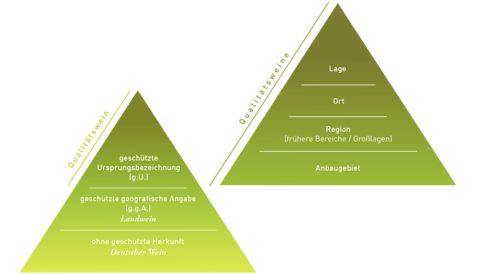
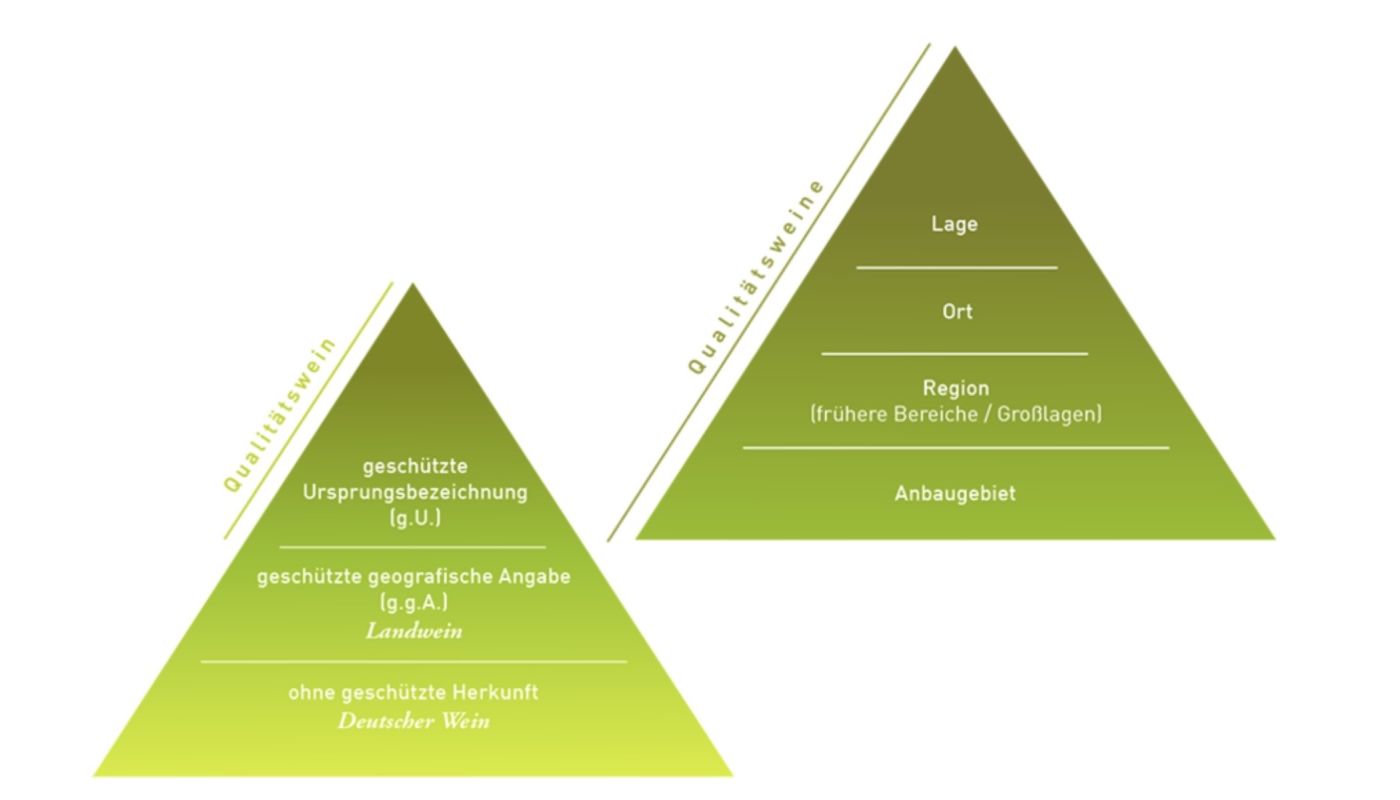
The basic one (on the left) is divided into three tiers with Deutscher Wein as the most basic designation without any further indication of provenance. The next tier up comprises wines with a protected designation of geographical origin (Landwein, equivalent to the EU’s PGI category). The top tier consists of wines with a status of protected specific origin (equivalent to the PDO).
The second pyramid (on the right) applies to the top tier of the first, basic pyramid. The bottom tier comprises wines with no further indication of origin than their region (for example Qualitätswein Pfalz). The next tier up consists of wines with a more narrowly defined origin or district or area. Perhaps the most significant change has been implemented in this section, as it abolished the use of the ill-conceived designation of Grosslagen. There will be no more wines such as Piesporter Michelsberg, whose name implied provenance from a particular site within a single village, whereas in reality it could be a blend of wines from up to 20 villages, more often than not without a drop coming from the famous village named on the label. To continue with our example of Piesporter Michelsberg, a wine coming from the same conglomerate of communes will have to be designated as Bereich Michelsberg, leaving out the suggestion that the contents of the bottle may come from Piesport (although with a bit of luck, they may contain one or two drops from the Mosel River banks at Piesport). The third tier of the pyramid on the right applies to wines which come from vineyards within the boundaries of the commune or place (Ort) named on the label. The top tier refers to wines from named individual sites (Lagen). Within this category it will now also be allowed to indicate a particular specific parcel within an individual site, so long as these have been entered into the vineyard register, meaning that made-up fantasy names are excluded.
With regard to this top tier of individual sites (Einzellagen) they will attach the following distinctions to indicate their style: Grosses Gewächs (dry), Erstes Gewächs (dry), Kabinett, Spätlese, Auslese, Beerenauslese, Eiswein, Trockenbeerenauslese.
More detail on Grosse Gewächse and Erste Gewächse
Only white and red wines produced from a single variety identified as traditional and characteristic of the particular region qualify for the designation Grosses Gewächs. The crop must be harvested manually and the yield should not exceed 50 hl/ha. The must should have a natural potential alcohol of at least 12%, come from a specified vintage and originate from a particular site or even smaller geographical unit. The wine has to be vinified dry (trocken, which means a maximum of 9 g/l residual sugar) and undergo sensory evaluation by an official tasting committee. Grosse Gewächse may not be released before 1 September of the year following the vintage if white and 1 June of the second year after the vintage if red.
The designation Erstes Gewächs applies to white or red wines produced from a single variety identified as traditional and characteristic of the particular region. The crop must be specially selected and not exceed 60 hl/ha on flat land, 70 hl/ha on steep slopes. The must has to have a natural potential alcohol of at least 11%, come from a specified vintage and originate from a site or smaller geographical unit. The wine has to be vinified trocken and undergo a sensory evaluation by an official tasting committee. Erste Gewächse may not be released before 1 March of the year following the vintage.
Which grapes are deemed traditional for and characteristic of the regional profile will be determined by regional committees comprising members of the trade and regional control boards. As they haven’t got down to that job yet, you could find yourself with a 2021 Wehlener Sonnenuhr Müller-Thurgau Grosses Gewächs next year if you are unlucky. Eventually, of course, Müller-Thurgau will be struck off the GG register, Riesling will be on it, some others like Weisser Burgunder are still under discussion.
I wish it would end here for the category of dry wines, but it doesn’t: growers will also be permitted to label their dry wines Kabinett trocken, Spätlese trocken and Auslese trocken. I have this on the authority of a wine-board insider whose phone number ends with 007, but whose identity will only be revealed at a later date, when I have had the time to study a 24-page document he has written. What it boils down to is that nobody should get hurt by the new directive and as old habits die hard they may continue to be used. If you do not want to teach your Auslese trocken customer new tricks, you can keep that designation going and not use the term Grosses Gewächs. The main thing is you do not lose the will to live!
Organisations like the VDP or Bernkasteler Ring, which have already used the terms Grosses Gewächs or Erstes Gewächs in the past for wines from members of their own associations, may continue to do so as long as they meet the requirements of the new federal directive.
In addition to the site of origin, wines from individual vineyards or parcels of such must also carry the name of the commune or part of commune they come from. This means that the current practice of the VDP to show only the name of the site on the label of their Grosse Gewächse, but not the village or commune of origin, is likely to be scrapped. Morstein will have to revert to Westhofener Morstein (the naming convention we adopt in our database as it's so much more informative than the vineyard name alone).
Once upon a time I studied law. Having read the text of the new wine law I do not regret having gone for wine instead.