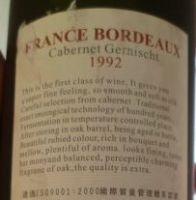
Much to the discomfort of wine vendors in China, during my travels around the country I amassed over 1,000 pictures. At every opportunity I photographed label and capsule details along with the moulded inscriptions on bottle bases, although at this stage I had little knowledge of how to interpret all the pimples, logos and numbers. [See, for example, the intriguing detail from the back label of a 1992 Cabernet Gernischt apparently from Bordeaux shown above left and described: 'This is the first class of wine...' It also carries fake Australian safety logos lower down the fake French label – JR]
For my part it was a huge culture shock to face shelves of wine and try to distinguish the original from the counterfeit in such a vast international range. Examining each bottle for every detail eventually caused suspicious security staff to descend on me waving their arms like windmills. But I'd been drawn to China by my Hong Kong wine fair experience and all indications pointed towards the problems being enormous. In one whole month nothing signalled to the contrary. However, I could not yet estimate the size of the problem, nor could I always be confident of determining original from counterfeit.
Furthermore, I was no closer to identifying the finer tricks of the trade. But then came a game changer. In his impatience to do business, a wine vendor in the southern city of Shenzhen foolishly gave me copies of labels and shipping documents to prove his wines' French authenticity. His explanations did not altogether add up, so some months later I was to visit his négociant supplier in Bayonne, south-west France, whose address – not name – was on the documents. This supplier confirmed my suspicions, which gave me the first lead as to the sophistication of counterfeiters.
Looking back I now know that over 70% of the wine I saw in China was not original, meaning what was written on the labels was not the same as the liquid in the bottles. The problems ranged from incorrect origin claims, copying of others' barcodes, counterfeiting of brands, and even a chemically assembled wine that had never encountered a grape.
Another curiosity: Chinese counterfeiters were exclusively cheating their own people and other regional Asian markets, as opposed to exporting to places such as Europe and the USA. For most fakes such as fashion goods, car parts, domestic products and so on, China survives on exports to the west, but for this newly developing wine market, both the Chinese and regional markets provided more than sufficient business.
It was now time to leave China. My costs had been significant but at least I had a library of knowledge and pictures such as this apparently award-winning Pinot Noir that managed to be both a Grand Vin de Graves and a Vin de Pays de l'Hérault. My first port of call was professionals and journalists. I needed paying clients to continue the work which should culminate in the raiding and closing down of counterfeiters. I felt the media would provide the perfect platform to awaken industry to my findings.
Logically my first stop was Hong Kong, where I had meetings and talked through my experiences both at their wine fair and during my month in China. Polite interest was shown but all declined to write on the subject or raise any awareness. Back in Europe I did the same with similar results. One famous wine publication even stated that as China counterfeits everything, my news was, by definition, not news.
Not deterred, I visited the London International Wine Fair clasping pictures and back-up information. Someone would listen, surely. But I was met with shrugs, cynical comments and often roars of laughter. All seemed in a hurry to take advantage of what they believed to be booming sales in China, but had no time for my message that the market was riddled with counterfeits, of which their brand might be next, or perhaps was already.
Richard Halstead of Wine Intelligence had carried out an excellent study of wine sales and growth in China which predicted slower growth than had generally been supposed by optimistic wine exporters. But in reality even his predicted sales volumes were over-estimates because much of the data inadvertently included counterfeits.
While approaching wine professionals and the media, I also contacted organisations representing countries, regions and appellations as well as brand owners. The feedback was deafening by its silence – although one American region did reply telling me they were unaware of any counterfeits in China, despite my email with photographs to the contrary. A similar reaction came from the Niagara Icewine producers.
In Australia a wine grower accused the Australian Wine & Brandy Corporation of ignoring my identification of a counterfeit label of his wine. They bickered for months, members of parliament even entering the fray (see these parliamentary proceedings in Canberra), without achieving anything, the irony being that within 48 hours of my finding the Chinese counterfeiter, I could have closed them down. However the rogue company still operates today.
I was shouting warnings to the wine industry but everyone appeared to be quite content with their casual stroll towards the precipice. With wine developing so fast in China, now was the time for Chinese taste buds to be honed before counterfeits became the benchmark.
However, one wine professional saw things differently and in April 2010 I was asked to a meeting that happened to be at a tasting in London. She arrived bang on time and picked me out from 20 other unknown faces. Disarmed, I fumbled my computer open and scrolled through my bank of pictures giving her explanations. Her understanding was immediate. Stupidly, I recall my own astonishment matching hers as I recounted my month's work in China. A few phone calls were then placed and introductions made. After 15 minutes my time was up. I left being told to email information and keep in touch. No wasted words. No wasted time. Brief but to the point. I had just met Jancis Robinson.
By June 2010, Ms Robinson had run a string of coherent and informative articles on Purple Pages [see the guide to our series on Chinese fakery – JR]. A French wine authority had picked up the story and requested a meeting. At last someone might be listening.
I left home in France for the meeting and en route visited the Bayonne négociant whose name I had found via the address on the Shenzhen shipping document. We looked through their records, which should have been identical to my copies, but the Shenzhen company had clearly replaced the négociant's name with their own, while retaining the Bayonne address. We studied images of the bottles, labelled Languedoc, that were shipped but my copies showed they had been relabelled in China with the name and image of a Bordeaux château.
My copies of the shipping documents also showed a far greater number of bottles than had actually left France, which suddenly made sense as, when in Shenzhen, I had seen a mountain of inexpensive Chilean wine which I now realised was to be re-labelled with the name of the Bordeaux château. Meeting the négociant had been a revelation, but as I left there was a bonus in that he mentioned there had been a French-speaking Chinese person, living in France, working on the transaction. With that news, I started to hear alarm bells ringing loudly.
To be continued on our Purple Pages with many more fascinating images...