I’m sure I’m not the only FT reader to be fascinated by precisely what is eaten and drunk during those Lunches with the FT described on page 3 of the Life & Arts section. Whenever anyone is brave enough to order wine, I give an inward cheer. Bravo, Carlo Ancelotti, who the other day not only proposed sharing a bottle of the Tuscan red Guidalberto, Sassicaia’s baby brother, but also urged his interviewer to indulge in a glass of grappa afterwards.
The following week a letter from an FT reader in Brooklyn was published questioning Ancelotti’s choice of a red bordeaux blend with lobster taglionini, and this has been followed up last Saturday and today by further opinions on the suitability of red wine with various foods. I have to say that in my experience the vast majority of wine professionals completely ignore the rule that advocates white wines with fish dishes. Many is the sole I have washed down with red wine while visiting Bordeaux.
Then there is the problem that we rarely eat just one foodstuff at a time, so that any wine has to match quite an array of flavours – octopus, burrata, aubergine, spinach and zucchini as well as the pasta dish at Ancelotti’s lunch, for example.
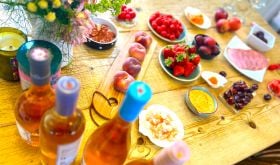
In a restaurant, it is rare for everyone at the table to order the same thing. All of which leads me to look increasingly for gastronomically versatile wines. In my recent tastings of the current crop of rosés, that category of wine that has definitively come out of the closet marked unfashionable, I am increasingly enthusiastic about a subset of pink wines that are bone dry, fairly assertive and not too light to stand up to a wide variety of different foods.
These are wines that can be served at a wide range of temperatures, too: from pretty chilled on a hot day to cellar cool, the same sort of temperature as suits light reds such as Beaujolais and many a Pinot Noir.
A certain amount of warmth and sunshine is needed to produce my archetypal food rosé. Typical Provençal rosé of the most fashionable sort today – very pale and light as a feather – is generally better as an aperitif than with any serious food, but a good pink Bandol with its extra herbiness and grunt can be just the job for the table, particularly if it’s one associated with the vigneronne Lulu Peyraud of Domaine Tempier, whose legendary hospitality was celebrated by food writer Richard Olney in Lulu’s Provençal Table (reprinted by Grub Street, 2013).
I have also enjoyed the similar rosés of Clos Ste-Magdeleine in Cassis, just along the coast from Bandol, although it is white wines for which Cassis is most famous. The Mourvèdre grape is the key to the substantial nature of these coastal rosés. More typical grapes for inland Provençal rosés are Grenache and Cinsault, the resulting wines tending to be lighter and fresher.
Grenache and Cinsault are also the characteristic grapes of one of France’s few all-rosé appellations, Tavel west of Bandol and Cassis in the far south of the Rhône Valley. Tavel is typically rather heavy and sometimes a bit syrupy, but the cult wines of L’Anglore are an exception. Natural winemaker Eric Pfifferling produces tantalisingly small quantities of dark rosés and light reds that are quite unlike any other Tavel. Buzzing with life, the ones I have managed to taste reminded me of violet creams and electrically charged strawberries but were far from sickly sweet. The 2013 enjoyed at Frenchie in Paris was serious enough to stand up to an array of first courses, then lamb and chicken with morels.
A number of producers in the Languedoc are taking rosé increasingly seriously, too. Cinsault can produce intriguingly herby examples, but Grenache grown on the better, higher sites can work well, too.
But in my experience most rosés made further north in France – even the increasing number of Bordeaux rosés – are refreshing and can make lovely aperitifs but are rarely dense enough to stand up to a main course. Many a pink wine is the result of draining off juice from the red-wine fermentation vat to make the remaining red more concentrated.
Italy can be a useful source of food rosés because of the savoury, not to say sometimes bitter, nature of the red wines and associated grapes there. Sangiovese seems to be able to make some fine dry pink wines in central Italy, and I must confess to sometimes preferring rosato to rosso in parts of Puglia on the heel of Italy where varieties such as Bombino Nero, Nero di Troia, Negroamaro and Primitivo can deliver successful if forceful dark pink wines so long as they are fermented out to dryness.
A quintessential Australian food rosé (see list below) made from the Valpolicella grape Rondinella grown in a relatively cool corner of New South Wales underlines the real potential for food rosés in northern Italy too.
The usual advice on drinking pink wine is to go for the youngest vintage available but it is not necessarily true for these fuller, drier rosés for the table. One of the most notable and distinctive examples is Viña Tondonia Rosado Gran Reserva, a pale orange rioja whose current vintage is, believe it or not, 2000.
An extract from my tasting note on this antique: ‘Waxy intrigue. Medium to full bodied and with freshness and orange peel on the finish. Light chew. Really distinctive. Food wine – I could even imagine enjoying this with Mexican food, and I have never written that in a tasting note before.’
Portuguese wine at one stage meant anodyne rosé – Mateus and Lancers – but one of my favourite pink wines for drinking with food is Dirk Niepoort’s Redoma Rosé from port grapes grown in the Douro Valley. This is another relatively dark, full-bodied blend, fermented in new oak in this case, but not at all oaky-tasting. It finishes dry and eloquently expresses the uniqueness of this northern Portuguese terroir.
I’m sure there are other fine examples of this useful genre made far outside Europe but, being based in London, I don’t see as many of them as of their European counterparts. The rosé trend has been slower to spread through the so-called New World, and producers are wary of exporting wines with an early sell-by date too far. Really dry, food-friendly white and pink wines are also less common outside Europe (generalisation alert), but something like Waterkloof’s Mourvèdre-based Circumstance Rosé from South Africa would, I’m sure, have gone very nicely with Sr Ancelotti’s lobster tagliolini.
FOOD ROSÉS
L’Anglore 2013 Tavel
Castello di Ama Rosato 2014 Toscana
Château des Chaberts, Cuvée Prestige Rosé 2015 Coteaux Varois
Domaine de l’Horizon Rosé 2014 Côtes Catalanes
Freeman Vineyards, Rondo Rosé 2015 Hilltops
Lopez de Heredia, Viña Tondonia Rosado Gran Reserve 2000 Rioja
Niepoort, Redoma Rosé 2014 Douro
Château de Pibarnon 2015 Bandol
Domaine de la Ribotte, Cuvée Anaïs 2014 Bandol
Château St-Jacques d’Albas 2015 Minervois
Domaine Tempier Rosé 2015 Bandol (or any vintage)
Waterkloof, Circumstance Cape Coral Mourvèdre Rosé 2015 Stellenbosch
See tasting notes and here are some more suggestions from other members of the team.
From Julia
Afros, Vinho Verde (last vintage I tasted was 2011 – it is not always bone dry because of notable tannins and acidity, but great with food, even roasted meat)
Alpha Estate 2015 PGI Florina
Azores Wine Company, Vulcânico Rosé 2015 IGP Açores
Chêne Bleu 2014, IGP Pays du Vaucluse
De Martino, Gallardía Rosé Cinsault
Julia Kemper, Elpenor Rosé 2013 Dão
Intellego 2015 Swartland
From Richard
Kutch Pinot Noir Rosé, Sonoma Coast
From Tam
Calmel & Joseph, Pays d’Oc
Ch Lagrezette, Le Pigeonnier, Cahors