
For this, my 99th wine of the week, I am returning to my favourite variety in its northern Rhône birthplace. It is now a well-established fact that Syrah is the best black grape variety of them all (in my house at least) and this Crozes-Hermitage from Jean-Luc Colombo is further proof, if proof were needed.
Usually seen as the poor cousin of Hermitage, Crozes-Hermitage does indeed produce a lot of humdrum red. The appellation includes plenty of flat, easily farmed land, which accounts for the large volumes produced, by northern Rhône standards. Last year, this amounted to 11 million bottles, and with 136 producers bottling their own versions, the quality varies accordingly. But the best Crozes-Hermitage can rival the best of any neighbouring appellation.

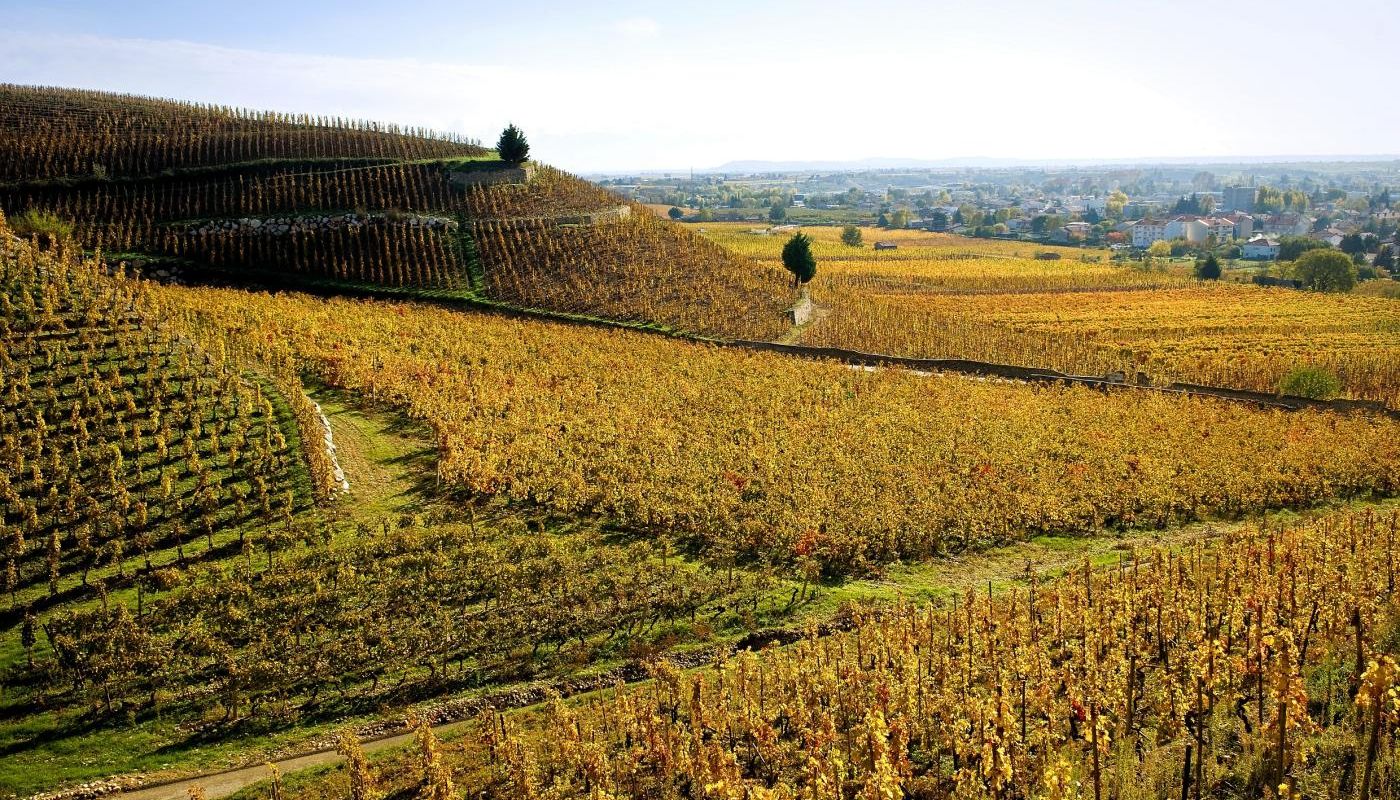
The most notable parts of Crozes-Hermitage have the same sort of sloped vineyards with granite soil that are so fundamental to the hill of Hermitage itself (such as those in the picture at the top of this article, courtesy of vins-rhones.com). These are visible in green on the map above, directly north of Hermitage, whereas the peach-coloured areas denote the flatter land on the southern plain bordered by the River Rhône to the west and the Isère to the south-east.
Colombo’s reputation was built on the outstanding wines they make on the steep slopes of Cornas, where they started in the 1980s. The first vintage of Fées Brunes Crozes-Hermitage didn’t come about until the early 2000s, with fruit sourced from vineyards on both the granitic slopes as well as the alluvial land, marked in brown.
This terroir is surely the source of the complexity and typicality displayed in Colombo’s version. I tasted both the 2019 and 2023 vintages and found a level of fruit power in both that goes well beyond the Crozes norm. That ripeness is reflected in the alcohol level, too – 14.5% on the label, whereas standard Crozes is more likely to be around 13%. However, it doesn’t have the fiercely furry tannins that define young Hermitage, making this wine entirely drinkable now.
The younger vintage overflowed with the black-pepper pungency that marks youthful Rhône Syrah, while the older one had a ferrous and smoked-meat tang revealing the bottle development that this particular wine can achieve. It’s the archetype of Syrah: spiced, black-fruited and savoury. The winemaking is nothing unusual, with destemmed fruit, temperature-controlled fermentation and eight months of maturation, partly in tank and partly in oak barrels, of which 15% are new.

At around €20, $30 and £30, Fées Brunes is either expensive for Crozes-Hermitage or half-price for Hermitage, and the latter mindset works for me. The 2023 vintage is available in Europe, Hong Kong and Singapore, while the UK is still working its way through the 2021. Over in the US, the 2019 is in current circulation, although the lowest price of $27.99 is for the 2018, which should also be worth having – it was a good vintage. The recently appointed new distributors (González Byass USA) tell me that the 2023 will be released at some point next year, so it’s worth getting the older vintages while you can.
For reviews of more than 60 wines made by Jean-Luc Colombo, see these results from our database.