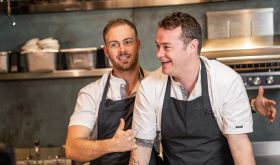
As I was just about to leave Noa restaurant, a 15-minute drive east of Tallinn, Estonia, I could not help but notice two very different chefs deep in conversation. They were Isaac McHale, the Scottish chef who has made such a success of The Clove Club in Shoreditch, east London, and Daniel Berlin, in whose restaurant in Skåne Tranås, southern Sweden, his father works as sommelier while his mother tends the vegetable patch.
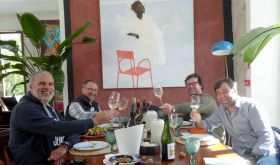
They were finishing their glasses of Pittacum 2010 from the Spanish region of Bierzo and discussing plans for the dinner for 60 they were jointly cooking the following evening to mark the end of the Sauce Gastronomy Conference.
Berlin was concerned since none of the ingredients he had asked for would, he had just heard, be available, with cod being a noteworthy absentee. McHale was doing his best to reassure him by rattling off the list of ingredients he had brought with him from his London kitchen. These included some homemade blood pancake batter, blood pudding, and seaweed from the isle of Bute. (Berlin had brought some wild bird liver mousse to serve as a canapé and the dinner was in the end a great success, apparently.)
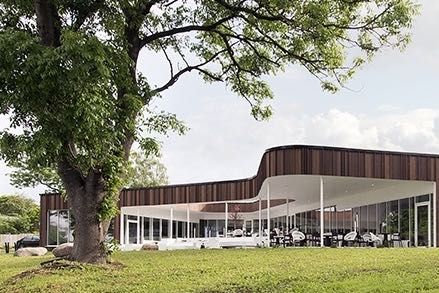
The reason for the absence of cod and other more expensive fish is historic and was, I realised, connected to the existence of the restaurant Noa in which we all were seated, a modern, largely glass building with views across the Gulf of Finland to the city’s Old Town.
Both are the result of the Soviet presence in the Baltic states that lasted until the early 1990s. With the east and the west of the city so close to Estonia’s borders and potential freedom, access to the coast was then strictly controlled, particularly at night. Today there are still parts of Tallinn that have commanding views of the water that would have been heavily built on if this were anywhere else.
All of this conspired to present restaurateur Martti Siimann with an opportunity. In 2011, in partnership with chef Tõnis Siigur, he had already established Oko restaurant in Kaberneeme, a 30-minute drive east of Tallinn, but as the Estonian summer lasts not much longer than three months, they decided they needed somewhere closer to the city. The land that was to house Noa, they discovered, was for sale and owned by friends. An agreement was reached; the neighbours were placated and planning permission, still difficult so close to the sea, was eventually granted. Noa opened in 2014 as the first building in Estonia in 25 years specifically designed as a restaurant.
Its design is triangular, planned initially around an ash tree that was in fact inadvertently knocked down by the builders, but with glass windows affording fantastic views across the water; several different levels; and mirrors for those who have to sit with their backs to the sea.
The larger and more casual part of the menu boasts a four-page fold-out menu with etchings of a beetroot, a fish, a cow and a piece of cake at the top of each to differentiate the sections. Next to the entrance is a glass door marked ‘Peakoka Pool’ or Chef’s Hall.
This section of the restaurant is the culmination of Siigur’s culinary ambitions. It seats about 40 on two levels: there is an open kitchen on the higher level with all the latest cooking methods on show; and the chefs can keep an eye on all their customers as they make their way through either a five-course or a seven-course tasting menu.
This may not sound very Estonian, and in fact certain aspects of the meal were to resound with a more international air than necessary, but in one crucial respect, my meal at Noa could not have taken place anywhere else. The bread and butter that were waiting for us were quite exceptional.
This, I was to appreciate from other good meals at chef Dmitri Haljukov’s Cru restaurant and at Janno Lepik’s Leib (actually the Estonian word for black bread) restaurant, both in the Old Town and described in Two doughy days in Estonia, are characteristic trademarks. Tallinn’s chefs seek to replicate the one aspect of Estonian cooking that they fully realise must never be forgotten. But it was at Noa, perhaps because it was my first meal in Tallinn or perhaps it was just because I was so hungry, that I fell so rapturously for Estonian bread – not just for the traditional dark rye bread but also for the focaccia style roll, topped with rosemary, and served warm in its individual baking tray. The salted butter was an added bonus.
This bread and our three snacks – whitefish with dill, cobia with mayonnaise and a skewer of duck and beetroot – were almost enough for me, but we were on the €79 seven-course tasting menu and that involved several more dishes. Best of these were an oyster sitting on a garlicky cream sauce and topped with thin slices of refreshing pomelo; the breast and leg of a pigeon served with small onions and a pigeon jus; and a memorable dessert of a bowl of sea buckthorn, the culinarily fashionable deciduous shrub. Here it was mixed with amaretto and infused with nitrous oxide to produce a sparkling, sweet finale.
The quality of the food, service and wine is of a high enough standard to keep the locals and visitors to Tallinn warm through the coming winter.
Noa Ranna tee 3, Tallinn; tel +327 50 80 589
Chef’s Hall open Wednesday to Saturday, evenings only