
22 July 2014 We tend to think of Sauvignon Blanc primarily as an unoaked wine, but I must say I have been hugely impressed by some oaked Sauvignons and in fact would probably more easily recall thrilling oaked Sauvignons than unoaked ones, despite the ocean of unoaked examples from Marlborough and Sancerre that washes around the globe.
So when my fellow Master of Wine Richard Bampfield, who represents the interests of Jean-Christophe Mau of Bordeaux négociant Yvon Mau in the UK, invited me to a blind tasting of oaked Sauvignons around the world, I jumped at the chance. As it happened, the day of the tasting was boiling hot, so it was fortunate that Richard had decided to hold the tasting in London's only winery, London Cru, as it was deliciously cool and spacious (even if winemaker Gavin Monery muttered darkly that he could do with more space to vinify the grapes they ship in from France and Italy). 
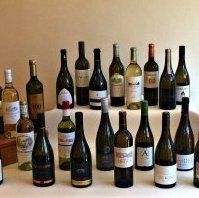
A total of 32 wines from nine regions in eight countries, pictured above before the tasting, had been decanted into neutral clear glass bottles. I was concentrating on assessing the quality of the wines rather than trying to identify their origins, but some of them expressed their provenance more obviously than others. That said, I didn't realise that the wines were ordered strictly by geography. I present my tasting notes below in the order I tasted the wines in case you think my perceptions may have been coloured by what I tasted previously.
Since the tasting had been organised from a Bordelais point of view (not least because Château Brown in Pessac-Léognan is managed by Jean-Christophe Mau for its owners the Mau family and the Dirkzwager family who own a Dutch wine importing and retail business), I suspect I was not the only taster to think that perhaps we would be treated to one or two of Bordeaux's starriest white wines. A suggestion of an Haut-Brion perhaps? Or at the least a Pape Clément or Smith? In the end, when given the crib admirably assembled by Laura Clay, we saw, and probably should not have been surprised, that Chx Brown, La Tour Martillac and a particularly lean Carbonnieux were the grandest white bordeaux included. And very good Brown it was too – which made me curious about how some of these even grander examples would have shown. (It is notable how often at the Southwold tastings every January we are disappointed by the performance of the Haut-Brion whites when they are served blind with other dry white bordeaux – a category that is usually 'won' by Pape Clément or Smith.)
While we are on the subject of oaked Sauvignon from Bordeaux, I cannot resist commenting on what I regarded as the usual lamentable performance of Caillou Blanc de Ch Talbot, although I see that for the group as a whole, this flabby wine was in the top three. I very much liked the group's other candidates for the top three however: Ch Brown and the glorious Reyneke Reserve 2011 from South Africa that was my favourite wine overall, to which I happily gave 18 points out of 20.
In fact, an analysis of my scores by region or country shows that my favourite source of oaked Sauvignon overall was South Africa (remember, I was tasting blind, even though at about the same time I was writing this article raving about South African wines). One of my three 17.5-scorers was the South African Chamonix 2012, the others coming from Mondavi of California and Greywacke of Marlborough in New Zealand. See below for my average score per region/country with the total number of wines in the tasting in brackets:
South Africa 16.75 (6)
Napa Valley 16.67 (3)
NZ 16.43 (7)
Bordeaux 16.14 (6)
Turkey 16.00 (1)
Friuli 15.75 (2)
Chile 15.75 (2)
Australia 15.67 (3)
Loire 15.25 (2)
The Loire average was dragged down by our extremely disappointing bottle of the Didier Dagueneau, Pur Sang 2008 on which we all remarked. This had been much more convincing last time I tasted it. But it could not be simply its advanced age because the Mondavi Fumé Blanc of the same vintage showed extremely well, I thought. Indeed the Californians in general looked very good, and rather obviously Californian in some cases.
But this was not a collection of wines for oakophobes. I know there are some tasters for whom even a whiff of oak automatically disqualifies the wine. Many of these wines had more than 'a kiss of oak' and most were fermented as well as aged in oak, even if for many the casks were as big as 500 or 600 litres rather than the traditional 225-litre barrique. None of the top wines had more than 50% new oak but many of them wore their oak on their sleeve – but often combined with truly stunning fruit to make a wonderfully complex whole. And my feeling is that if the wine is young and the oak obviously top quality, then so be it.
All in all, this is a wine style that can be extremely rewarding and rarely costs a bomb. The only aspect I find less than refreshing in some of them is a character I describe as 'oily', when a heavy oaky quality overbears the fruit.
I think of myself as a fan of Sémillon in the blend with the Sauvignon Blanc, but this tasting didn't show any clear correlations. It was fun though, and there were many wines worthy of your attention if you like substantial but appetising dry whites with real refreshment value.
AUSTRALIA

Aged for three months in 100% new oak. Mildly catty nose. Edge...
Old cask fermentation. Lots of vegetal refreshment on the nose...
Femented and aged for six months in oak barrels and demi-muids.
S...
NAPA VALLEY
...
CHILE
Fermented and aged for 18 months in 600-litre barrels. Pale gold...
Aged for six months in 500-litre French oak barrels. Smoky...
FRIULI
BORDEAUX
74% Sauvignon, 26% Sémillon. Matured for eight months in 35% new...
55% Sauvignon Blanc, 40% Sémillon. Aged for 8-10 months in 80%...
LOIRE
100% Sauvignon. Fermented and aged in new oak. Chalky nose...
100% Sauvignon. Fermented and aged for 20 months in oak, 30% new...
NEW ZEALAND
100% Sauvingon. Cuveé juice fermented in old oak barrels. Rich...
100% Sauvignon. 50% matured in French oak cuves and foudres...
Fermented and aged in oak barrels, less than 10% new. Tense...
Fermented in (mostly old) barriques for 12months. This is...
A portion was fermented in neutral French oak barrels. Water...
Matured in 500-litre French oak puncheons for 16 months. Rich...
30% fermented and aged in French oak barrels, 5% new. Only one...
SOUTH AFRICA
60% Sauvignon Blanc, 40% Sémillon. 11 months' oak ageing, 50%...
Fermented and aged for 10 months in French oak casks, 25% new...
100% Sauvignon Blanc. Fermented and aged for 15 months in 300...
TURKEY
Sauvignon Blanc. Fermented and aged for 10 months in barrel...













