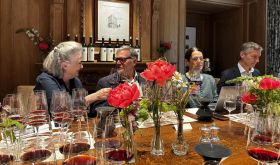
The Bordeaux vintage tasted most recently at the blind-tasting marathon held every January at Farr Vintners’ Thameside offices in London, 2022, is bittersweet.
The best red wines were really, really good, vindicating 2022’s status – along with 2020, 2019 and 2016 – as one of the four best vintages in the last 10 years. They were almost uniformly high not just in fruit concentration but also in colour and tannins – this was a tasting to blacken the teeth and dry out the palate – which means that the wines should have an impressively long life.
But too many of them cost markedly less now than they did when they were released en primeur in late spring 2023. This unfortunate fact has done much to erode the world’s wine buyers’ confidence in the entire en primeur system whereby wines are shown to the trade and media as embryonic cask samples in April and then offered for sale, long before bottling and sometimes before final blending, in the weeks after that.
To take an extreme but sobering example, a case of six bottles in bond of the (exemplary) first growth Château Haut-Brion 2022 was initially offered, in 2023, at more than £3,000. Today the same case is selling at just over £2,000. The price decreases have been particularly marked among the most famous and/or most ambitious châteaux. By contrast, those properties famous for relatively realistic pricing such as Château Léoville Barton, Château Brane-Cantenac and Domaine de Chevalier have been spared the ignominy of such obviously sluggish demand.
Interestingly, although there was a lot of banter during our three days of tasting among the 20 tasters, 18 of them in the trade, there was very little mention of price. Presumably it was just a very sore point although, as Stephen Browett of Farr Vintners added later about a notably weak vintage, ‘Not as much of a sore point as in 2021 where we felt they [the Bordelais] were clearly being very greedy. 2022 at least is a great vintage’.
When it was first shown, in April 2023, 2022 clearly had the stuffing and structure needed for potential greatness, but it was a mystery, too. Normally after a summer as hot and dry as that of 2022, acid levels would be expected to be dangerously low across the board. But I remember quizzing winemakers and proprietors about why the best 2022s seemed so surprisingly refreshing as well as concentrated and could find no one with a very satisfactory answer.
The wine scientists at the University of Bordeaux who play such an important part in advising local producers were adamant that, however worryingly low were the acid levels naturally present in the grapes when they arrived at the cellar, no additional acid should be added since acid levels would rise during fermentation. (Carelessly done acidification can result in wines with very obvious, unintegrated acidity.)
When tasting these 2022 reds I saw no evidence of acidification. And certainly there was no need to add any sugar to ferment into extra alcohol such as is sometimes done when grapes are underripe. The 2022s are not wines for the faint-hearted. Alcohol levels in the reds were rarely below 14%, and on the right bank often 15%. In three cases, including the extremely delicious St-Émilion Château Valandraud (which showed so well once bottled in 2024, too), alcohol levels on the label were as much as 15.5%. This was another conundrum about these 2022s – and indeed about wines today in general rather than, say, 10 years ago – high-alcohol wines are no longer dogged by an off-puttingly hot sensation at the end of the tasting experience.
On the right bank there were only three wines with as little as 13.5% alcohol – Châteaux Cheval Blanc and Quintus in St-Émilion and Beauregard in Pomerol – whereas four left-bank wines were just 13%, including the sister St-Julien châteaux St-Pierre and Gloria, both of which showed particularly well.
Of the reds, the only wines I found disappointing were the lesser St-Émilions that didn’t seem to have enough of a core of fruit to withstand all that tannin in the long term. But nowadays the best St-Émilions such as Angélus, Ausone, Belair-Monange, Canon, Cheval Blanc, Clos Fourtet, Figeac, Pavie, Tertre Roteboeuf, Troplong Mondot and Valandraud are great wines with none of the overdone oak and extraction that used to be all too common in the appellation.
Pomerol used to outrank St-Émilion in blind tastings of this sort but the lesser 2022 Pomerols seemed to lack a bit of energy, even if all the famous names – Église-Clinet, L’Évangile, Lafleur, Le Pin, Petrus, Trotanoy, Vieux Château Certan – were impressive. In fact, along with left-bank first growths Châteaux Haut-Brion, Mouton and Margaux, Église-Clinet and Petrus were my favourite wines of the three days.
The Château Margaux was so intensely rich and dramatic, I could easily have taken it for Petrus. Mouton, on the other hand, seemed a bit more backward than usual but was beautifully mineral and saline while Haut-Brion was more classic with lovely freshness and a silky texture. Lafite and Latour displayed their usual finesse and rigour respectively.
Both Pauillac and Margaux were excellent in general with St-Julien, usually a favourite appellation in this marathon, tasting a little less classic and much richer than usual with less energy overall than the wines from the Margaux appellation. A real star, for both me and the group, was Margaux’s Château Brane-Cantenac, which was already more approachable than most but will surely last into the 2050s, too. This vintage was a standout in James Lawther MW’s 2025 vertical tasting of Brane-Cantenac.
For the group as a whole, stars were Châteaux Cheval Blanc and Église-Clinet on the right bank and the wines from the Haut-Brion stable and Domaine de Chevalier in Pessac-Léognan. The group’s favourite St-Julien was Ducru-Beaucaillou whereas mine were, equally, Gloria, Léoville Las Cases, Léoville Barton and Talbot.
The group’s favourite St-Estèphe was Montrose while I was more taken in this vintage by Cos d’Estournel and Meyney. Stunning Pauillacs, other than the first growths, were Forts de Latour, Grand-Puy-Lacoste, Pichon Baron, and Lynch Bages; this last was the group favourite.
Whites were, as expected, less impressive in this hot, dry year. I’m a big Sauternes fan but it seemed as though only the most ambitious properties managed sufficient freshness in a year with sky-high sugar levels. Doisy-Védrines, La Tour Blanche, Suduiraut and Yquem had much more interest than most.
The increasing number of dry wines now being made at Sauternes châteaux were much better than in the past, although C de Sec du Château Closiot, the favourite of all of us, was made by a recent incomer from Burgundy, Jean-Marie Guffens.
As for the traditional dry whites, we tasted mainly Pessac-Léognans plus whites from the first growths. They were better than expected from such a hot vintage although they are not great value compared with the best oaked Sauvignons from elsewhere in the wine world.
Recommended better-value 2022s
Most of these are offered by the case in bond but a few are offered by the single bottle with all taxes and duties paid.
Dry white
Le C de Sec de Château Closiot 2022 Bordeaux Blanc 13.5%
£18 per bottle duty paid Hedonism, £150 for 12 in bond Farr Vintners
Reds
Mauvesin Barton 2022 Moulis 14%
£25.14 per bottle duty paid Private Cellar
Montlandrie 2022 Castillon-Côtes de Bordeaux 14%
£180 for 12 in bond Farr Vintners
Cantemerle 2022 Haut-Médoc 13.5%
£210 for 12 in bond Morgan Classic Wines, £220 Bordeaux Index and many others
Tronquoy 2022 St-Estèphe 14.5%
£118 for 6 in bond Farr Vintners
Meyney 2022 St-Estèphe 14%
£115 for 6 in bond Bordeaux Index
Labégorce 2022 Margaux 14%
£32.89 per bottle duty paid CostCo
Gloria 2022 St-Julien 13%
£144 for 6 in bond Lay & Wheeler
Lynch-Moussas 2022 Pauillac 14%
£161 for 6 in bond Cru World Wine, £39 per bottle duty paid Tanners
Malartic Lagravière 2022 Pessac-Léognan 14.5%
£165 for 6 in bond Nickolls & Perks
Brane-Cantenac 2022 Margaux 14%
£344 for 6 in bond Cru World Wine
For tasting notes, scores and suggested drinking dates, see my three tasting articles published earlier this week: white wines, right-bank reds, left-bank reds. For international stockists, see Wine-Searcher.com.
Back to basics
Isn’t bordeaux a red wine? |
|
Admittedly, more than 85% of all of Bordeaux’s wine is red but dry whites (and rosés to a certain extent) are on the rise. The main grape variety is Sauvignon Blanc, often blended with the Sauternes grape Sémillon and Sauvignon Gris. The Entre-Deux-Mers region produces a lot of light, dry, aromatic, crisp white with the simple Bordeaux appellation. But the classiest dry white, invariably oaked, has always come from the Pessac-Léognan appellation south of the city of Bordeaux (with Graves further south), from châteaux that have traditionally made both reds and dry whites.
This is now being challenged by a wide range of very varied dry whites made from grapes that previously made sweet wines in Sauternes and Barsac south of Pessac-Léognan. They are increasingly common because sweet wines in general, and sweet white bordeaux in particular, is so difficult to sell.
Another new development is the host of smart red-wine châteaux now producing a white wine. Pavillon Blanc de Château Margaux, Haut-Brion Blanc and La Mission Haut-Brion Blanc (which used to be called Laville Haut-Brion) were the prototypes but they have been joined by (rather fresher, simpler) dry whites from the famous red-wine likes of Châteaux Cheval Blanc, Cos d’Estournel, Lafleur, Lagrange, Lynch Bages, Mouton, Palmer, Talbot and many more. Most are sold with the appellation Bordeaux Blanc but a new one, Médoc Blanc, was created last year. |