
17 February 2018 A slightly shorter version of this article is published by the Financial Times. See my notes from the tasting of 2000 and 2001 burgundies described here.
Which is better, a wine with potential or one that tastes good now?
Undertaking the (questionable) exercise of awarding scores to individual wines, and vintages in general, commentators tend to favour concentrated, tannic wines over light, relatively soft ones. So, for instance, for the classic reds of Bordeaux and Burgundy, 2008 is generally regarded as definitely ‘superior’ to 2007, because it has more stuffing and its relatively high tannin content should preserve it for longer than the accessible 2007s that are already drinking so well.
I look forward to undertaking a two-day tasting of bordeaux 2008s at the beginning of next month as they approach their tenth birthday when, traditionally, fine red bordeaux begins to be broachable. But I have been enjoying a host of the much more pliable 2007s for the last four or five years, and experience has taught me that a high level of tannin, the phenolic preservative extracted from grape skins, is not a sure-fire marker of quality in a wine.
It is only worth ageing a wine with lots of tannin (puckering the inside of the cheeks a bit like cold tea) if there is enough fruit to support it as it decreases with age in bottle. Many is the vintage – I’m thinking of you particularly, 1988 – in which tannins seemed to outlast the fruit and, after years in a cellar, all a bottle has to offer the drinker is the chewy vestige of tannin long after the youthful fruit has faded, making way for uncomfortably dominant acidity.
Red bordeaux is naturally more tannic than red burgundy (Cabernet and Merlot grapes generally have thicker skins than Pinot Noir) so I am much less wary of bordeaux vintages that are particularly tannic in youth. In contrast, it seems to me that much of red burgundy’s charm lies in its perfume and purity of fruit. Only the very finest examples demand anything like as long ageing as top red bordeaux while a heavy charge of tannin slowly combines with other compounds to result in a much more complex, seriously great burgundy. And such wines tend to have soared into an unaffordable stratosphere anyway.
But long before recent rampant inflation of burgundy, I was always a fan of Côte d’Or vintages described, and often dismissed, as ‘charming’. I was a slightly shamefaced fan of 1982 and 1992 red burgundies, overshadowed by their immediate successors but providers of pleasure so much earlier than either of these. If you make the right call in a more tannic vintage of burgundy – and here I am certainly not decrying the 1993s that have aged beautifully – you will be rewarded with some great bottles, but you can generally buy them only when they are released at under two years old, and will then – unless you are one of the lucky few to have your own perfect cellar – have to pay for storage for many a long year. Softer vintages on the other hand can be enjoyed in their youth and you may not even have to despatch them to professional storage.
We tend to assume that a vintage that is not stuffed full of tannin in its youth will not age well, but I experienced a convincing demonstration the other day that this is not necessarily true.
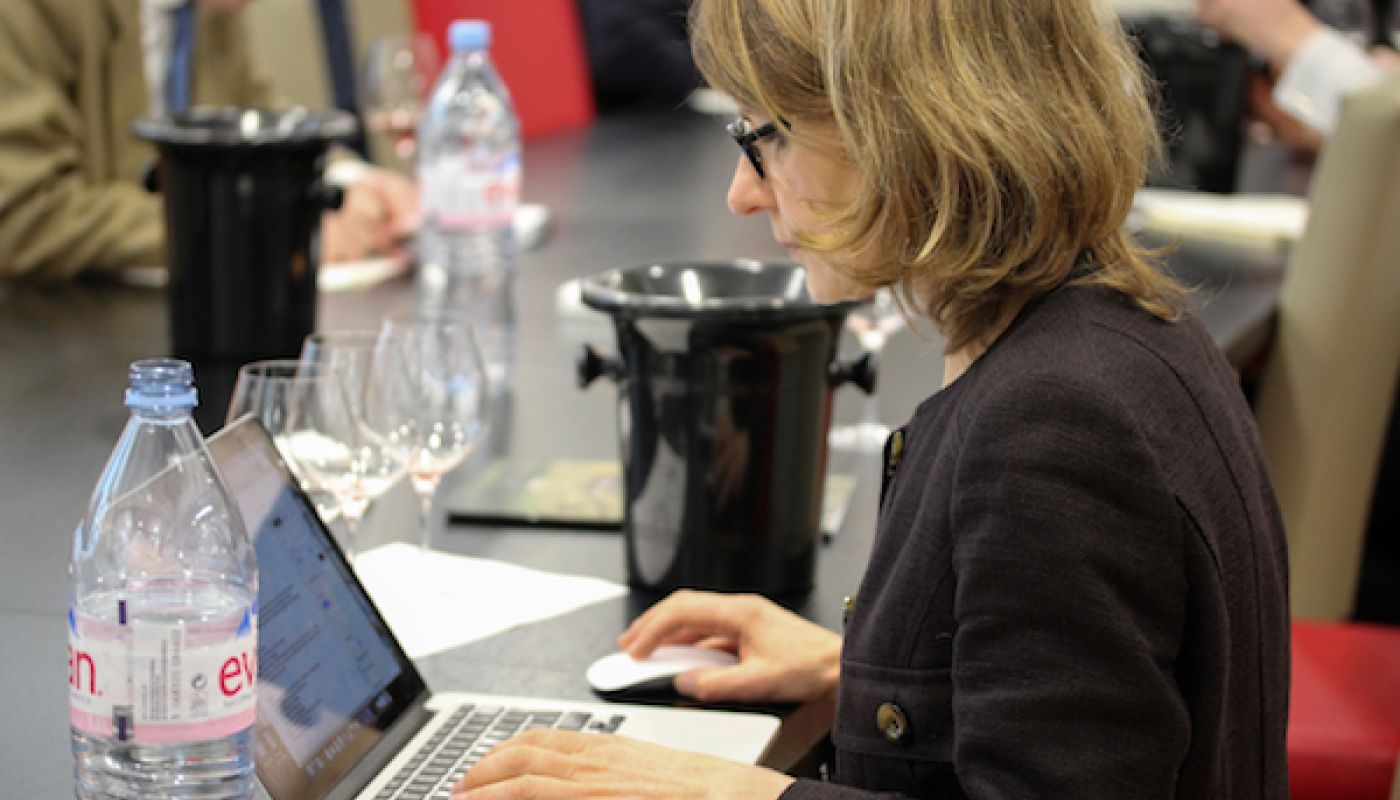
Burgundy specialist and Master of Wine Sarah Marsh is continuing her series of horizontal tastings of mature burgundy, at the instigation of Côte d’Or growers whom she describes as ‘understandably frustrated at the speed at which their top wines are consumed at home and in restaurants’. She decided to start an annual look at mature reds with a range of wines, 37 in total, from the 2000 and 2001 vintages. The growers contributed a selection of wines, mainly premiers and some grands crus, to be tasted by a group of us commentators, sommeliers and burgundy specialist retailers at London wine merchant Goedhuis in the hope of encouraging more people to age fine burgundy. Sarah is pictured above at the tasting.
The 2000 vintage, initially described as a white wine vintage, and considered slightly suspect because of the generosity of the crop, was the first I surveyed in detail for JancisRobinson.com and I always liked the reds – especially but by no means exclusively those from the Côte de Nuits which were left unscathed by some heavy mid-September rain.
The next year, 2001, saw quite a bit of rot and was one of the first in which sorting tables became de rigueur. It was also marked by rain (and hail in Volnay) and under-ripeness in the least favoured vineyards, and was always described as relatively tough, often because the tannins did not have a chance to ripen fully.
Of the 22 reds from the 2001 vintage we tasted on the last day of January, there were 10 grands crus, wines at the top of the tree in Burgundy, while most of the rest were premiers crus, one rung down. Even after all this time in bottle, the chewy tannins were still very much in evidence in virtually all of these 2001s. In the best cases there was still enough fruit left to trump those tannins but some of the wines lacked a persistent and glorious finish – which one would hope for in a burgundy costing more than £150 a bottle.
The 15 reds from the 2000 vintage were gentler and, generally, more of a pleasure to taste. Like other commentators, I never expected the 2000s to last as long as this. Admittedly in some of the 2000s the fruit was starting to give way to acidity (and some of the 2001s were also a little too tart as well as being noticeably tannic), but there were some real highs, and the Chambolle-Musigny, Les Amoureuses from J F Mugnier (a producer who explicitly tries to make his wines accessible in youth because he recognises how impatient modern wine collectors are) was still pure joy.
One thing worth mentioning is that two of the 37 bottles donated for this tasting (bottles too rare to have back-ups) had to be discarded because of cork taint. Discussing the tasting afterwards, Sarah put a positive spin on this proportion describing it as ‘not bad’. But if I had paid the going rate for a bottle of premier or grand cru 2000 or 2001 red burgundy, over £150 a bottle, I would have been very cross indeed.
This was a tasting that proved, yes, it is worth ageing fine burgundy – even from a ‘soft’, ‘early-maturing’ vintage such as 2000. But if they give pleasure throughout their lives, surely so much the better.
Superlative 2000 and 2001 red burgundies
These were wines I marked at least 18 out of 20, representing 22% of the 22 2001s and 27% of the 15 2000s in our tasting. (It is worth pointing out that there were relatively few wines for which we had both vintages.) See my tasting notes on these wines and wine-searcher.com for such international stockists as there are.
Premiers crus
2001 and 2000 Comte Armand, Pommard, Clos des Epeneaux
2001 and 2000 J-F Mugnier, Chambolle-Musigny, Les Amoureuses
2001 Humbert Frères, Gevrey-Chambertin, Petite Chapelle
2000 Bouchard Père et Fils Beaune, Grèves Vignes de L’Enfant Jesus
Grands crus
2001 Dujac, Clos St-Denis
2001 Rossignol-Trapet, Latricières-Chambertin
2000 Armand Rousseau, Clos de la Roche













