
See 120 tasting notes on 2009 classed growth bordeaux taken at this tasting and this video of it.
You could learn a lot about the world's fine-wine trade just by keeping your head down and ears open at the annual London showing of the latest classed-growth bordeaux to make its tortuous way into bottle. Last week it was the turn of 119 of the hugely hyped 2009s to be shown, in impeccable tasting conditions with bright natural light streaming in overhead, in the Royal Opera House's Hamlyn Hall.
A very significant proportion of the key players in London's vibrant fine-wine selling and broking subculture were at the Union des Grands Crus event, mostly complaining about how tough the market is at the moment. Or, rather, how much less of a doddle it is to sell expensive wine now than it was a year ago when Lafite was trading at more than twice its current price. Last year, with the hugely ripe and dramatic 2009s to sell en primeur and the Chinese fine-wine market on fire, was a dream year for fine-wine traders. But the Liv-ex Fine Wine 50 index has been in free fall since and the price of Château Lafite, the poster child for the burgeoning Chinese market, has suffered particularly. One explanation is that, whereas Château Lafite was seen as the ultimate business gift, there has been a clampdown on the extent to which company money may be used for wine purchases
And who in the West wants to buy seriously fine wine at the moment? I heard someone from one of the biggest fine-wine traders grumbling that he had one client who had spent £4m on 2009 bordeaux with him when it was offered last year but that that same collector hadn't bought more than 'the odd case' of the 2010s offered this year.
More poignantly, one wine merchant of longstanding but no longer in the trading mainstream was heard collaring an old friend who still is and offering him a case of Lafite's second wine Carruades from the 2000 vintage that had been sitting in his personal cellar. If only he had thought to offer it at the same tasting of 2008s in October last year
These tastings are always jam packed and not just because it is the first chance the trade has to see how a new vintage of some very expensive and widely traded wine looks in bottle but because there are such fine networking and temperature-taking opportunities. A firm handshake and a knowing smile across the table can help secure a château visit for an important client or even, in the case of the many château owners who are also négociants, can help increase an allocation of a sought-after wine – when the good times return.
It helped attract 800 visitors to the tasting that these bottled 2009 classed growths had not been shown en masse before – except to a similar number of people, far more of them in the restaurant business rather than the wine trade, at the Palais des Congrès in Paris the day before. Even the most cynical bordeaux trader was particularly interested to see how the 2009s would taste in bottle. For this was probably the most opulent and obviously ripe vintage that Bordeaux had ever seen (in contrast to the rather more lissom 2010s and the definitely more savoury and austere 2008s). Would these 2009s be showing signs of going all sweet and jammy on us? Or perhaps the high sugars and relatively low acids would translate into obviously alcoholic wines with heat rather than persistence on the finish
In fact, I'd say only two of the 56 wines I tasted (all left bank) seemed to lack refreshment value, both only coincidentally from Margaux, Châteaux Prieuré-Lichine and Lascombes, sold last summer by a consortium of American investors to (yet another) French insurance company. I noticed (after tasting the wine) that the alcohol level stated on the former was 14% – notably high for a wine from the Médoc even if by no means unusual in St-Émilion and Pomerol nowadays. My colleague Master of Wine Julia Harding tasted the right bank wines at this 2009 tasting and found herself looking for the refreshment factor more often than me, although she was impressed by how bright – rather than raisined – the fruit in the St-Émilions was in general
I noticed that the tannins were pretty insistent in a number of the reds I tasted and wondered whether some of them would close up and retreat into a sullen shell over the next few years. But in general, these are wines to drink long before the 2010s and probably before the 2008s. Their stages of evolution seemed very different, with some successful wines such as Châteaux Beychevelle, Branaire Ducru, Brane-Cantenac and even Siran lacking the enormous, brooding potential that is evident in many 2005s and some 2009s, but presenting themselves as very attractive drinks for the medium term.
Then there were the wines that seemed to have taken on flesh and density since I tasted them from barrel last year. Both of Château Mouton-Rothschild's stablemates, Châteaux Clerc Milon and d'Armailhac, looked lovely last week – classical but much more confident and refined than I remember when en primeur. Both Châteaux Langoa-Barton and Léoville-Barton had rather more flesh now, although they are both made, like Château Léoville Las Cases, with no concession to sweetness whatsoever, while the third relic of the original Léoville estate, Château Léoville Poyferré, is more obviously playing to the gallery – with great success.
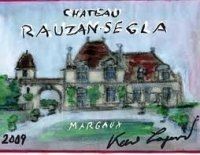
A wine that stood out for me both en primeur and last week from bottle was Château Rauzan Ségla, which may be teased on account of the Karl Lagerfeld cartoon above of the château chosen to adorn this 350th anniversary bottling by the estate's owners, the Wertheimers of Chanel. Mind you, even its neighbour, the much less conscientious producer Château Rauzan Gassies, managed to make a pretty attractive wine in 2009.
The dry whites were in general a little softer than in most vintages and the sweet whites, some spectacular, were particularly rich
All in all this was a thoroughly attractive range of wines, all with vibrant colours, lots of ripeness and tannin, just enough acidity in most cases but wines which can easily taste sweeter than most vintages because of this low acidity. It echoed Julia's and my recent tasting of an even greater number of 2009 Crus Bourgeois, Médoc reds supposedly a definite step down from the classed growths – and sold at much lower prices, so their makers cannot usually afford to be as lavish in terms of production methods and selection. The best of the Crus Bourgeois were at least as good as the least successful of the classed growths, I thought, suggesting that in 2009, the spread in terms of quality is much narrower than in a more typical Bordeaux vintage. The bargains among left-bank 2009s are surely the finest Crus Bourgeois, which can be found for well under £20 a bottle, as opposed to the classed growths, which can sell for hundreds of pounds a bottle
That said, none of the first growths, the most expensive and usually most thrilling red bordeaux that have in some cases been selling for more than £1,000 a bottle, were included in this recent tasting. I was offered the confident prediction from one of the Bordelais that prices for wines from the challenging 2011 vintage would come down. Hardly a scoop, alas.
Below are some of my favourites, although bear in mind that I have not retasted the first growths and some of the super seconds in bottle.
LEFT BANK REDS
d'Armailhac
Branaire Ducru
Clerc-Milon
Langoa Barton
Léoville Barton
Léoville Poyferré
Pichon Longueville (Baron)
Rauzan Ségla
SWEET WHITES
Climens
de Fargues
Guiraud
Sigalas Rabaud
Suduiraut
La Tour Blanche
See 120 tasting notes on 2009 classed growth bordeaux taken at this tasting.













