Exit 24 from the Bordeaux ring road is not the most familiar to wine lovers but I took it the other day en route for a village in the pretty northern sector of the Entre-Deux-Mers with the slightly unlikely name of Naujan et Postiac where the winemaking family Despagne have recently been making waves despite their unglamorous location.
Although an ocean of Appellation Bordeaux Contrôlée, as reds made here have to be called, sits unloved, unsold and occasionally ignominiously distilled into industrial alcohol, the debut 2001 vintage of the Despagne family’s new AC Bordeaux, Girolate, has twice managed to win the top rating of five stars from the demanding Grand Jury Européen and, as has just been announced, was voted best wine of all in a comparative tasting of right bank 2001 red bordeaux last April. At the GJE’s tasting in Austria last month of 72 top Merlot-based 2001s from around the globe, Girolate came eighth, ahead of dozens of St-Emilion Grands Crus and Pomerols including such celebrated names as La Mondotte, Valandraud and Tertre Roteboeuf. I had heard similarly enthusiastic reports from colleagues about this novel wine and so was anxious to see whether and how such quality had been coaxed from this lowly address.
The Despagnes are nothing if not discreet – a map is needed to find the house and offices even in this tiny village – but according to Thibault Despagne, 33, who now runs the operation, there are no signs because this was his parents’ home and they are not yet equipped to receive visitors – something they will presumably have to rectify if Girolate continues to perform as they hope. The Despagnes are perhaps not in great demand from French visitors since they export about 95 per cent of what they produce: the likes of Ch Tour de Mirambeau in all three colours, Ch Bel Air Perponcher nearby, Ch Rauzan Despagne just east of Bordeaux, also AC Bordeaux, and Ch Mont Pérat in the promising Premières Côtes de Bordeaux on the north bank of the Garonne. “I’ll show you where we make Girolate,” Thibault promised, “and there we will eventually welcome visitors.”
But first, I had to taste it, and hear something of the background to it. Thibault’s father Jean-Louis Despagne took over when his father died in 1969, at the tender age of 28, having already travelled to North and South America and, like several significant contemporaries around the world, been particularly impressed by the new vision of technically perfect wines as promulgated by Robert Mondavi of the Napa Valley. Expediency and technique were the watchwords in the Entre-Deux-Mers at the time and the first thing Jean-Louis did was to rip out every other row of vines so that the vineyards could be mechanised and persuaded to produce large quantities of light-bodied, fresh reds and, especially, whites.
By the 1980s, when Europe’s wine lake began to fill and it was clear that quality and not quantity was necessary for survival, those rows of vines went back into the soil in an effort to increase vine density, lower the yield per vine and produce riper, more characterful grapes. In 1987 the highly proficient Joël Elissalde, now technical advisor to the Cercle Rive Droite, the important association of ambitious but unclassified right bank wine producers, was hired by the Despagnes. What was his job title chez Despagne, I asked? Thibault started to juggle words such as ‘associate’, ‘director’ and ‘general’ but the bearded Elissalde cut in with a firm “Non. ‘Vigneron’ est mon titre.”
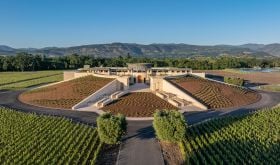
It seems clear that although Elissalde has a hand in all of the Despagne output it is Girolate that is really his passion. And when I saw both how it is grown and made, I realised just how pioneering it is. Girolate comes from a gently south-facing slope of 10 hectares (25 acres) of clay over the limestone that is quarried locally – just like some of St-Emilion and Pomerol’s best terroirs a few miles north of here. “Alain Vauthier of Ch Ausone [the quintessentially limestone-dominated St-Emilion] is our hero,” Thibault said reverently. The vineyard was replanted in 1999. Instead of the widely-spaced rows with grapes trained to hang at convenient waist to shoulder height that characterise the rolling vineyards of Entre-Deux-Mers, the healthy, regular little bunches of Merlot at Girolate are trained so low that they really do almost touch the ground, absorbing heat and not, so far, affected by frost. The rows are less a metre apart, just like Ausone. “We originally thought we’d go for 5,000 vines per hectare,” Thibault explained, “but then we thought we’d try 10,000. Our neighbours think we’re mad.” On the day I visited plant doctor Jean-Pierre Cousiné of Narbonne was going systematically through the vineyard examining each plant and checking its health rather like a dietician.
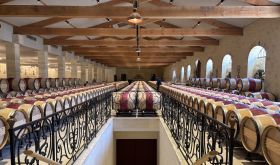
Joël continued, “we want to produce small yields per vine, with high levels of both sugar and acidity, rather than concentrating the wine in the cellar”. Girolate tends to ripen a good 10 days before its more sparsely planted neighbouring vineyards. But if the vineyard is remarkable, the way the wine is made in a pretty ex-walnut mill (being groomed as visitor centre) is unique. Unusually for a red wine, Girolate is all fermented, parcel by parcel, in barrel with each of the ![]() 150 barrels rotated twice a day in an effort to produce a wine with super-gentle tannins. This is made possible by a specially-designed metal cradle with rollers, the award-winning Oxoline barrel rack for which the Despagnes were the first private customers. The grapes are handled like premature crown princes, by nine polyglot cellarworkers in metaphorical kid gloves. No pumping, just gravity, even for draining the young wine out of the barrels after fermentation (where barrel rotation also comes into its own). Every drop of press wine (“where the power but not harshness is”) is squeezed out of the remaining grapeskins by the gentlest of basket presses and flows by gravity into barrel. The most challenging operation apparently is re-assembling each barrel after it has been loosened to get the end off and the pomace out.
150 barrels rotated twice a day in an effort to produce a wine with super-gentle tannins. This is made possible by a specially-designed metal cradle with rollers, the award-winning Oxoline barrel rack for which the Despagnes were the first private customers. The grapes are handled like premature crown princes, by nine polyglot cellarworkers in metaphorical kid gloves. No pumping, just gravity, even for draining the young wine out of the barrels after fermentation (where barrel rotation also comes into its own). Every drop of press wine (“where the power but not harshness is”) is squeezed out of the remaining grapeskins by the gentlest of basket presses and flows by gravity into barrel. The most challenging operation apparently is re-assembling each barrel after it has been loosened to get the end off and the pomace out.
 150 barrels rotated twice a day in an effort to produce a wine with super-gentle tannins. This is made possible by a specially-designed metal cradle with rollers, the award-winning Oxoline barrel rack for which the Despagnes were the first private customers. The grapes are handled like premature crown princes, by nine polyglot cellarworkers in metaphorical kid gloves. No pumping, just gravity, even for draining the young wine out of the barrels after fermentation (where barrel rotation also comes into its own). Every drop of press wine (“where the power but not harshness is”) is squeezed out of the remaining grapeskins by the gentlest of basket presses and flows by gravity into barrel. The most challenging operation apparently is re-assembling each barrel after it has been loosened to get the end off and the pomace out.
 Founded on the belief, backed up by Jean-Louis’ old friend, oenologist Michel Rolland, that the 18th century reputation of red bordeaux was made on yields of no more than 20 hl/ha, it is no wonder that Girolate is not cheap. According to winesearcher.com it is retailing at between the mind-boggling equivalent of £40 (Belgium) and £162 (Brazil) a bottle at the time of writing.
The name Girolate comes from the hamlet next to the vineyard, but sounds like a clever creation with its vaguely chocolatey sound and particularly apt suggestion of gyration. Cruscant, the name of the steeper, south-facing slope opposite the Despagnes’ base which is currently being prepared for planting with Cabernet may not be as memorable for Anglo-Saxons but the wine will doiubtless be priced no less ambitiously.
The good news is that the Despagnes are by no means the only producers in Bordeaux trying to make great wine in less celebrated corners of the region. But if the 2001 is anything to go by they seem to have hit upon a particularly beguiling combination of exceptionally flattering texture with fruit that it both velvety and lively and can be aged for many years in bottle, red bordeaux’s trump card.