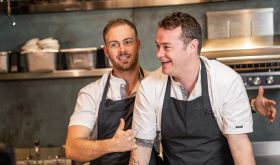

The kitchen at RyuGin (The Singing Dragon) was immaculate just before midnight after an extremely busy Saturday night. The tanks holding the live fish were bubbling away while the counter tops held rows of gleaming knives, pots and pans. The only sound came from the tinkle of a couple of waiters polishing glasses.
Lined up against the far wall were the chefs, six young Japanese and one Canadian working there for a month, who had all played their part in serving the restaurant’s 26 customers with their intricate, multi-course kaiseki, or tasting menu, their faces full of energy and expectation.
When Heston Blumenthal of The Fat Duck in Bray, Berkshire, then walked into the kitchen they spontaneously broke out into smiles, cheers and loud applause, sentiments which he reciprocated as he thanked them and the waiting team for what he described as ‘a remarkable meal’.
Excited questions followed for the next half an hour before RyuGin’s chef/proprietor Seiji Yamamoto guided Blumenthal to the waiting taxi. Bowing incessantly, he too was reluctant to see his revered guest leave and rather unwisely held Blumenthal’s hand through the open window until forced to relinquish it as the taxi sped away. Fortunately, no physical damage was done to either chef.
The principal reason Blumenthal and numerous other top chefs from around the world had gathered in Japan was to attend the recent three-day Tokyo Taste, modestly described as ‘the world summit of gastronomy’. This event, which had taken the last two and a half years to organise, was the dream of Dr Yukio Hattori, who runs a leading culinary school in the city and advises the Japanese government on his country’s nutritional policy.
These increasingly frequent gatherings of top chefs, food scientists and investigators into the origins of taste began in Vittoria and San Sebastian in Spain before gaining a higher profile with the first Madrid Fusion seven years ago. They now take place under the guise of Omnivore in Le Havre, France, and Identita Golose in Milan, Italy, whose organisers, somewhat incongruously, will host the first gathering of this kind in London in late May.
The roll call of those taking part in Tokyo Taste has never been equaled anywhere. Joel Robuchon and Pierre Gagnaire represented France; Ferran Adria of El Bulli, Juan Mari Arzak of Arzak and Luis Aduriz Andoni from Mugaritz had come from Spain; Dong Zhenxiang was over from his restaurant Beijing Dadong, away from a kitchen which prepares 1,000 Beijing ducks a day; Massimiliano Alajmo from Le Calandre near Padua represented Italy; Tetsuya Wakuda from Tetsuya’s in Sydney was, perhaps not surprisingly, Australia’s representative; and Grant Achatz from Alinea in Chicago came from the US. Japan was represented by four chefs: Nobyuki Matsuhisa, who, during his demonstration, explained how 30 years ago he had initially managed to convert Americans to eating raw fish at his Nobu restaurants by slightly cooking it on the outside; Seiji Yamamoto; Yoshihiro Narisawa of the minuscule Les Creations de Narisawa in Tokyo; and Kunio Tokuoka, whose grandfather founded the initial Kitcho restaurant in Kyoto.
But from the moment Dr Hattori opened the first panel discussion with Adria, Blumenthal, Nobu and Robuchon it became clear that, while their presence, demonstrations and insights into new cooking techniques were to prove a source of great inspiration to the 1,000 young Japanese chefs in the audience, these Western chefs owed a great debt to Japanese cooking.
The reasons they gave for their continuing return to this country, which Robuchon explained he had first visited in 1976, were varied. There was the desire to learn more about umami, the fifth taste element after sweet, salt, bitter and sour, which occurs so often in Japanese food as a result of the prevalent use of dashi, a stock at its most refined when made from shaved and dried bonito, seaweed and shiitake mushrooms. Japanese cooking always taught them, they explained, that while Western chefs are finally beginning to respect the importance of the seasons in their approach, this is an area Japanese chefs have never lost sight of.
Meanwhile the structure of the ‘kaiseki’ menu, which originated in Kyoto and incorporates various cooking styles at fixed points in the meal, provides a constant inspiration as they develop their own tasting menus. Finally, there was the unbroken Japanese respect for their traditional dishes, which they may adapt but never forget. It was this particular aspect of Japanese cooking which had first impressed itself so strongly on Blumenthal during a previous visit to Kyoto and had subsequently inspired him to research the history of his native cooking and to revive many long-lost British dishes. These will appear at The Fat Duck on a tasting menu devoted solely to historic British dishes later this year.
While the audience was dutifully respectful to all the chefs on show, there was no doubt that it was Blumenthal who captured their and the Japanese media’s attention. This was not in most cases because they had eaten at his restaurant but because Blumenthal, 42, has managed to establish himself so quickly (The Fat Duck has been open for only 13 years), so widely and despite coming from a European country without a rich and respected culinary tradition. While Japan has produced a vast number of highly talented chefs, few have been able to establish their own identity, to escape from a tradition where the chef’s name and identity are secondary to their style of cooking and the techniques they use.
This process is finally beginning to change as some of the young Japanese chefs emerge and manage to impart their own personality within the unchanged structure of the kaiseki menu – none more personably than Yamamoto.
His ten-course menu still acknowledges tradition in its structure and contents (including one rather forgettable dish of fugu, or blowfish, sperm) but was impressive in every other sense, particularly the final fish dish of blackthroat sea perch. This was presented on a white rectangular dish with the sliced fish, the first of spring’s new broad beans, lotus root and Japanese raspberry laid out on the lower right hand side of the plate. The opposite corner of the plate was taken up with black letters and a red painting, both incorporating miso sauce. While the former spelt out the name of the fish in both English and Japanese, the silkscreen drawing was an impressive representation of the fish itself, letters and an image removed by the round disc of lotus root used as an eraser. It was stunningly impressive.
All these demonstrations, discussions and late night gatherings in the bar at The Imperial Hotel took place against worsening national and international economic news from which no chef anywhere can escape. And while the talk amongst Tokyo’s restaurateurs was of how they are going to have to consider tempering their chefs’ culinary imagination in an effort to keep their businesses alive, it was left to Ferran Adria, who had initiated the process of what is now referred to as molecular gastronomy, to put the current situation in perspective.
'The situation in Spain at the moment is not good, even though, surprisingly, bookings for El Bulli this summer have been even stronger than ever before', he explained over a gin and tonic. 'But I can see a future in which the number of chefs who can take the same culinary risks as we have done over the past decade will be severely reduced, I’m afraid. I think that in size at least we will become rather like the number of Formula One racing teams or haute couture houses in Paris and Milan, of which there are now only a very small number as they are so expensive to maintain. But this period will also be a great challenge to chefs. I think we will have to pursue our goals with even greater passion and to work even harder to please our customers. And that is not necessarily a bad thing.'
[Our image of the restaurant's entrance comes from www.andyhayler.com, a restaurant review site with full contact details and a rave review of RyuGin where the reviewer cites an average price per head of £163 – JR]