29 May 2017 This article has been syndicated.
For those of us responsible for The World Atlas of Wine, Chile is a nightmare. Every time a new edition is needed, the extent of viticulture in this, the longest and thinnest country on earth, has grown. For the first six editions we could – just – squeeze the Chilean wine map on to one page with our usual north to south orientation. In the seventh edition, vine growing had spread so far north and south that we had to turn the map through 90 degrees and run it across the bottom of a double page spread.
For the next, eighth edition, I really don’t know what we’ll do because viticulture now extends from 18°49′ in the Atacama Desert to 46°33’ south in Patagonia, with some cartographically inconvenient breaks in between wine regions.
Earlier this year I was invited to visit what was billed as Chile’s southernmost vineyard in commercial production, six-year-old Pinot Noir vines clinging perilously to a hectare of basalt on the river Puelo at 41º south, very close to the Argentine border. Road links between Chile and Argentina are few and far between this far south. My original plan to reach this area via Argentine Patagonia foundered when I realised I would probably need a horse to manage it.


Instead we flew from Santiago to Puerto Montt, gateway to Patagonia, and were thoroughly shaken for a good three hours on substantially unpaved roads before boarding a speedboat that took us for 20 spectacular minutes across a lake formed by the river Puelo (above, with ferry). Our initial destination was a lodge owned by wine producers Villaseñor, who have vineyard holdings in Colchagua and Curicó for their Kenos brand and have plans for a further 40-ha (100-acre) vineyard in Patagonia. Villaseñor’s commercial director has to drive 12 hours each way several times a month to oversee the company’s Patagonian operations.
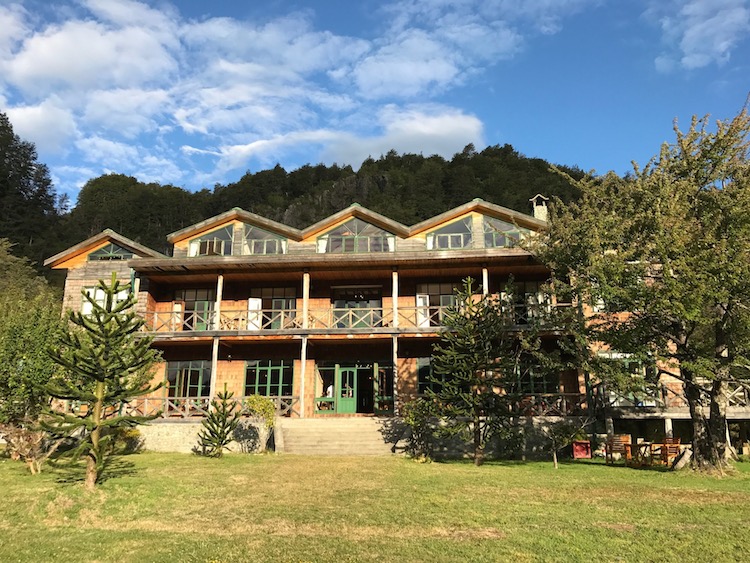
Even if the vineyard had turned out to be non-existent, or the wine undrinkable, I would not have regretted making this journey. Mitico Puelo lodge, originally constructed out of local wood by an American in the 1990s, was Chile’s first dedicated fly-fishing lodge (below, with evening view from our room) but it exerted a powerful charm even on this angling agnostic. Approached on foot from the small jetty, across a wooden bridge that swayed with each footstep over the fast-flowing mountain stream that provides all the electricity needed by the 40 guests it can accommodate, the lodge sits on a meadow overlooked by soaring mountains and a dramatic waterfall. It is pure southern-hemisphere Heidi in air so pure that my lungs felt as though they had been spring cleaned.

I was accompanied by my co-author of Wine Grapes, Swiss geneticist José Vouillamoz, who was charged with examining the wild vine that gave rise to the Pinot Noir vineyard. An extensive, fully mature vine had been found thriving, indeed almost strangling the tree that has long supported it, near the waterfall and inspired the owners to look for somewhere nearby that would accommodate a proper vineyard. José has taken samples of the leaves so that he can analyse the wild vine’s DNA back in Switzerland. He has since confirmed that it is Bonarda, the variety known as Charbono in California and Douce Noire in Savoie. No one knows how the heck it got there, but it may have arrived over the Andes from Argentina.

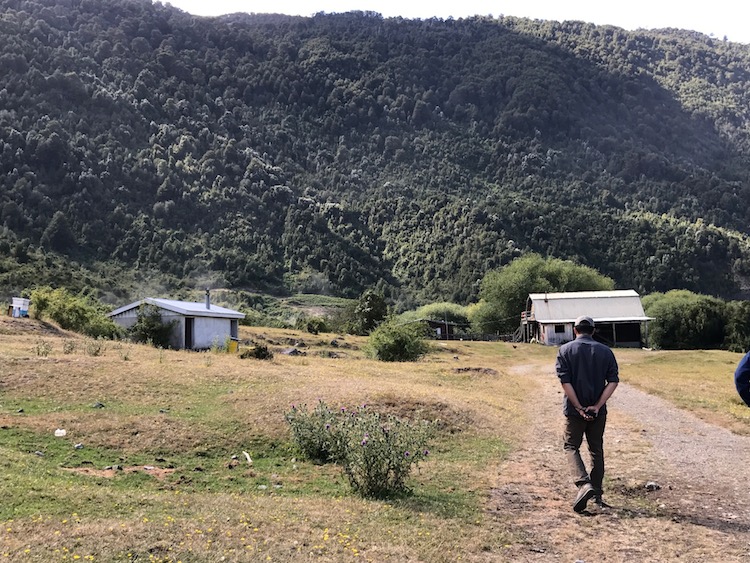
The morning after our arrival we travelled in a small boat a further 15 minutes upstream and then walked half an hour through woods and then across an open valley with a couple of farms in which whole skins of sheep and cows were drying in the barns. There was no particular path and certainly no road. But we eventually got to several small vine plantings, most of them experimental, where a wide range of varieties have been trialled. We were told that the most successful are, apparently, and rather surprisingly, Marsanne, Mourvèdre, and the Pinot Noir that has been planted on the highest patch of flat land exposed to the most daylight. This is not the most obvious place for a vineyard – annual rainfall is usually about 2,000 mm (79 in) – but the soils here drain pretty well.
After being picked by a crew shipped in from Villaseñor Wines, the grapes travel 900 km (560 m) north to the winery in Talca via a track that runs conveniently close to the vineyard and the regular ferry across Puelo lake. The debut vintage of Puelo Patagonia Pinot Noir (rather a good name, I think) is 2014. It has been smartly packaged with an incredible amount of technical information on the back label and actually tastes convincingly of light, fresh, unoaked Pinot with a little warm mineral undertow.
In fact it tastes so good that Villaseñor’s Chinese importer wanted to snap up the lot. He has made do with half of the 1,300 bottles produced and is apparently charging the equivalent of US$150 a bottle in China.

I wonder, however, how long Villaseñor can hang on to its status as Chile’s southernmost commercial vineyard (view therefrom above). As supplies of water diminish, all manner of Chilean wine producers are sniffing about down south. There is also a research station, operated jointly by Undurraga’s winemaker and a government research agency, at Chile Chico at 46° 33′ in Aysén region in a particularly favoured corner of Chilean Patagonia where they are trialling different grape varieties. The nearby General Carrera lake moderates what would otherwise be a climate too cool for vines, and cherry trees can be grown very successfully there, although winds can be inconveniently strong.
On my return from Chile’s far south I received an email from Miguel Torres the younger (who has long championed southern Chile in general) telling me that he and his father have recently acquired 800 ha close to Coyhaique at 45° 34′ in Aysén, close to the Argentine border. For the next few years they will be experimenting with different vine varieties, recognising that this is a decidedly long-term project undertaken as a bet on accelerated climate change.
I should add that Argentina’s southernmost vineyard in terms of latitude is Alejandro Bulgheroni’s planting at Sarmiento in the Chubut region at 45° 60′, between the new Torres property and the Chilean government research station in terms of latitude. This is bad news for New Zealand actor Sam Neill, who was hoping that his Last Chance vineyard for the Two Paddocks wine operation was the world’s most southerly. A recent latitude reading put it at 45° 15′. So just the southernmost in New Zealand then.