Ricard Giner-Sariola writes of Catalan ancestry and heritage, I live a British kind of life in North London, where I earn a living in international higher education. I did also once work in wine, and until last year I was on the Committee of the Wine Society. Now I live for wine. And thankfully a few other things, all of which keep me healthy, and a few people, all of whom keep me sane.
Gazing into the eye of the hare
Since childhood, I have grappled with the painful difficulty that paradoxes are real. How can something self-erasing be real? I see them everywhere, every day: the more I think, the less I know. But I only considered them in cerebral terms, like a problem to be solved by thought alone.
Until I saw them in wine.
I saw that wine embodied multitudes of animated paradoxes: wines that taste of granite while containing no minerals from granite; wines that tell a story without words; the unmistakable aroma of strawberry where strawberries have never been. And above all, a living expression of the ancient problem of other minds: how can one person’s experience ever be truly known by another? The problem is present, hovering like Descartes’ deceptive demon, when two or more people taste the same wine and discuss it. I say star anise, you say fennel.
My relationship with Tempranillo goes back almost 40 years, to the summer of 1988. I was home from university and Viña Real Crianza, a simple but splendid red Rioja, was my parents’ everyday supper wine. It was the 1986 vintage. The label contained useful information such as alcohol level, and an intriguing little map of Rioja Alavesa, but not grape variety. Later that year, a shopkeeper in a now extinct little delicatessen in Fitzrovia told me that Tempranillo was the foundational grape of all red Rioja. He sold me a Tondonia 1979, which I bought to drink with a friend on my 21st birthday. A wine from a poor, forgotten vintage became transcendental, fixing my framework of aesthetic appreciation indelibly. It presented me not just with so many more layers of fragrance than the Viña Real, such as carob, prunes and charcoal, but also a melancholy mushroomy note, reminiscent of dark cellars and the spores of history.
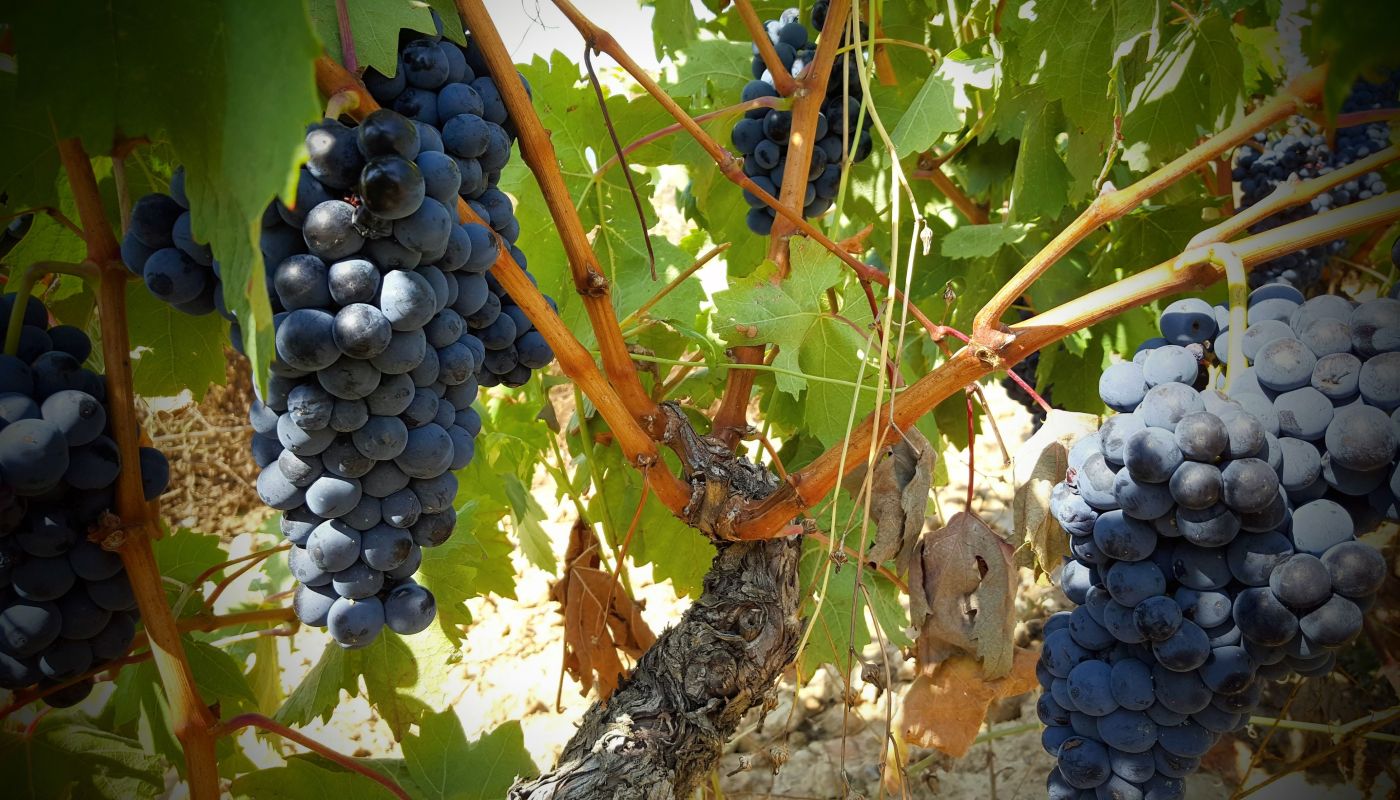
Tempranillo, affectionately, is the diminutive for “early ripening”. And it has other names: Tinta del País, Tinto Fino, Tinta de Toro – from the Latin tinctus, literally to stain, a tint, a dark inky stain. A country tint, a fine tint, a tint from Toro. And in my native Catalonia, Ull de Llebre: “eye of the hare”, each berry staring at you.
Another time, I learned that in Rioja, Tempranillo is often “supported” by other grapes such as Graciano or Mazuelo. My head spun. Why did it need assistance? Did Tempranillo even have intrinsic properties? Was it inseparable from the qualities it obtained from its soil, from its environment, from the winemaker’s intentions and preferences?
Why, in Ribera del Duero and Toro, does Tempranillo explode into aromatic hues entirely unalike? Well, we do know: altitude, diurnal temperature variation, soil, humidity… Like a traveller accumulating wisdom, Tempranillo carries the story of the Iberian Peninsula: its landscapes of undulating slopes, craggy Cantabrian peaks and Atlantic breezes in Rioja, the unforgiving blistering summer sun and open continental vastness in Ribera and Toro. A common narrator producing wines profoundly contrasting, wines deeply rooted in their respective localities and traditions.
Consider Prado Enea, the 2001 vintage: soaring aromas of cherry, vanilla, leather, the sizzling marbling on a barbequed ribeye steak, moist pipe tobacco. Exquisitely nuanced, perfect density and weight. Unforgettably romantic and bafflingly profound, a colossus of a wine. Just the thought of its silky seduction makes me sigh.
Or Mauro 2004. A humble Vino de la Tierra de Castilla y León, because the great winemaker Mariano García didn’t want to obey the rules of neighbouring Ribera. But almost the whole wine expresses the mysterious power of Tempranillo to take you deep into the heart of the place in which it’s grown and nurtured. Huge structure, explosive fragrance of sweet spices dancing alongside the fruit, a glossy freshness. Exuberantly youthful and energetic, with backbone and nerve. Richly satisfying, richly textured. Less of a sigh, more of a gasp.
So this was Tempranillo in Rioja, and Tempranillo in Castilla.
Then I discovered age. Age made me see that place is only one of the deep dimensions of difference in a grape. Time is the other.
With age came emotion. Space made me think; age made me feel. It was no longer the case that a grape could be something important, serious and deep. It was now the case that grapes could transport you back in time to a distant summer, and speak to you through the ages, the entire arc of the story told through olfactory sensations, each aroma a word.
My old friend Tondonia took me there. The 1964 vintage, tasted in 2018. Many years before this shattering epiphany I had known Ygay 1928, Bujanda 1973… But this, this was like being spun backwards into a vortex. Spain, in 1964: still another decade of dark dictatorship ahead, the country just beginning to open up to the world. In Rioja, the perfect vintage: the summer warm but not roasting hot, September mild and dry. I tasted the Tondonia in the legendary López de Heredia cellar with a small group, all silent, surrounded by countless cobwebbed bottles, and in that first light smattering of clove and cinnamon, figs and carob, through tears of emotion, I saw that the dazzling symbiosis of opposites contained in that glass – tradition and modernity, robustness and delicacy, mundanity and sublimity, humility and hubris – was not something to be understood in the mind, but to be felt in the heart.
At last I saw Rioja in terms of Tempranillo: in youth, tannic vigour and pepperiness. In middle age, velvet (itself a paradox: lustrous in one direction, hirsute in the other). And finally in old age, fiendishly involute, Byzantine in its sheer exuberance of aromatic complication.
Time changes wine, and in an enigmatic fecundity, produces more paradoxes. Over time, red wines become lighter in colour, and white wines become darker. Sometimes, if they are old enough, you cannot be certain of their colour at birth.
Reason cannot untangle the paradoxical mysteries of the grape, but with emotion, we can inhabit Tempranillo itself.
Main image caption: 'Tempranillo vine in the Muga vineyards in Haro, La Rioja, 2018'.