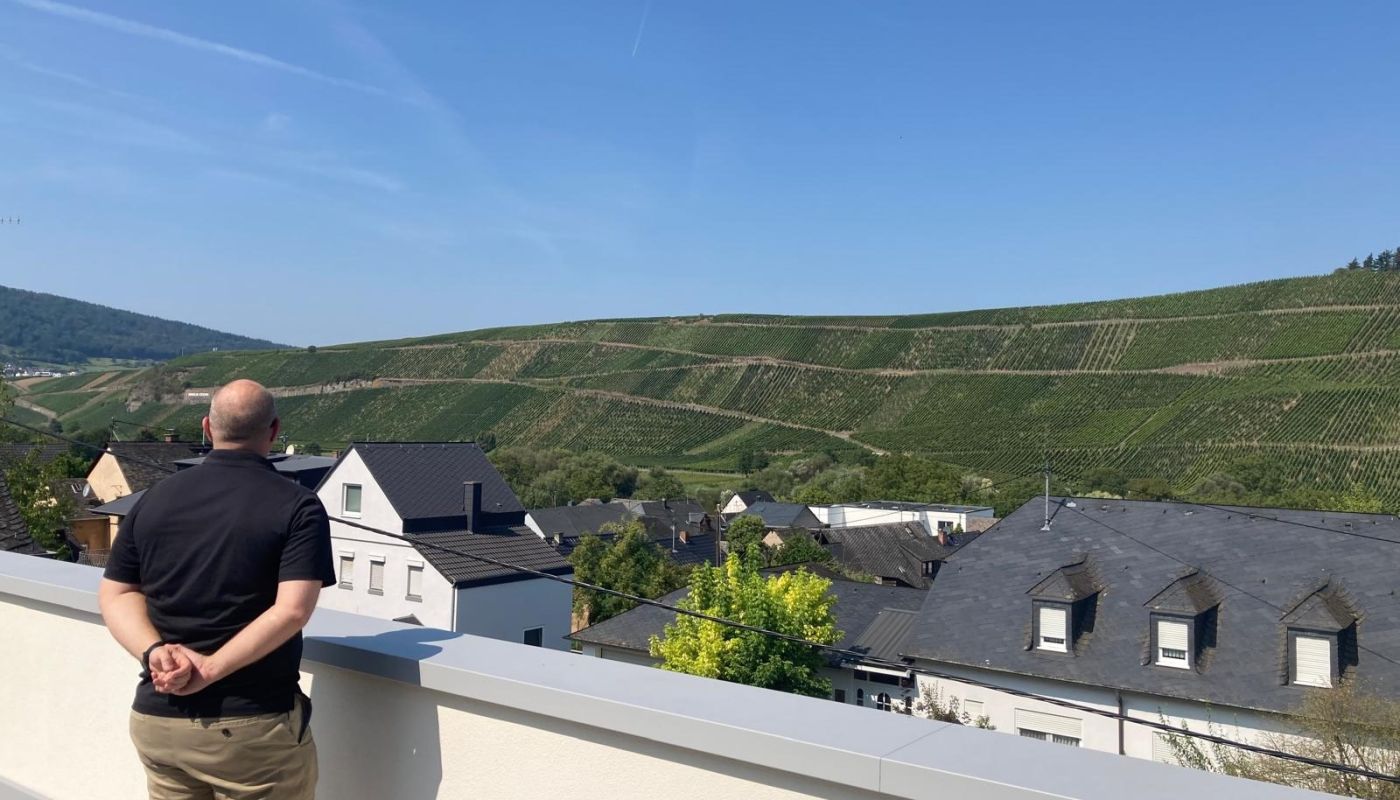
Matt King writes Matt’s obsessive personality rotates focus among multiple interests but is always intense. At times these have included starting small businesses, running marathons, building coffee tables, back-country camping, CrossFit, golf, and fantasy football, among others.
And now, of course – wine.
He went to Kansas State University and then Oxford on a Fulbright, worked for a decade at the World Bank on climate finance and now helps run a clean cooking fuel business in Africa called EcoSafi. Blah blah blah.
More importantly, he’d like to think he’s a reliable friend to many, a rock for his family and a stalwart partner to his wife.
Luckily, his new hobby is far more enjoyable with company.
Reluctantly Riesling
How I learned to love Germany through Riesling
“They’re sending us to Wiesbaden, Germany!” my wife, a US Army officer, exclaimed.
“That’s incredible!” I said.
“That’s disappointing,” I thought.
Why not Vicenza, Italy? It’d be only a short train to Venice, with other world-class cities like Florence and Rome reachable for easy weekend trips.
(Not to mention being in the heart of the Veneto and a short distance to Tuscany and the Piedmont.)
Were there no roles at embassies or small outposts in Spain or France? I could see myself regularly enjoying paella in Barcelona or strolling through the Jardin des Tuileries in Paris.
(Not to mention sipping on a white Rioja or delicate Burgundy while doing so.)
Why not Brussels, the home of NATO and the capital of Europe? Or an air base in England, where I could be walking the Cotswolds or experiencing the chaos of London?
(Not to mention indulging in either’s iconic ales – whether Trappist or cask-pulled and room-temperature.)
Although I’d consider myself well-traveled in Europe, I’d fallen into the myth of Germany as the Old World’s uninspiring younger sibling.
And while German beer is world class – it wasn’t enough to get me overly excited (pilsner is from Czechia, after all!) or to fill the void I seemed to see in the middle of the European wine map.
But then my German colleague, who hails from Wiesbaden’s working-class neighbor Offenbach, dismissively shared that all they do on that part of the river is “sit around and drink wine.”
“How lazy!” I said.
“How lovely,” I thought.
Within six months in the Rheingau, I’d had my share of riesling at seemingly-ubiquitous local festivals, including Wiesbaden’s popular Rheingauer Weinwoche.
Too sweet. Lifeless. Simple. Meh.
I swore off it for the next six months, and took pride in being a riesling contrarian.
Then my friend Seth moved to Germany for work.
A wine connoisseur, he asked me to give it a chance. Made me, really.
“You’re doing it wrong!” he laughed.
“You’re probably right,” I said.
“You’re crazy,” I thought.
A forced excursion with Seth to Georg Breuer in Rüdesheim opened my eyes.
Steffi in the tasting room taught me about the VDP system. Walked me through the nuances of the production process. Suggested how to approach and then appreciate a proper riesling trocken. Gave us her reservation that night at Weingut Carl Ehrhard, even though a table for one of their locally-renowned tasting dinners was a rare prize.
Perhaps most importantly, I found a riesling that I loved. The 2022 Estate Lorch.
Some might argue that it is a lowly ortswein from a relatively less-regarded vintage that struggled with challenging conditions. But the crisp, mineral experience had me hooked.
“I had been doing it wrong,” I realized.
My newly-opened mind and better-educated perspective took me in search of my next Lorch.
To the Mosel Valley, where producers have taken the exquisiteness and precision of slate-based rieslings to another level. Where Oliver Haag regaled us with his passion for winemaking on the dramatic terrace overlooking the Juffer Sonnenuhr.
To other producers of the Rheingau, where Künstler’s Hölle might be perfection in-a-glass and Robert Weil’s Gräfenberg spätlese was the first late-harvest riesling that I’ve truly adored.
To the Pfalz, where – despite the high expectations (and price tag!) – Dr. Bürklin-Wolf did not disappoint.
The more riesling I tried, the more I began to understand the nuance.
Crisp. Acidic - sometimes biting but more often well-balanced. Layers of flavors and textures that need to be peeled back and explored.
Kinda like Germany, no?
And so, my newly-opened eyes started to recognize the balance, beauty and brilliance of my temporary home.
Hard to get to know but worth the investment.
(Like the weekly market. Intimidating with the chaotic crowds, overwhelming options and a density that tempts dismissal but that has rewarded us with the best produce we’ve ever tasted.)
Steadfastly and quietly reliable but with undercurrents of intense flavor that can dance and sing.
(Like my coaches and classmates at the local CrossFit gym. Patient with my poor German language skills but the heart and soul of our energetic workouts.)
Under-appreciated at first but once cracked is full and vibrant and exciting.
(Like my wife’s German co-worker. Direct and assertive but inexhaustibly helpful in planning all the logistics for her unit’s annual ball – and now my favorite of all her colleagues.)
It requires patience. An open mind. Curiosity.
“Time under load” as a former gym coach used to say.
We’ll leave next year. Although I’m ready, I’m sad and disappointed yet over-joyed we had the opportunity in the first place.
It’s a complex mix of emotions. It’s complicated. Just like riesling.
And so I arrived in Germany a skeptic. Then became the opposition. Then curious.
But now committed.
We’ll take with us a wealth of memories, a hard-earned appreciation for and love of Germany, and a good life lesson to stay open.
Not to mention a world-class riesling cellar.
The image is captioned: 'overlooking the Juffer Sonnenuhr from Fritz Haag'.
















