Jonathan Bates writes after forty years working for one of the UK’s scientific Research Councils, I retired as Director of People and Skills in 2014 and now enjoy a quiet life in Dorset, punctuated by regular trips to France and occasional visits to Argentina, Chile and India. Wine and music continue to be essential parts of my life and sharing a good bottle or a song with someone I like gives me total pleasure.
Faithfull to Ente
Happenchance.
Because, of course, we live accidental lives. We turn down a particular street on impulse, we pause to gaze in a shop window or at a face glimpsed through a crowd, we hesitate, change our minds, vary our route. We turn left; we could have walked on. Whatever.
Sometimes we end up In the right place at the right moment.
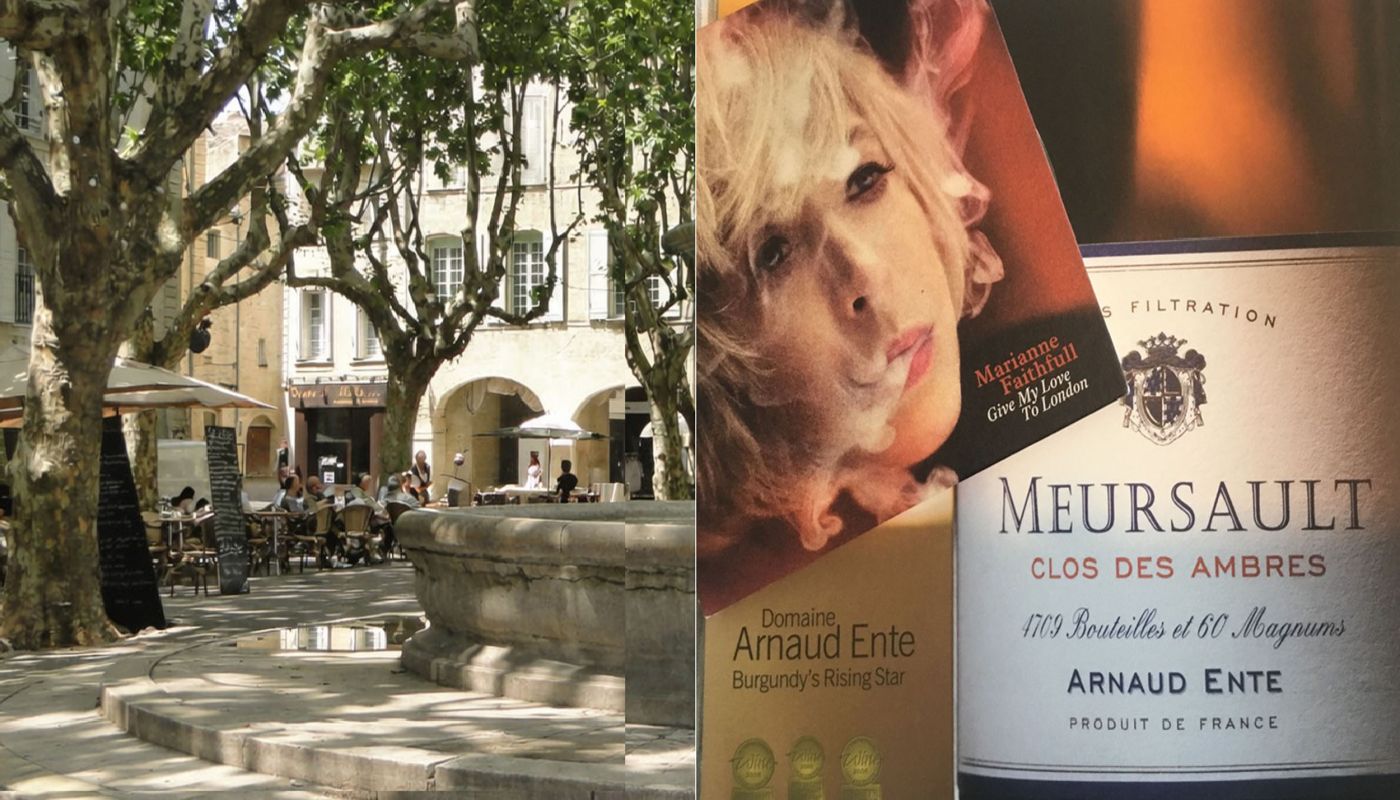
So it was that I found myself sitting at a table outside an out-of-season café in France, beneath ancient plane trees, on a day that was quietly calm and set up like a cliché: dappled light, birdsong, a breeze so gentle it was like my wife’s hand resting on mine. The quietness of the square was overwhelming: it would have been easy to fall asleep.
Except for one thing. I was drinking one of the best wines I had ever tasted.
This was the late 1990s. I was into my forties, at a time in my career when I could consider buying occasional bottles of very good wine, when cases of Chassagne Montrachet and Meursault were starting to appear alongside the Gigondas, Chateauneuf and St Emilion in what I rather grandiosely called my cellar.
This wasn’t a Chassagne though, nor a Meursault, or a Puligny. The label simply described it as Bourgogne Chardonnay. It really shouldn’t have been this good.
It couldn’t be this good…
I liked to think that I had an idea what great Burgundy tasted like. I had drunk Roulot, Coche-Dury, Ramonet, Leflaive. Not often, but enough to know that this was up there with the best of them. The same crystalline clarity, that sense that the winemaker had gently persuaded the flavours to appear, rather than beaten them out of the grapes with a few hefty staves of wood. That lingering, developing taste in the mouth.
I inspected the label more closely. Arnaud Ente.
Not a name I knew.
I sat there, enjoying the sunshine, sipping, rolling the wine around my mouth. Finding secondary flavours. And then, as if to add another layer to the experience, a song began playing in a room somewhere above me.
I knew it instantly. It was as if someone had carelessly opened a photograph album and let faded pictures slip from dried-out photo corners, send them tumbling towards me like ghostly leaves. Because this was the song of my youth. This was me, eleven years old, kneeling on the rear seat of a car leaving a Cornish village and gazing backwards at a deserted bay whilst Marianne Faithfull’s voice broke my heart.
As Tears go by. A uniquely English voice, perforating the trees in a small French town.
I had watched Marianne in concert. Not in the ‘60s, when that song had appeared in the UK charts, but in more recent times. I loved the variety of her output, the boldness and confessional quality of her voice. Her forays into Weill.
I would go on to watch her many more times. I would hear her sing As Tears go by every few years, her voice increasingly scarred by the passage of time, infinitely more sad with each passing decade. I’d see her hobble onto stage, a broken women singing Broken English, in the last years of her life. Provoking more tears than the notes that drifted like leaves in the square that day.
I sat there, sipping this quite extraordinary wine, and listening to an echo of my past, overtaken by the extraordinary coincidence of events. The music only added to the surprise of the wine. It hadn’t been an expensive bottle. It had cost rather more than I might have expected for an ordinary Bourgogne (which was, to be honest, why I had chosen it) but it wasn’t an outrageous price. Arnaud Ente wasn’t well known then.
I went home and filled my cellar with bottles of Ente’s Bourgogne and a small quantity of his Meursault too. The wine merchants who sold them indicated that the problem was there weren’t many bottles, which was borne out by the numbering on the labels. I liked the idea that I owned so many percent of the vintage of a particular wine. I continued to buy it in subsequent years, from wine merchants whose shops have long closed, from one London based supplier who still offers it, until it finally became too expensive for me. The world has discovered Ente now.
I have a few bottles left of the 2011 Bourgogne Chardonnay which – amazingly -still tastes fresh. I drank one the other day. I sat and sipped it in my Dorset home and let Marianne Faithfull seek out the corners of the room, her voice scribbling graffiti around the walls, scattering notes that sent spiders scurrying.
The good news is than since that day in France I have discovered many other Burgundy wines that outperform their status. I recall an Auxey, a Pouilly Fuisse, a Macon. Another simple Bourgogne from the Cote d’Or. Although nothing, I think, quite so good as that Ente.
I have discovered many alternatives to Marianne Faithfull too.
I have discovered voices that caress me like fine wine.
As I grow older there is little that gives me more pleasure than sipping a good glass of chardonnay, perhaps a discovery I have made, perhaps something I have splashed out on, whilst listening to the music of an artist I like to think I discovered. Throw in a room overlooking the sea and I am in my element.
So let me pour you a glass: here’s a Bourgogne Chardonnay for you. You think it takes like a Meursault? From the Puligny border? I agree. Here, examine the label.
Here’s another glass, something a little different. You think this reminds you of Roulot? And so it should; it’s Charcra, from an estate he works with in the Argentine.
Let me play you something, a song you may not know…
You haven’t heard of Dar Williams? Oh, let me play you the The Ocean…
You will want to hear more.
Published unedited and in accordance with the rules of the competition published here.