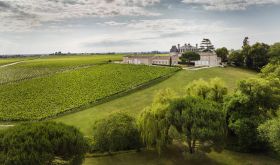
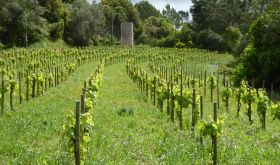
Brian Schmidt is the only vigneron I know whose working pattern tends to be dictated by the phases of the moon, but is deeply sceptical of biodynamics. He admits, 'I'm very close to the moon', but could not be further from the loony fringe. He is a cosmologist. And not just any old student of the planets but, as of last December, a Nobel laureate. His work, along with that of Saul Perlmutter and Adam Riess in the US, has demonstrated that, contrary to what we have been taught, the universe is not contracting but expanding at an accelerating rate. An American by birth now resident in Australia, he has just been elected to the Royal Society in London, and the list of international awards for his scientific work is almost embarrassingly long.
In fact he says that such have been the calls on him since he received his Nobel prize in Stockholm in early December that 'the only thing that saved me' was a long-planned trip round Europe in the weeks just afterwards with his Australian economist wife and their teenage children when no one knew how to contact him. But between Stockholm and a family Christmas in Austria he flew back to Australia for a week so that he could spray his vineyard near Canberra and protect it from the fungal diseases that were threatening it.
On the face of it, it seems a little strange that someone who can converse with confidence and conviction about the likelihood of life at the far end of the galaxy (reasonable) and who has made a discovery that calls every string theorist's life's work into question should have such a propensity for micromanagement, but Professor Schmidt, 45, views wine production as the ideal counterweight to cosmology. He is also determined that he and his family and friends should do all the work in his 1.1-hectare vineyard and small cellar – with the sole exception of pruning, for which he drafts in a Laotian crew.
South east Asian influence extends to the name of the vineyard, Maipenrai, a Thai word he assures me means 'she'll be right', given to the property by the previous owner, an Australian aid worker. After an upbringing in Montana, Alaska, Arizona and then Harvard, Schmidt found himself in Canberra in the mid 1990s in his capacity as professor of cosmology at the National University there and his work at the Mount Stromlo National Observatory (hence the fact that his availability for wine work is governed by what the moon is up to).
I met him when he was giving a talk at a (rather scientifically imprecise) wine conference in Tasmania. He freely admitted that, on exposure to fine wine, he became addicted to it and was in danger of analysing it to death. But he then realised how viscerally rewarding it could be to look down into the soil rather than up into the universe and planted his vineyard in 1999. He raised the biggest laugh with his winemaker audience when explaining how he justified this folly to his wife on the grounds that they would make money from it – and almost as much when outlining the bucolic vision of their spending 'quality time' in it together.
Canberra District has a rather indeterminate reputation as a wine region. Its most famous wine is a Shiraz/Viognier blend made at Clonakilla, whose winemaker Tim Kirk trained as a Catholic priest and is Schmidt's best wine buddy – a different personal élevage that he relishes. But the Canberra wine that first caught Schmidt's attention was a Pinot Noir from his near neighbour in much cooler territory at Lark Hill which inspired him to devote his vineyard to the demanding red burgundy grape.
He describes his first vintage, 2003, thus: 'Eeegh. Not faulty, just terrible to taste. I was worried it would always be like that. I've never released it. It's still all tannins and no fruit.' But, having tasted the Maipenrai 2009 (right,, in Schmidt's small winery), I can assure you that it is very respectable indeed. We tasted it with dinner in Hobart alongside an offering from the same vintage by Gary Farr, one of Victoria's most admired Pinot veterans, and it easily held its ground.
Schmidt seems touchingly thrilled by the world of wine. Although he could presumably run rings round most wine scientists, he expresses any scepticism with courtesy and good humour. He is concerned, for example, that the work of Australia's leading writer on viticultural matters, John Gladstones, is not peer-reviewed and has a particular quibble over the precision of his estimates of growing season temperatures, leading to a disagreement over the likelihood of global warming. (Gladstones is agnostic.) Grand middle-aged man of Australian wine, Gladstones disciple Brian Croser, tells ruefully of how long it took him to realise that the affable questioner in one of his celebrated lectures was not the usual ill-informed contrarian but clearly a highly qualified scientist.
I asked Schmidt what surprised him, as a scientist, about the wine world. 'I'm actually surprised how technical a lot of commercial wine production is. Things are done very much from an industrial chemistry point of view at certain price points, but that's not the impression you get with wine. I suppose it makes sense because if you want to make a reasonable $7 bottle of wine, it does take a lot of that sort of skill.
'But on the other, artisan side of town, it surprises me how some people, especially small winemakers in the Old World, leave the science out completely. I think that's to their detriment. It's always good to have some idea of what's going on, whether it's cheese or sourdough, so that you can stop bad things happening. It's their livelihood but they seem to be almost proud of doing nothing. For instance, if the pH of a wine is 3.9, nothing is going to save it. Bacteria are bound to take that wine down eventually. I would have thought that's something useful to know. I like sourdough… but I don't like faulty products.'
The 2012 vintage of Maipenrai was picked on the hardly auspicious date of 1 April, by a 'big party of 90 astronomers, economists' and other friends of Schmidt and family so numerous that they must have stumbled over each other in the vineyard. He got the fermentations finished before setting off on his travels to the Royal Society in London, a workshop in Oxford and a trip to North Dakota to visit his 92-year-old grandmother. He reports, 'the reality is that I'm making better wine than I thought I would. The whole process is simple but beautiful' before pointing out 'It's easier to sell your wine when you have a Nobel prize, it turns out'.
SOME OTHER CANBERRA FAVOURITES
Clonakilla Its subtle Viognier-influenced Shiraz almost single-handedly turned round the Aussie Shiraz supertanker
Collector Admired one-off wines made by Alex McKay, about whom Schmidt says, 'he's a real intellectual'
Lark Hill One of the coolest spots can make some fine, refreshing Pinot Noir
Wallaroo Deliciously refined Shiraz from a ridge of granite in the Hall district