Organic de-alcoholised wine?
The dpa (the German Press Agency) sold a story last week on the German government’s desire to have EU law changed in order to allow alcohol-free wines to be labelled as organic. The German Minister of Agriculture, Cem Özdemir, made a statement in a press release that, ‘With the support of other member states, Germany has submitted an application in Brussels for the de-alcoholisation of organic wine to be approved under EU law.’
I want to tackle a few things in regard to this piece of news but I’m going to start with why de-alcoholised organic wine wouldn’t automatically qualify for organic labelling. Under EU organic certification for wine, in addition to being limited in what pesticides and herbicides you’re able to use, you are also limited in your winemaking practices – and vacuum distillation, in essence the process of gently heating a wine under vacuum so that alcohol boils off at a lower temperature, is prohibited (take a look at Julia’s article on the science of alcohol reduction for more on how de-alcoholisation works). It’s notable that vacuum distillation is approved for organic food – just not for organic wine. And until December 2021, non-alcoholic wine was subject to EU food law, not EU wine law. Because regulations take a long time to go into effect it wasn’t until January 2023 that the organic seal was prohibited on de-alcoholised wines.
When it was realised that this was the case, steps began to be taken to adapt regulation on de-alcoholised organic wine production. According to the European Parliament, changes will likely be implemented at the end of 2024. I believe, but can’t be certain, that the new press release on this is because adaptations are currently being ironed out.
Because it’s interesting, I’d also like to mention that under US law, de-alcoholised wine is still subject to food law instead of wine law – which means that, unlike regular wine, which cannot be labelled as organic wine if it contains any added sulphites (it can only say ‘made with organic grapes’), de-alcoholised wine can be labelled as organic even with added sulfites. Personally, I think that it’s damaging that the US government allows wine made with a more intensive and environmentally harmful process to be labelled as organic before allowing regular wine producers to do so but that’s politics and powerful lobbies.
Beyond the scope of this convoluted regulatory information, I want to mention a couple things in regard to organics and de-alcoholisation. People tend to buy products labelled as organic for two reasons – either they believe that they’re better for them or they believe they’re better for the environment. I cannot prove to you that organic de-alcoholised wine isn’t better for you than regular organically farmed wine – I just think it tastes worse and I’d rather drink one of our recommendations in our recent article NOLOs for dry January but in regard to environmental stewardship … de-alcoholisation is entirely at odds with sustainability. The process of de-alcoholisation is insanely energy intensive. If you’re buying organic de-alcoholised wine because of the environmental benefit, you would really be better off considering a product that consumes less energy – like, say, one of the teas in the article I just told you about.
Australian wine glut
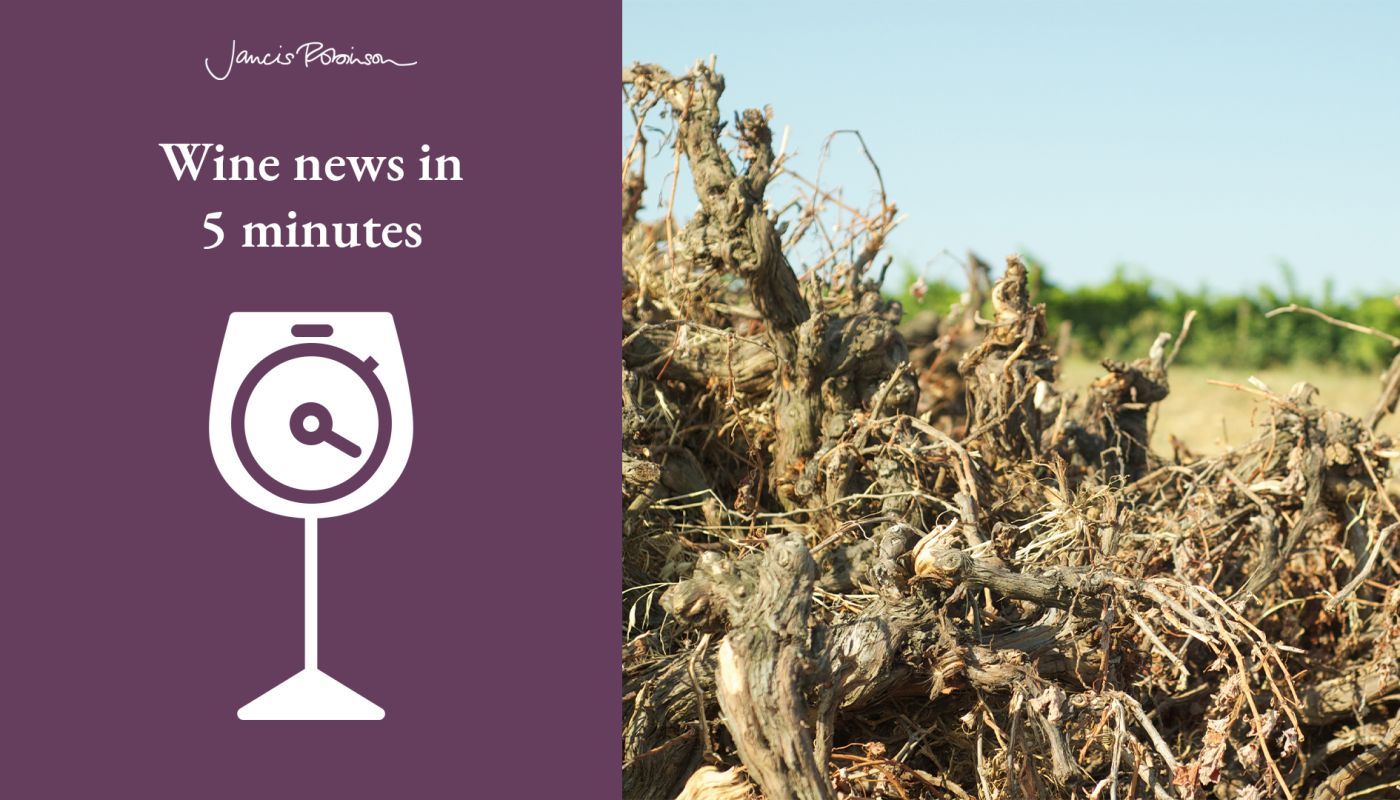
Last week CNN and the National Post reported that Australian growers were ripping out millions of vines due to the Australian wine glut. Most of this ripping is happening in Riverland, Riverina and Murray-Darling, where most of Australia’s bulk-wine production takes place. The Australian Broadcasting Corporation (ABC) reported that growers in Riverland are calling for a moratorium on grapevine plantings of red varieties.
Then yesterday, ABC reported that last Friday, 8 March, Australia’s agriculture ministers met and agreed to put together a task force of government officials and industry groups to propose solutions for Australia’s wine industry. They’re expected to have preliminary suggestions at the end of April. It remains to be seen if the Australian Grape & Wine association’s request for an AU$86 million support package will be included in the new federal budget that will be announced in May.
As far as the wine glut is concerned, I’d like to remind everyone that it’s not just Australia that should be putting together these committees and proposing aid packages. France has already put measures in place, but the US, Spain and Chile would benefit from committees like these and from discussions on which agricultural commodities are in high demand and could bring sustainable returns and which jobs farming skill sets could transfer into.
Unsustainably low wine prices
When I spoke about protests in France in the news broadcast on 30 January, I also spoke about supermarkets pushing for unsustainably low prices because government was pushing them to keep food affordable. Well, this week saw an egregious wine offer …
Lidl is offering bottles of bordeaux at €1.89. This offer went up on 6 March and on the morning of 7 March grower unions began protests at stores around the Bordeaux area.
Sales of bottles of wine for this cheap mean that growers were paid unsustainably low prices. Depending on which news source you look at, protestors have been asking for a minimum protected price somewhere between €1,000 to €1,300 a barrel, which, as I illustrated last week, breaks down to around €3.33 to €4.33 per bottle, just in wine cost. While the government has offered the industry aid, it has yet to make moves to set a minimum barrel price.
I believe you already know how I feel about this. Farming is currently an undervalued job and the less we’re willing to pay for food, the more talented forward-thinking farmers agriculture will lose. If buying direct from a winery or direct from your local farmers market is an option for you, I highly encourage you to do so. This at least encourages free-market competition. Right now, many large retailers have so much buying power that they are in the position of dictating what they’ll pay to merchants who, because of the current oversupply, then dictate prices to growers – and that’s an unsustainable system.
This is a transcript of our weekly five-minute news broadcast, which you can watch below. You can also listen to it on The JancisRobinson.com Podcast. If you have breaking news in your area, please email [email protected]. And if you enjoy this content and would like to see more like it, please subscribe to our site and our weekly newsletter.
Photo of uprooted vines at top by Jonathan Macagba via Getty Images.