See my recent tasting notes on about 65 white 2006 Châteauneufs and 165 red 2006 Châteauneufs.
The question every wine professional dreads is "What's your favourite wine?" As with our children, we love them all equally for their very different charms and capabilities. Except, that is, for one sort of wine that I was always able to cite as doing nothing for me: white wines from the Rhône valley. With the exception of the headily scented Condrieu, whites such as Châteauneuf du Pape tended to be fat, heavy, sometimes prematurely oxidised and without any of wine's vital refreshment factor.
Over the last few years however it has become increasingly clear that the number of producers in the Rhône Valley willing and able to make whites that are top quality by any standards has risen quite remarkably. Like Bordeaux, the Rhône is now able to field hundreds of complex, rewarding white wines that are every bit as worthy of attention as white burgundy (whose overall quality has not risen, I would argue, in recent years). Not insignificantly, white Rhône wines are also generally much less expensive than 2006 burgundy, on which I shall be reporting next week. Marks & Spencer, for example, have been selling two fine 2006s at £13.99 each.
Rhône whites also have the advantage of being made from very varied blends of grape varieties. In the north, in such appellations as Hermitage and Crozes-Hermitage, Marsanne and Roussanne dominate but in the south Châteauneuf du Pape Blanc can be made from any combination of Roussanne, Grenache Blanc, Clairette, Bourboulenc and Picardan.The first three are the most common in Châteauneuf while Viognier is not, for historical reasons, allowed – only in Côtes du Rhône. Similarly, Picpoul (so tart it stings, according to its name) and Marsanne are also grown in the region even though not officially allowed in white Châteauneuf.
Marsanne, as varietal versions from Australia, California and the Languedoc show, makes broad, sometimes marzipan-scented wine with no shortage of body. Roussanne, sometimes spelt Roussane, is a little nervier, provided it is not picked too late, with a fine scent that routinely reminds me of gorse in spring sunshine even though I openly admit to not being at all sure I have ever smelt such a thing. Clairette is tight, tart and mineral-scented in youth but oxidises easily as it ages. Tangy Bourboulenc, which can even produce fine late harvest wines, can also liven up the blend, while the relatively rare and rustic Picardan can add a citrus note. Making a white Châteauneuf can be as ramified as blending one of Provence's more conventional perfumes in Grasse way to the east.
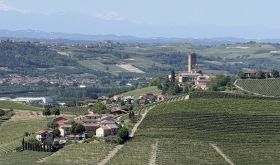
But as with the much more common red wines of Châteauneuf (whites still represent well under 10% of total production), they express not just many different combinations of grape varieties made and aged in everything from stainless steel and concrete to casks of all sizes (for Roussanne in particular), but also the huge variety of different terroirs within the zone. There is clay, sand, limestone and galets, the giant stones so beloved of vineyard photographers. Châteauneuf truly is a cocktail of a wine.
There are still some unreformed white Châteauneufs to be found. But last month in the little town of Châteauneuf my tasting of about 60 2006s blind revealed 22 wines to which I awarded a score of at least 17 out of 20 – a very high strike rate for me. As well as exhibiting more varied flavours, the wines are very obviously richer in build than any but the grandest white burgundy. The major problem is this sunny corner of Provence, which tends to result in alcohol levels on average of about 13.5% in whites, is keeping enough acidity in the wines. Some producers add more of the tartaric acid naturally found in wine, as is routine in so many warmer wine regions. Others deliberately suppress the softening effect of the second, malolactic fermentation. I found that many of the wines had a slightly but not unpleasantly bitter note on the finish that reminded me of the quinine in tonic water. Some producers argue that this, together with the natural astringency of some of the grapes, acts instead of acidity to stop the wines from tasting too flabby.
In my impressive array of 2006 whites, some wines for which small oak barriques had been used for fermentation and ageing tasted more like a cross between a white Rhône and a white burgundy than a white Châteauneuf with its trademark honeysuckle aromas. These more structured wines might be of particular interest to newcomers to the style, being more reassuringly familiar than a full-on Châteauneuf more dominated by fruits and sunshine.
According to Paul-Vincent Avril of the hugely admired Clos des Papes, good white Châteauneuf can taste of pear, peach, apricot, anise and grapefruit in its first three years. François Perrin of Château de Beauastel cites honeysuckle. But what both are agreed on is that something very odd happens to it in middle age. At roughly six years old, even the finest white Châteauneufs, such as the Vieilles Vignes Roussanne for which Beaucastel is so famous, tend to go brown and lose their fruity appeal. François Perrin winces at the memory of the bottles he has had returned by restaurants whose sommeliers should, arguably, know better than to list such wines at this delicate stage. Then eventually the wines lose their brown tinge entirely and start to taste more mineral and refreshing before taking on flavours of quince, almond and honey. "You can drink 2001 to 2006 now," Perrin told me, "From 1994 to 2000 you have to forget for the moment. But anything older than 1994 is fine." (I'll be publishing Pascal Chatonnet's scientific explanation for this phenomenon on purple pages on Monday.)
To prove his point he opened bottles of 2000 and 1992 white Ch de Beaucastel and a 1988 Vieilles Vignes. The 2000 was pale tawny and smelt unappetisingly flat and oxidised. It's easy to see why people would send this back in a restaurant. On the palate it had a certain honeyed appeal though seemed dangerously low in acid. I thought it smelt of truffles. "Fruity truffles", the Perrins' sommelier in residence Fabrice Langlois corrected me.
The 1992 on the other hand was already much paler and smelt of minerals. Much less sweet and fat than the 2000, it had a refreshing green liveliness about it and seemed to have much more acidity than the younger wine. The 1988, only the third vintage of this old-vine, barrel-fermented varietal Roussanne, was incredibly nervy and vivacious. Gold with green highlights it was chock full of mineral scents, had a beautifully complete texture and positively caressed the palate.
At Clos des Papes on the other hand, Paul-Vincent Avril chose a bottle of his 2000 white to demonstrate that it had already moved on to the excitingly tingly, refreshing mineral stage, so clearly different white Châteauneufs have different ageing cycles. The lesson, I suppose, is not to give up all hope of one that seems to have gone brown. Other bottles at least should come right in the end.
Beaucastel's sommelier Fabrice Langlois, a Parisian, is a huge fan of white Châteauneuf. "People don't realise how useful they are for gastronomy. They go beautifully with olive oil-based dishes -but their bitterness can be a great complement to all sorts of food."
My favourite 2006 white Châteauneufs
La Bastide St-Dominique
Ch de Beaucastel
Ch de Beaucastel, Vieilles Vignes
Clos du Caillou, Les Safres
Cellier des Princes, L'Eclat du Prince
Dom Font de Michelle
Dom Giraud, Les Gallimardes
Ch La Nerthe
Clos des Papes
Dom de la Solitude, Barbérini
See my tasting notes on about 165 red 2006 Châteauneufs and 60 white 2006 Châteauneufs.