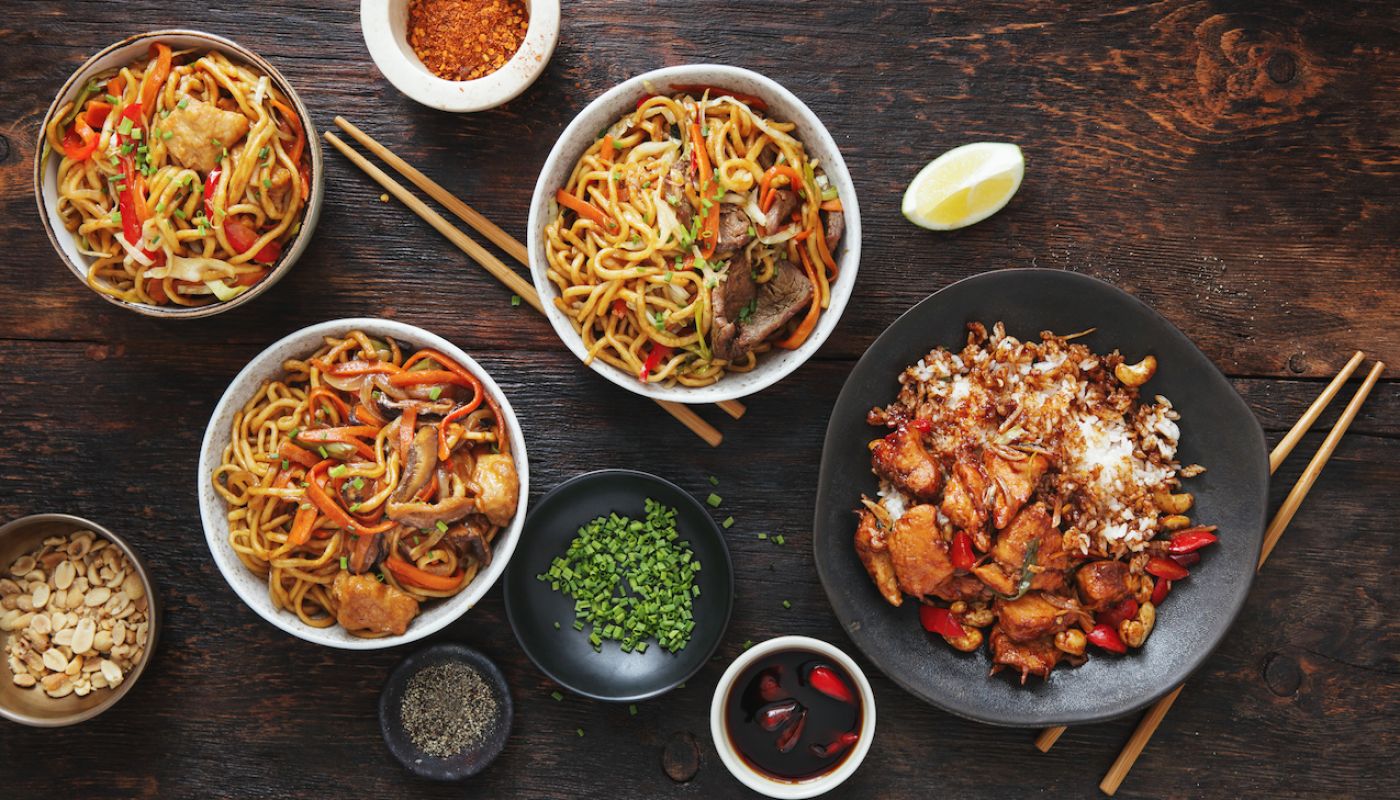
China is rarely out of the news. The source of COVID-19; the country on which smartphone production depends; as well as being a country so vast that the adjective Chinese, rather than a more specific regional appellation, when applied to a restaurant can be construed as something derogatory.
All these thoughts went through my mind as I recently climbed the stairs of Carousel on Charlotte Street to enjoy a Cantonese hotpot dinner to celebrate the Lunar New Year (the Year of the Rabbit, in case you missed it), a joint arrangement between Amy Poon and Carousel.
The latter is an admirable enterprise but one that I find awkward to write about. It specialises in bringing in talented chefs from all over the world to cook a set dinner for a fortnight. As such, it does not fit into any format for me: by the time I will have tasted the chef's cooking they will have moved on and be in no need of another write-up.
This time, although only available over two nights on 19 and 20 January, it was to prove slightly different as the genesis of these two evenings is rooted firmly in London restaurant lore. Poon explained how when she rose to her feet before the evening got under way.
‘My father, Bill Poon, opened his first Chinese restaurant on Lisle Street in Soho in 1973. I remember going there as a little girl. Then he moved to Covent Garden in 1976 and in 1980 won a Michelin star. The stars of the day used to come there and I worked there as a teenager. It was fun but very hard work.’
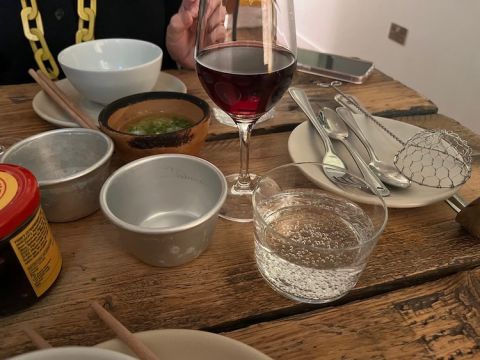
There were burners in front of every couple on which the waiting staff put large pots of hot chicken stock, alongside a battery of cooking utensils and various bowls. They then returned with a succession of ingredients for each of us to cook as we wished: enoki, shimeji and wood ear mushrooms; bok choy; tofu puffs and silken tofu; pork meatballs; prawns; chicken thighs and finally glass noodles to finish what remained of the stock to be enjoyed as soup. It was all good but because there was only one method of cooking there was little variety in the flavours (the dinner cost £55 per person plus drinks and service).
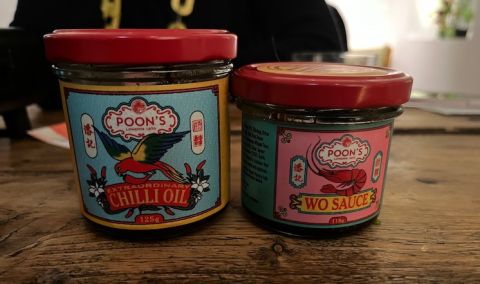
Before she left the dining room to get on with the preparation Poon added that she would have liked to carry on the culinary precepts that her father had instilled in her but that time, money and circumstances had prevailed against it. In 2018 she quit her job in advertising and managed to raise £250,000 and set about finding a site but then, she explained, the project lost momentum. There followed two years of lockdowns. Instead, Poon began a company that specialises in the home delivery of very good quality wontons as well as a range of top-quality Chinese sauces: a chilli oil; a chilli vinegar dressing; a WO sauce (a riff on XO sauce); and a very superior soy sauce. All of them are excellent and would provide a distinctive edge to anyone’s cooking.
Amy Poon’s story has a happy ending, one that many Chinese leaving China and Hong Kong in the 1960s and 1970s would have happily settled for. But her story, in outline at least, reminded me of three other families who came from Asia to the UK, opened a restaurant because that was the only profession open to them (and one that in those days required only limited capital). They may have settled and prospered but wanted their children to do anything other than follow them into hospitality. Despite this, their children have opened restaurants and done quite spectacularly.
In 1982, Chef Peng arrived in London from Taiwan, opened a restaurant which in deference to his original teacher he named Hunan and began cooking what must have been one of the world’s first set-menu restaurants in Pimlico. Growing up in a family-run restaurant was no fun for their son Michael, who had no intention of working in it.
But as a student at Westminster College, then called a catering college, Michael fell under the tutelage of lecturer Norman Fu, who introduced him to the charms of German Riesling and, as the world of wine beckoned, Michael simply followed. Today, Hunan’s wine list is 20 pages long and full of what he believes are the best examples of particular grape varieties that match the dinner menu (£92.80) or the shorter lunch menu (£58.80). There are classic Pinots and their counterparts from California, New Zealand and Oregon; wines that show off the essence of Italy; and under a heading ‘stone into wine’ a comprehensive range of Riesling, Grüner Veltliner and a Soave Classico from Pieropan. When I asked Walter Speller, who helped Peng with his wine list until 2020, whether he was still involved, I received this reply: ‘I stopped working on Michael’s list because he kept on buying stuff and selling them by recommending them and we never got on top of this beautiful chaos. So we decided to just let it sprawl…’.
The hugely talented chef Andrew Wong had a remarkably similar upbringing to Michael Peng, growing up in his parents’ restaurant, then called Kym’s (after his grandmother), in Victoria, which led his parents to the same conclusion: their only son should do anything other than follow in their footsteps.
After studying at Oxford and the LSE, however, Andrew ‘fell’ into cooking, inspired by his journeys around China. He returned to London, started cooking and, after his father's death, renamed the restaurant A Wong in late 2012. Since then he has only prospered.
A Wong has been forced to change most notably by Michelin, who have awarded this restaurant two stars. As a result, the restaurant has become more formal and more expensive: it was £150 per person for the food plus service when we ate there last November (plus £100 for the wine pairing). But everything has been done to upgrade the experience thanks to the watchful eye of Nathalie, his wife, business partner and front-of-house eyes and ears. Highlights of our meal included a garlic-steamed wild tiger prawn with mung bean noodles, crisp chilli, caramelised beef and pickled carrots; and a variation on king crab noodles, a dish that brought back happy memories of all the meals I have enjoyed in Hong Kong.
Lastly, to Alan Yau, the creator of wagamama, yauatcha, Busaba Eathai and Hakkasan restaurants inter alia. Yau arrived in the UK from Hong Kong aged 12 to join his parents in King’s Lynn, Norfolk, where his father, an experienced tailor, had turned to cooking as that was the only profession accessible to immigrants at that time. ‘I disliked it intensely’, Yau explained to me when we met in 2011, ‘and at that stage of my life I really wanted to run a mile from a career in restaurants.’
But the reality of the responsibility of being the eldest son in a traditional Chinese family, even one a long way from home, prevailed and Yau initially opened a Chinese takeaway called Capitel that proved successful. Inspired – and also heavily influenced by studying the McDonald’s approach to restaurants whose aim was ‘to simplify to multiply’ – he kept searching for the right formula.
Having been introduced to ramen noodles by a Japanese friend of his sister, who explained that this was the Japanese dish she most missed in London and whose nickname had been wagamama (Japanese slang for a spoilt, rich kid), Yau believed he had found a way of simplifying the cooking of an important Asian foodstuff. Ramen noodles require only three ingredients: the soup, the noodles and the topping. In April 1992 Yau opened the first wagamama in a basement off Gower Street: 3,000 sq ft (280 m2); six long communal tables that sat 104; an average main course price of £3.80 – all for an investment of £388,000 (over budget, as seems to be Yau’s wont). Through a highly successful franchise operation, today wagamama has branches in most cities in the UK and across 22 other countries in Europe and the Middle East, although Yau severed his connection to the company 25 years ago.
What united these four individuals in their very divergent restaurant success? Did the initial rejection play a part? Is it something to do with a sense of responsibility, something particularly Chinese? My own feeling is that it has a great deal to do with timing: that by the 1990s and 2000s being a restaurateur had become a far more credible and prestigious profession for these people than it had ever been for their parents.
Or is it that the 3,000-year-old history of Chinese gastronomy would not allow them an escape?
Kung hei fat choi!
Carousel 19–23 Charlotte Street, London W1T 1RL; tel: +44 (0)20 7487 5564
Poons London, for wontons and sauces
Hunan 51 Pimlico Road, London SW1W 8NE; tel: +44 (0)20 7730 5712
A Wong 70 Wilton Road, London SW1V 1DE; tel: +44 (0)20 7828 8931
Top image courtesy of Eugene Mymrin via Getty Images.