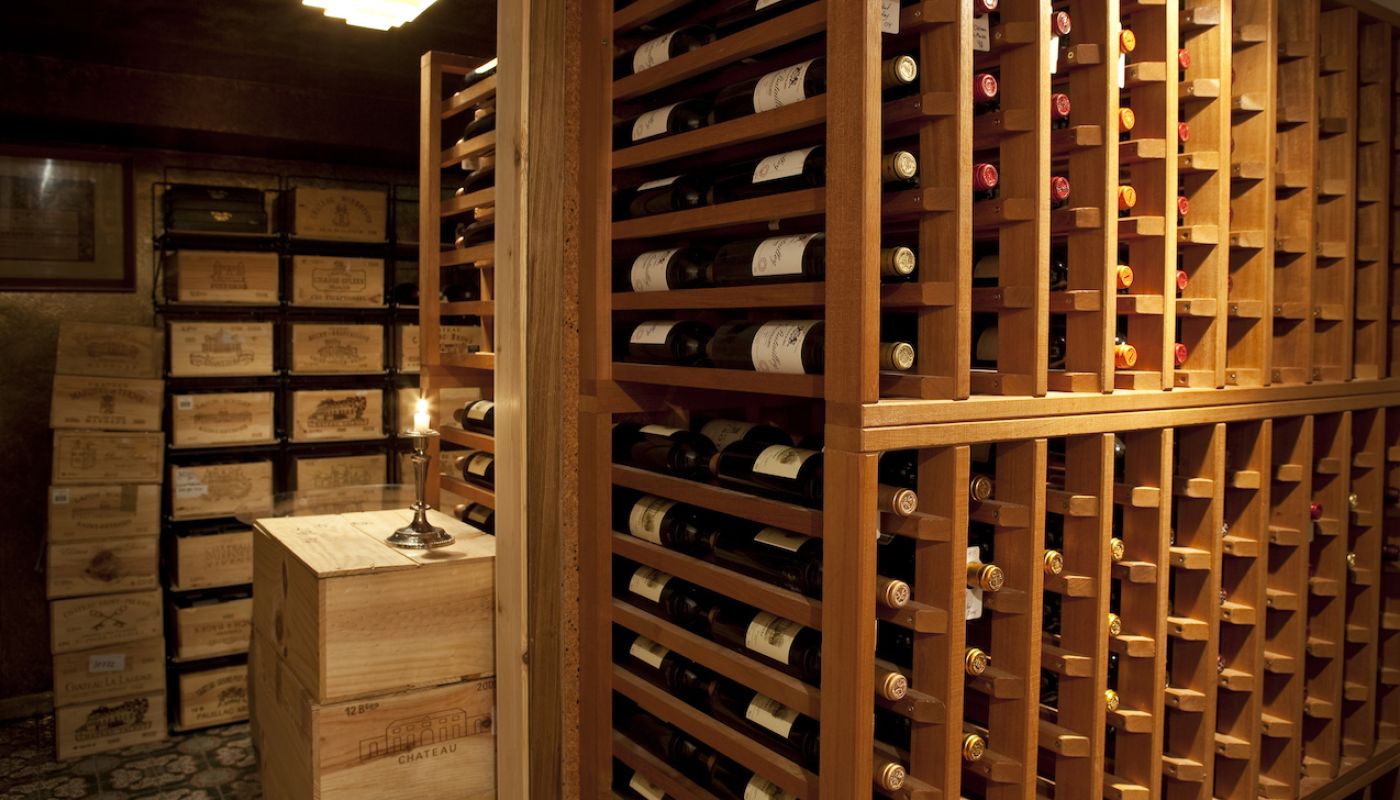
‘I wonder whether you could devote one article to offering some thoughts on how to build a high-quality cellar, with comparable quality wines to those that many love from the classic wine regions, but without breaking the bank? For example, cru bourgeois, lesser-known Rhône, German whites/reds, South Africa, Eastern Europe, etc.’
First you need to decide where you’re going to store your wine. If your idea is a nice little collection at home, you will have to buy your wine ‘duty paid’, meaning the price will include the duty payable wherever you live. (Nicholas Bull lives in the UK, where duty is currently £2.67 a bottle on most wines plus VAT at 20%.) This gives you the flexibility of buying only a few bottles of each wine but you need to be very sure that your ‘cellar’ is sufficiently cool (around 13 °C/55 °F), dark and not too dry – otherwise the corks will dry out and start to let in air, which may be useful in a glass or decanter to soften young wine but is disastrous for bottles of mature wine.
Most wine collectors today, however, buy by the case ‘in bond’ at prices that exclude these tedious taxes so that they can store their wine in a bonded warehouse that provides ideal storage conditions. The relative merits of various outfits offering this service is probably a suitable subject for another article (though see our unique international guide to Where to store) but this has the advantage that you can always sell your wine easily – because a buyer can feel confident that the wine has been stored well. In fact, professional storage is virtually mandatory if you intend to sell any of your collection – unless you can prove that you have a temperature- and humidity-controlled cellar.
There is an international market for fine wine. Many collectors in Asia and some in the US and Europe keep their wine in British bonded warehouses because of their proximity to London’s nucleus of fine-wine traders and auction houses and because UK warehouses have a good reputation for being cool and humid.
It’s worth remembering that, unfortunately, in the UK anyway (not so in the US), many fine wines are available only by the standard case, which has widely been reduced from 12 75-cl bottles to six. And in your calculations you will have to factor in the cost of storage, generally between £10 and £20 a year per case, which can certainly add up. The other disadvantage of professional storage is that, unlike a domestic wine collection, you can’t decide what to open on impulse.
Red bordeaux is the prime cellar candidate because, although the wines can increasingly be drunk young, like vintage port they really need time to show their best. Now is a great time to buy bordeaux in the lower and middle reaches because the market is extremely soft. Bordeaux is made in vast quantities and demand for it has decreased to such an extent that vine growers in less propitious sites are being bribed to pull out their vines.
From smarter addresses, I’d be careful to choose top-quality vintages with a notable level of tannin that will keep them in good shape for many years. The 2019s and 2016s are obvious candidates that are still available in some quantity, 2019 being the vintage offered en primeur during lockdowns so – most unusually – at decent prices on release. The prices of the 2019s have generally caught up with the robust prices of the 2020s, a vintage I will be tasting blind in depth very soon and will report back.
Excellent value can be found from Bordeaux’s so-called ‘super seconds’, the estates whose wines hover somewhere between the level of what were famously classified as first and second growths in 1855. I specifically recommend what are known loosely as their second wines (as opposed to the flagship bottling known as the grand vin), not least because those particular châteaux are extremely selective about what goes into their grand vin.
Obvious examples include those of Léoville Las Cases (Clos du Marquis and Le Petit Lion), Palmer (Alter Ego), Pichon Baron (Les Tourelles and, longer-lasting, Les Griffons), Pichon Lalande (Réserve de la Comtesse) and Rauzan Ségla (Ségla). Second wines can also, usefully, provide really satisfying drinking earlier than the grands vins, so long as you don’t drink them alongside the relevant grand vin at the latter’s peak maturity.
There are also châteaux lower down Bordeaux’s famous ranking system that regularly overperform in the blind tastings of a four-year-old vintage that I participate in every January. Meyney of St-Estèphe springs to mind, and Siran in Margaux can last much longer than most Bordeaux drinkers realise. Duhart-Milon, the little brother of first-growth Lafite, is very much cheaper yet offers the oak quality and attention to detail of a first growth.
As for the crus bourgeois, a rank below the crus classés, or classed growths, the best of them can also be great value although they are for drinking not trading, and won’t generally last as long as the wines cited above, nor usually reach quite the heights. Names such as Beaumont, Belle-Vue, Le Boscq, Cambon La Pelouse, Charmail, Clément Pichon, Deyrem Valentin, Lilian Ladouys, Malescasse, Moulin Rouge, Noaillac, Patache d’Aux, Paveil de Luze, Petit Bocq, Peyrabon, Preuillac, Ramage La Batisse and Vieux Moulin are more reliable than most. It’s worth choosing a vintage such as 2019 with no shortage of ripe fruit and tannin. The average quality of the crus bourgeois has increased enormously. They used to suffer in less ripe vintages because they are in less propitious sites than the crus classés, but now that summers are warmer, quality is much more consistent. See this tasting article on 2019 and 2020 crus bourgeois tasted recently.
All of these are Cabernet Sauvignon-influenced wines on the left bank of the Gironde estuary. Wines produced on the right bank, generally made from Merlot and a bit of Cabernet Franc, tend to be more expensive but the Fronsac appellation can provide real freshness and value while more and more fine wines are being made in the Castillon appellation, effectively an extension of the more expensive St-Émilion one. The late Denis Durantou of L’Église-Clinet in Pomerol developed Les Cruzelles and La Chenade in the satellite appellation Lalande-de-Pomerol. They can offer the lusciousness of Pomerol without Pomerol’s high prices.
If you are looking for wine to drink soonish, the Bordeaux market is crazy in that mature wine can be much better value than the latest ‘vintage of the century’. And you won’t have to pay those storage charges for years. Good candidate vintages are 2014 (a vintage I’ll be assessing blind soon), 2012, 2005 and 1995, and the best 2002s can be well priced.
Good sweet white bordeaux can last even longer than red bordeaux – decades in many cases. It’s currently unfashionable, so, in view of the care and expense needed to make it, it’s seriously under-priced. Taking a long-term view, I’d be tempted to invest heavily in it now – so long as you, like me, also enjoy drinking it.
I seem to have come to the end of my allotted space without leaving Bordeaux. I shall continue this topic next month, making some suggestions for cellar candidates from elsewhere.
Bordeaux for the canny collector
Prices are given per bottle but in many cases you will have to buy by the case of at least six bottles.
Reds
La Chenade 2019 Lalande-de-Pomerol 14%
£20 R&B Wines. In bond per case of 6: £75 Appellations, £80 Justerini & Brooks
Ch Paveil de Luze 2019 Margaux 13.5%
£25.80 Four Walls Wine. In bond per case of 6: £170 Farr Vintners
Ch Meyney 2019 St-Estèphe 13.5%
£28 R&B Wines, £29.61 Lay & Wheeler, £33 Wine Trove, £34.20 Four Walls, £35.75 Lea & Sandeman. In bond: £22 Lay & Wheeler
Ch Gloria 2019 St-Julien 14%
£35 R&B Wines and many other merchants. In bond: £24.50 Lay & Wheeler, £27.50 Justerini & Brooks, £28 Mann Fine Wine
Ch Palmer, Alter Ego 2019 Margaux 14%
£26.90 per half Hedonism, £85 per bottle Nemo Wine Cellars and Banstead Vintners
Ch La Grande Maye 2016 Castillon Côtes de Bordeaux 14.5%
£16.50 Divine Fine Wines
La Chenade 2016 Lalande-de-Pomerol 14%
£29.94 Four Walls Wine, £34.50 Mumbles Fine Wine
Ch Le Crock 2016 St-Estèphe 14%
£26 Wine Trove. In bond: £22.75 Justerini & Brooks
Ch Capbern 2016 St-Estèphe 14%
£27.41 Jeroboams
Ch Les Cruzelles 2016 Lalande-de-Pomerol 14.5%
£36.95 Mumbles Fine Wines, £37.14 Four Walls
Ch Pichon Lalande, Réserve de la Comtesse 2016 Pauillac 13%
£45 The Wine Society
Ch Meyney 2012 St-Estèphe 13.5%
£29.40 Justerinis, £36 Four Walls Wine, £36.30 Bon Coeur
Sweet white
Ch Coutet 1995 Barsac 13.5%
£44 The Wine Society
For tasting notes, scores and suggested drinking dates, see our 250,000-strong tasting notes database. For international stockists, see Wine-Searcher.com.
Image courtesy of Arctic-Images via Getty Images.