
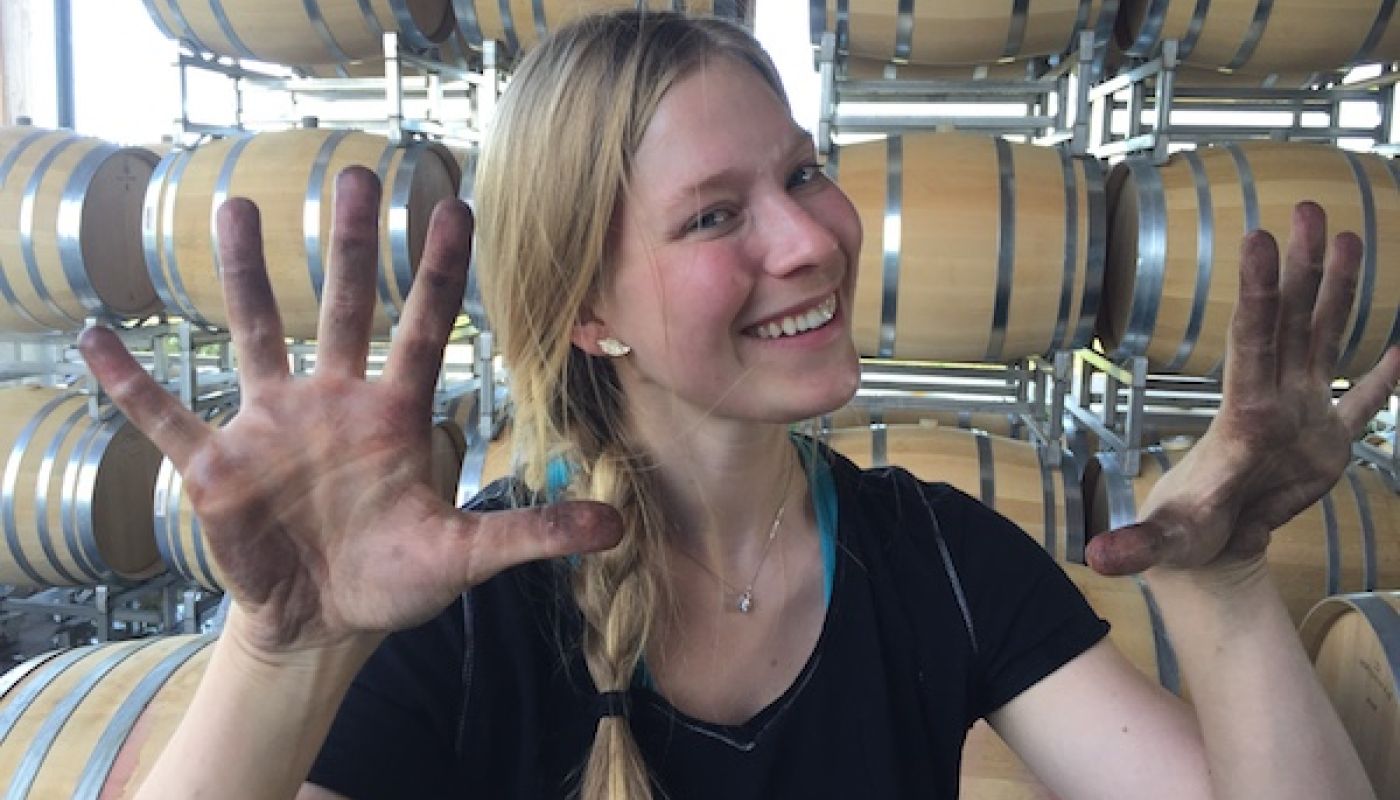
21 October Samantha Cole-Johnson files her penultimate report, in which pH plays a vital role. See our Members' forum for an enthusiastic response to her reports.
It’s crazy to think of the number of producers who make wine without even a basic lab. I know it’s been happening for thousands of years and making wine isn’t rocket science, but the amount of data you can garner from running a bit of analysis is so helpful. I spent half of this week in the lab running analysis on barrel samples. This gave our winemaker and assistant winemaker the data they needed to troubleshoot quite a few things before they turned into real problems.
If you remember, last week our assistant winemaker was thrilled because five lots of our Chardonnay had fermented out to dryness. Well, the good news is that a couple more lots finished fermentation and are dry. The bad news is that not all of the Chardonnay finished before the entire winery started going through malolactic conversion this week. This spells trouble.
If primary (alcoholic fermentation) is interrupted and secondary (malolactic conversion) kicks in when there’s still sugar in your wine, then you have to start worrying about VA (volatile acidity). This is caused by bacteria (instead of yeast) eating the sugar in your wine and creating acetic acid and ethyl acetate (instead of ethanol) as byproducts.
The machine I’ve been running barrel samples on is called ‘the foss’ [Foss is the name of the manufacturer] and can read sugar levels, malic acid, lactic acid, alcohol and volatile acidity. Up until a couple of days ago, we were content to cross our fingers and hope that primary fermentation would continue its slow roll alongside secondary. Unfortunately, we reached a point where primary fermentation slowed down too much for comfort. As well as leaving sugar for bacteria to eat, the interruption of primary also stops the production of carbon dioxide and leaves your wine unprotected from oxidation (the barrels are not filled to the top yet).
The decision was made to start building a yeast culture. This is done by taking bags of yeast and a little 37 °C (98.6 °F) clean water and mixing them. You let this sit and activate for 30 minutes and then – ideally – you start adding grape must with lots of sugar in it. The problem here is that we finished pressing off our Chardonnay weeks ago so we don’t have must. We have almost dry chardonnay. But, as the yeast need sugar to thrive, we had to mix sugar with our almost dry wine.
We fed the yeast culture with the sugar and wine mixture bit by bit, until it was violently fermenting (it overflowed the top of a vessel). We then measured specific gravity (sugar level) of the culture to make sure that there was enough sugar so that when we added it to barrel the yeast wouldn’t be shocked (remember that these wines are very close to dry) and die. Then the real work began.
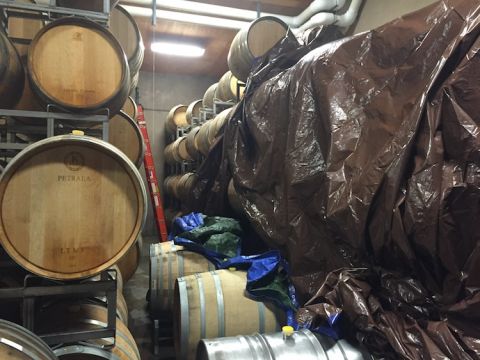
A team of three of us ran around the Chardonnay cellar siphoning what amounted to 500 litres of wine from two dozen barrels and then adding the exact same amount of yeast culture back to each barrel we’d siphoned out of. Then, to give the yeast some extra help, we built what can only be described as a ‘shanty town’ to keep the Chardonnay barrels warm. We covered the barrels with tarpaulins, stuck heaters underneath, and then held it all down with barrel racks. It’s not the prettiest but the hope is that it helps keep the yeast happily fermenting.
In other news, we finished pressing on Tuesday. The days prior were spent racking the 2018 wines out of barrels and into tank, and then washing all of the barrels so they were ready for the 2019s.
Washing barrels is mind-numbing but pleasant. If the weather is nice, we do our washing outside. It involves blasting the inside of the barrels with scalding hot water, steaming them, then creating a vacuum by sticking a bung into the hot barrel. This pulls the staves tight but also assures you that your barrel is sound. When you pull the bung out you should hear an audible whoosh as air enters the barrel; if you don’t then your barrel has a leak. After that, we rinse the barrel again with cold water, move it inside, and fill it.

We had some new additions to Pinot barrelling-down procedures this week: we started adding acid. A couple of weeks ago I was sure we wouldn’t have to add acid. All the Pinot we harvested came in between 3.2 and 3.45 pH. We were thrilled! So what happened? During red fermentations, tartaric acid will bind with potassium and precipitate out as tartrate crystals. I knew this but what I didn’t realise was how much potassium our musts contain and, as a result, how much this precipitation affects our wines’ acidity.
I asked our winemaker if the amount our wines' pHs increased is normal. His response was that it’s a result of our site. Though we don’t necessarily have more potassium in our soil, for some reason it’s much more available for uptake. He also said that a wine will have a higher jump in pH with whole cluster because there is potassium in the stems. This is why our winery doesn’t do more whole cluster (we do some but not a lot).
A few of our ferments went up above 3.65 pH post-fermentation (a jump of 0.3 in pH in a couple of wines). Also, the musts that came in at 3.45 pH aren’t necessarily the ones that are now above 3.65; it depends on what the potassium content of the must was. As the pH of the wines will rise further after malolactic conversion, we’re adding acid to anything that is now above 3.65 pH.
Adding acid at this stage isn't ideal but it's certainly not uncommon. While you can add acid before, during, or after primary fermentation, and you can even add it to a finished wine, the earlier you can do additions the better. The longer you wait, the more disjointed the wine will feel.
While we wish we'd known we needed to add acid to some lots during fermentation, at least the wine will still be acidified before malolactic conversion finishes and will have a long time to mature in barrel. Also, our acid additions for the few lots that need it is relatively minor, only about 0.75 g/l of tartaric acid (determined through acid trials). The rule of thumb is 1 g/l of tartaric to drop a pH by 0.1 but it’s a very imprecise rule because tartaric will be buffered by lots of things (hello, potassium) and may drop only half that much. This is why you need to run acid trials on each separate lot of wine and determine how much acid you need specifically for that lot.
Winery work is starting to wind down now and although cellar hands will be running around cleaning for another month, my last diary will be next week. (I’ll save you the dull stories of power-washing.) As one harvest starts to wrap, I’ve accepted a position in Barossa Valley for another harvest beginning in February.
I hope to be bringing you reports on very different, technical, larger-scale winemaking next year!













