I write all too often about the detail of specific wines and all too rarely about the mechanics of how to serve and handle them. But at this time of year, when many of us are in entertaining overdrive, I thought a little practical advice may be useful.
Temperature
This is the single most important aspect of serving wine.You can change completely how a wine tastes by serving it too cool or too warm. In my experience, many reds are served too warm and whites are often served so cold that it is difficult to smell their all-important aroma.
I’m afraid I have never been a great enthusiast for wine thermometers. Clinical is the last thing I want wine service to be. But I can say that if a room is warm enough for shirtsleeves and sleeveless dresses, it is probably too warm for the long-term storage of wine. Best to keep red wines somewhere a little cooler until just before you want to serve them. Larders be blessed. Red burgundies, and Pinot Noir in general, respond especially well to being served a little cooler than comfortable room temperature.
Reds served too warm can taste soupy and flat. Even if you feel they are on the cool side when you pour them, they tend to warm up fast in the glass. If they need encouragement, warm hands round the bowl of a glass can be remarkably effective. Or, if you need to warm a seriously cool red in a hurry, pour it into a decanter that has been rinsed out with hot water.
If you are serving a red wine that is just a little bit too young, with tannins that are a bit too chewy for comfort, these polyphenols that dry out the inside of the cheeks as cold tea does will be less noticeable if you serve the wine just a little warmer than usual – and vice versa. See Matching wine and food below for further ways to add instant maturity to a red wine.
Perhaps a more common problem is how and how much to chill white wine and champagne. I have certainly plunged bottles into deep freeze cabinets to cool them in a hurry. I have also of course forgotten them and discovered them only when the cork has been forced out by a chunk of expensive ice.
Champagne really does need to be served pretty cool; otherwise the cork can pop out with dangerous force, quite apart from the wine’s lack of refreshment value. This may seem obvious but if you need to chill multiple bottles and have access to the wintry outdoors, even a large windowsill, this can be a much more convenient option than cramming a fridge dangerously full or resorting to a bath full of ice. If you do use some form of ice bucket, remember that icy water is much more effective than ice cubes alone, since so much more of it will be in direct contact with the bottle(s).
The fuller-bodied the white wine, the warmer I serve it since the aroma needs the encouragement of cellar temperature rather than a straight-from-the-fridge chill to escape. Complex white burgundy, for example, shows its best at a temperature remarkably like the ideal, relatively cool, serving temperature for a red burgundy.
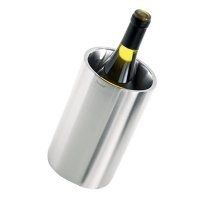
Vacuum bottle holders that keep chilled or warmed bottles at that perfect temperature can be particularly useful. The Screwpull stainless steel version at £25 is shown here, but you can find transparent plastic ones for not much more than £5.
Matching wine and food
It can be fun to search for perfect combinations, but unless you are that way inclined, please stop worrying about it. It matters only if you care. If you don’t, you will find it remarkably easy to drink any old wine with any food.
The one tip I would pass on is that you can make a chewy young red taste much less chewy if you serve it with a chewy food such as roast meat, goose or steak.
And sweet foods, especially desserts, make wines that are drier than the foods are (which is all dry wines and many sweet ones) taste pretty austere and tart. So very, very sweet wines are the best companions for puddings. Mildly sweet wines are probably better enjoyed with something salty – cheese, pâté, even ham – or on their own as an alternative to dessert.
Opening and decanting
In my experience, only very old wines that have developed so-called ‘bottle stink’ seem to benefit from being opened in advance and left in the original bottle. But young wines can be encouraged to open out and accelerate the ageing process by being aerated: poured into another vessel such as a decanter or a jug which will allow a surface area much greater than that in a bottle neck. The tougher and more youthful the wine, the longer in advance it can stand being opened. When entertaining, I tend to open and decant red bordeaux and red Rhône wines between 10 and 20 years old just before guests arrive, Italian wines (especially Barolo and Barbaresco) several hours earlier, and red burgundy not at all.
But I am a great believer in decanting white burgundy an hour or so ahead of serving it – partly because a decanter full of golden wine looks so lovely and partly because white burgundy is currently so unreliable, thanks particularly to the blight of random oxidation, that this allows enough time to find a substitute. That hour or so the decanter spends in a refrigerator seems to get it to just about the right temperature.
It can also be a good idea to open screwcapped wines ahead of serving them to check whether they are reduced and have a vaguely offputting smell in the rotten eggs/garlic/struck flint/cabbage/rubber spectrum. In most cases this will dissipate if you aerate the wine – perhaps just pouring it into a jug.
Leftovers
In some households, leftover wine is an oxymoron, but we wine writers tend to live our lives surrounded by it. The key to keeping wine as fresh as possible for longer than a few hours is to minimise its contact with air and to keep it as cool as possible. So if the wine is reasonably sturdy, it can be useful to pour any leftovers into a small bottle and stopper it up, leaving as little head space as possible between the wine and the stopper, before putting it in the fridge – reds as well as whites. But many modern wines will last even in a half-full bottle for several days, even a week, before deteriorating and losing their freshness and fruit. The younger and more commercial a wine, the longer it is likely to last once opened.
Madeira lasts forever in an open bottle. Tawny port and vibrant young ruby will last a few weeks, as will rich sherries. But vintage port that is old enough to be interesting behaves much like a red table wine, as do dry sherries such as the finos and manzanillas that are such a godsend for encouraging our appetites at this convivial time of year.
For more on these topics, see Resouces>Learn about wine>Wine & you.