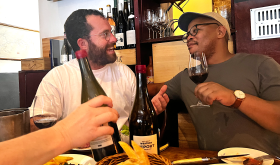
As wine producers are wont to do, they had brought along a few of their wines to be served with this dinner for seven of us, so we ended up with bottles of each of their Chianti Classico 2007, L'Apparita 2007 and Vigneto Bellavista 2001 on the table. Apart from these different names and vintages, and some very slight variation in colour, the three bottles and labels looked virtually identical, certainly much more similar in colour than the reproductions of the labels look here, yet the wines behind them are quite dissimilar (and, incidentally, sell for very dissimilar prices). While the Chianti Classico is the usual blend of 80% Sangiovese and a wide range of other varieties grown all over the 50 ha of vines on the estate, L'Apparita is their famous all-Merlot bottling that sells for about five times as much, and Vigneto Bellavista, a selection of the finest wine in the finest vintages from their oldest vineyard, costs about the same as L'Apparita but of course tastes quite different.
 Yet there is absolutely nothing to indicate these differences on the label.
When I suggested to Lorenza that it might be helpful to provide a few more clues on her labels she looked horrified, and rather affronted. She seemed to think, as in my experience so many Italian wine producers do, that back labels are for wimps and mass-market low life. Fine for a cheap supermarket Chianti to boast on a back label, as so many mass-market wines do, that the wine was produced from the finest grapes picked at optimum ripeness and vinified using the utmost skill, but she clearly expects her customers to be as well informed about her wines as she and Marco are. And yet this stylish couple admitted that, in response to 'the crisis' that dominates any consideration of the Italian wine market, they are currently in hot pursuit of new markets. Marco was just off to Brazil and they are now setting their Chianti caps at the burgeoning Chinese market. So would it not be helpful to spell out to these new customers just what is in each bottle, I wondered? I'm not asking for vacuous sales puffery, but genuine, useful information that will help consumers choose and get more out of wine.
I can understand that if a wine producer is certain that every single one of their bottles is either world-famous (like Domaine de la Romanée-Conti, for instance, which even I think can do without the words Pinot and Noir on the label) or will be hand sold by a sommelier, or by a small wine retailer run exclusively by highly educated and motivated wine enthusiasts, then there is no need to give anything other than the mandatory legal information, plus perhaps some suitable branding on the label. But this surely applies in the minority of cases.
The prevailing wisdom among the majority of wine producers, not just in Italy but especially in the more traditional European wine regions, seems to be that there is something dishonourable and superfluous about using their labels to impart information. (Castello di Ama, like so many producers everywhere, fail, for example, to put on their labels the name of the website on which they have spent so much. This is simply crazy.)
But whenever I do encounter fine wines labelled with germane, factual information about them, I for one feel extra positive about them. For decades Ridge Vineyards in California has been exemplary in this respect. The design of the single label incorporates an attractive box of text which gives all the information the curious wine drinker needs about every bottle: growing season peculiarities, precise assemblage, when it was bottled, likely evolution.
Torres of Catalunya and Chile also have an admirable track record for providing background information of use and interest to the consumer – in this case usually on a back label. And I love, really love, those champagne producers such as Bruno Paillard who tell us how old each cuvée is and when it was disgorged. This is vital information – especially for non-vintage blends which all look so superficially similar on a shelf. These are all instances of wine producers treating their customers as intelligent adults rather than, surely somewhat arrogantly, starving them of information.
I can understand that aesthetes such as Lorenza and Marco at Castello di Ama may have deep reservations about adding a back label to their bottles (which they already have to do for the US warning label), but the bottle we happened to choose to go with our dinner the next night at another wine-loving Florentine restaurant, Guscio, showed that you can get a remarkable amount of useful information on a front label if you try hard enough. I Sodi di San Niccolo is Chianti Clasico producer Castellare's top bottling. Apparently added by hand rather charmingly on the label was the fact that this 2004 had been made of 85% Sangiovese and 15% Malvasia Nera, and had not been bottled until May 2008 – actually the third week of May 2008.
I could probably live without knowing which week the wine was bottled in but I was thoroughly grateful for everything else.
And when all of Italy's tens of thousands of different wines made each year, many of them carrying fantasy names and often rather obscure DOCs and/or addresses, are labelled with the name of the region responsible for them, which I understand is currently illegal for DOC wines because many IGTs carry the name of the region in which they were made, I will be a truly happy consumer.