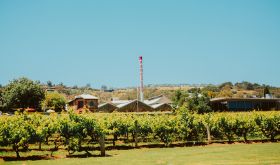
In 2005, Rupert Koopman was walking across De Grendel wine estate in Durbanville, when he suddenly noticed something. A botanist who was there to work on preserving critically endangered vegetation, he’d been inspired to take up the cause of threatened plants after hearing during a talk that Lachenalia liliflora was thought to be extinct. Yet there it was at De Grendel, right in front of him.
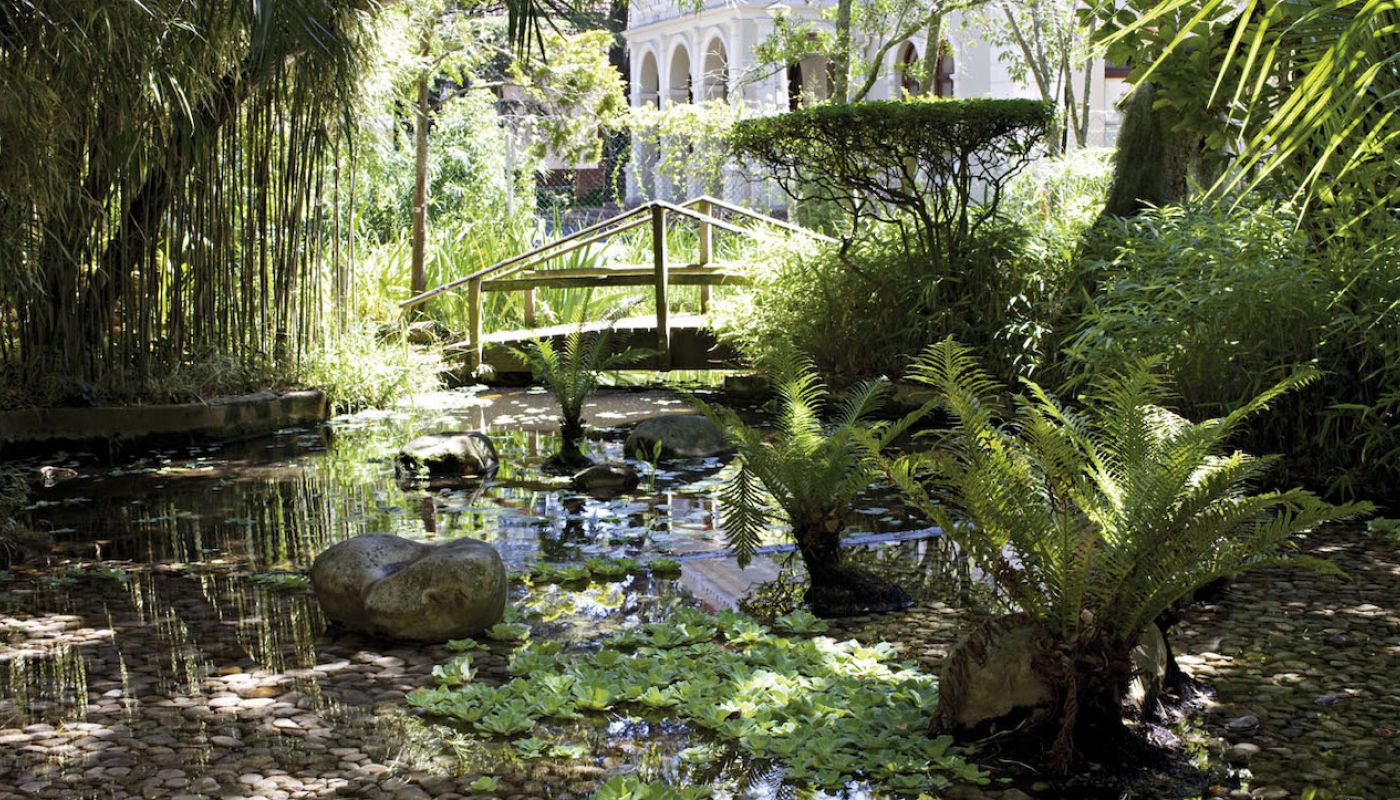
Koopman, who now calls himself ‘an ecological fixer’, has worked in plant conservation since 2007, including at CapeNature and the Botanical Society of South Africa. This past July, he took a group of us wine professionals for a spin around the Stellenbosch University Botanical Garden (pictured above), taking the opportunity to describe South Africa’s enormous plant wealth. Even in winter, the garden was alive with everything from aromatic plants to multiple examples of pelargoniums.
On that stroll, Koopman mentioned that every time a new farm or vineyard is created or extended, there is the possibility that an overlooked plant will be torn out and lost, perhaps forever. Koopman pointed out a tiny, green-leafed plant, the Oxalis fragilis, or Koringberg sorrel. ‘It flowers for two weeks’, he says. ‘If you missed it, then you might not know it was there.’
And for a long time, people did miss it. It was last recorded in 1936 and then never seen again, presumed extinct. Yet it was rediscovered in July 2020, more than 80 years later – a much-needed good news story in a world of accelerating extinctions. The World Wildlife Fund conservatively estimates that the world is losing between 200 and 2,000 species a year, while noting that the number may be many times that.
In a later interview, Koopman explained that ecosystems in Mediterranean climates are particularly rich in plants that may exist in only tiny niches. There are five such regions: California, south-western and southern Australia, central Chile, southern Africa, and the Mediterranean basin.
Given these are also regions where Vitis vinifera flourishes, it’s more than likely that many vineyards are populated with rare plants. Koopman says he has frequently found rarely recorded and threatened species when combing through farms and vineyards. For that reason, he wants land owners in these regions to call in botanists before they either create or extend their vineyards or other properties. Depending on what’s found, botanists or botanical organisations might want to collect the seeds. At other times, the best thing is to leave the plant where it is, and just be careful not to damage it.
Not every place has a rare plant waiting to be discovered. Koopman notes that many European regions have been inhabited and farmed continuously for so long that it’s less likely that botanists would make a dramatic find.
‘The other thing about Europe is that most of it is post-glacial’, says Koopman. ‘What’s made us so rich here in species is that we haven’t had glaciers all the way to the bottom of South Africa, and that climatic stability for much longer allowed the speciation [when a group within a species separates from other members of its species and develops its own unique characteristics].’
And while vineyards may not offer up plants on the endangered list, according to Koopman it’s still possible to ‘find something really interesting at a vegetation community level’.
Conversely, introducing alien species as cover crops can cause problems, simply by occupying the niche that might ordinarily belong to another species. Also, if their seeds need wind or birds to disperse them, they can end up far from the original vineyard.
‘There are benign aliens that won’t spread in fynbos’, South Africa’s native shrublands, says Koopman, noting that oak trees are a good example. And then there are invasive aliens, which can run rampant. ‘The Australian eucalyptus and acacias, brought in for timber, loose sand control and wind-breaks. And some pines from Europe which have wind-dispersed seeds and have a propensity to spread.’
Surprisingly, even a native plant can act as an invasive species if it was brought in from another region. ‘In terms of native plants, as a first principle, it’s good to try and source it from as near an area as possible’, says Koopman. ‘We tend to talk about a 10-kilometre [6-mile] radius in the restoration space.’
An expert view
Koopman would like to see vintners seeking professional botanical help. [Prue Henschke in South Australia is a rare example of both vine-grower and botanist – JR.] A botanist may not only be able to advise on whether a species is right for the location or not, but can choose plants with specific properties, such as the ability to fix nitrogen. If they can’t help, they may know someone who can.
Koopman added that having a good nursery to call on is critical. ‘Someone like me can identify the plants in the wild, but I don’t necessarily know how to grow them.’
He’s also aware that farmers often work on low margins, and that the services of a botanist are not usually budgeted for – so he wants to encourage citizen science where people go out and look at the land for themselves.
South Africans can get help with plant identification from the South African National Biodiversity Institute. People can also log on to a free online portal called Farm Mapper, run by the Department of Agriculture in the Western Cape, to access both agricultural and ecological information. During our online meeting Koopman shared his screen and clicked through the site, honing in on a map of Stellenbosch. ‘This is the Paardeberg mountain’, he said. He zoomed into the side of the mountain. ‘Here’, he said, ‘the layer shows that local winemakers are working with decomposed granite soils – and that means it’s possible to make an educated guess about what type of plants are likely to be found there.’
Viticulturists elsewhere may also have government services they can call upon. Generally it’s worth checking with whichever department is responsible for land management or agriculture. A spokesperson for Australia’s Department of Climate Change, Energy, the Environment and Water, for example, pointed to Australia’s National Vegetation Information System. But where the government can’t help, a local university may be able to.
For citizen scientists, there is a wealth of online resources. One such is iNaturalist, a joint initiative of National Geographic and the California Academy of Sciences, where people can upload pictures of plants and have someone from the community help to identify them. There are also numerous plant-identification apps available, though not all will be able to help with rare plants.
There’s no downside to taking the time to check out plants. Even if that strange-looking thing turns out to be a common species, identifying it will bring a closer connection with the natural world. And if it turns out to be something rare and wonderful, that’s a celebration-worthy victory at a time of seemingly endless loss.
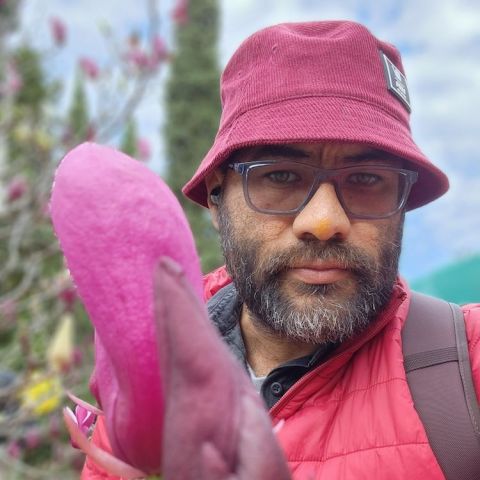
The tour of the Botanic Gardens was part of the ARENI Live conference in South Africa. Felicity Carter is the Editor of ARENI Global. Main image courtesy of Stellenbosch University Botanical Garden. Rupert Koopman supplied the other image.