If perchance you are interested in my article published at the weekend on Minerality continued, you may also like to know how two winemakers, experienced in the art of making serious volumes of wine, answered my query about the feasibility of producing a wine for the mass market that could be described as ‘mineral’ via winemaking rather than because of the vineyard-derived characteristics of the fruit.
Justin Knock MW, London-based Australian consultant:
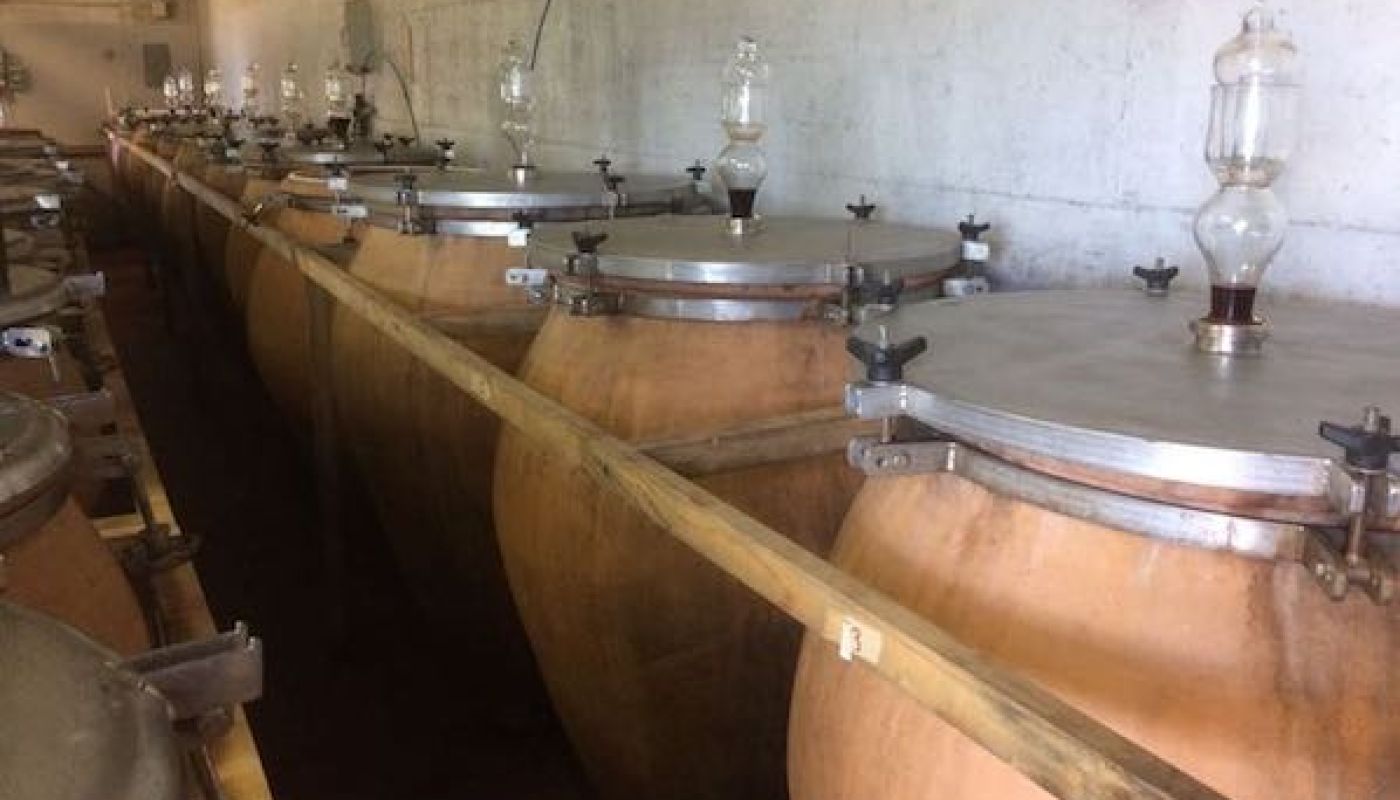
- Concrete and clay could certainly impart minerals into wine, but whether they do or not I don’t know as it depends on the particular vessel characteristics. You typically leach calcium from concrete and potassium from clay if they are not lined with epoxy or a layer of tartrates, for example. I’m not aware of calcium lending a mineral taste. Mass-market winemakers are trained to avoid it as it can lead to unsightly sedimentation. Potassium could certainly give an impression of saltiness (I recall that grapes from Padthaway were seen as being slightly salty in the late 1990s) and of course leaching potassium from clay might raise the pH, which would also change the sense of texture. Clay amphorae are also highly oxidative with a rapid evaporation rate so that may be having an impact on the character of the wine that lends credence to minerality in an overall more complex mixture.
- Yes, you could theoretically use these techniques on more mass-market wines but practical limitations from cost and scalability exist and you might therefore only feasibly be able to do it on a small portion of the blend. Concrete is expensive with a large carbon footprint. Clay is also expensive, small capacity and not an efficient use of space in wineries.
- I know Randall Grahm did trials with rocks in tanks to see if he could impart minerality in his wines – he was always ahead of his time – but I’m not sure that it was successful in the way that he hoped.
- I think there are better ways to impart minerality in mass-market wines other than the vessel of fermentation or maturation. Reductive winemaking overall is a more effective tool for imparting a sense of minerality, I believe. As examples check out the Kooyong, Clonale Chardonnay (UK importer Enotria) or Plantagenet, Three Lions Chardonnay (Liberty) for exceptionally skilful reductive winemaking that gives a strong allusion to minerality, albeit better examples than typical mass-market styles. Sandhi’s Bent Rock vineyard Chardonnay is another good example.
- Overall I’m of the opinion that minerality is more closely aligned to reductive sulphur compounds and actual saltiness transmitted into wine from the grape skins (such as salt spray from highly maritime vineyards such as Santorini and the Canary Islands) than the winemaking vessel.
- It would be fascinating though for a winery to run a large, organised trial to explore the impacts of directly immersing various minerals into wine to see if they can be transmitted. Could be a fool’s errand but it might reveal some interesting things.
Matt Thomson of Blank Canvas, NZ, with considerable winemaking experience in Italy, southern France and South America:
This does strike me as an interesting topic.
I can definitely taste a character that comes from ageing in amphorae. I do sometimes also get something from concrete vessels.
Exactly what the mix of compounds leaching out of these vessels to impart these characters is something I know little about. Maybe new amphorae will have more of this than used ones, similar to oak perhaps?
Most concrete tanks are now lined with epoxy or even stainless steel. I'm sure you're aware of most of the reasons why, but essentially the two main reasons are ease of cleaning and preventing leaching of metal ions which lead to visual instabilities.
Amphorae are normally lined with epoxy, ceramic, beeswax or mastic gum. Some of these impart quite strong characters themselves as you'll be aware. Some clays can be high in arsenic and choice of source is important for food/drink usage as you can imagine! I suspect that the linings are permeable to a degree as we can all taste this amphora character.
This is a fascinating topic you've hit on and is something that warrants further research. There must be a way to develop this as you suggest, but I'd say there is a lot of work to be done to ensure that what is added are the positive components. It will also be important to ensure that the additions don't lead to instabilities and that they are legal and safe.
One thing that strikes me as I think more about this is that amphorae are definitely not neutral vessels, nor is oak and arguably concrete next to stainless steel. Maybe for the maximum expression of terroir stainless steel is best? Or perhaps in some cases like Pinot Noir the reductive environment can suppress fruit and origin. Horses for courses perhaps?