
Pub quizmasters, take note. The country with the most grapevines per capita is … Moldova. Wine is hugely important to this country, one of the poorest in Europe, sandwiched between war-torn Ukraine, with a slice of Russian-occupied Transnistria in between the two, and Romania, another important wine producer.
Somewhere between 150,000 and 200,000 Moldovans work in the wine sector and virtually everyone has at least one relative who grows vines and makes at least some homemade wine. Back in 2005, wine constituted a quarter of the country’s entire export earnings. Almost all of this exported wine went to Russia, where Moldovan wine constituted about 25% of all the wine consumed there.
But in 2006, not unconnected with conflict over Transnistria, Russia, identifying how it could inflict most harm, suddenly banned imports, and even domestic sales, of wine from Moldova – and from its other major wine supplier Georgia. For both countries this was disastrous in the short term, but in the longer – admittedly painful – term has provided real impetus to make better wine that will appeal to more discriminating markets. In May 2006 the Georgian defence minister Irakli Okruashvili was quoted admitting that ‘many [Georgian] wine producers exported falsified wine to Russia’, with the explanation that ‘Russia is a market where you can sell even turds’.
As Eastern Europe wine specialist and Master of Wine Caroline Gilby puts it, ‘losing the Russian market meant that Moldovan wine had to reinvent itself’. Gilby went to Moldova in 2006 as part of a USAID-funded project to assess how to improve the country’s important wine sector. In her 2018 book The Wines of Bulgaria, Romania and Moldova, she writes about the trip, ‘this was some of the worst winemaking I’ve seen in my life – old Soviet-style reactor tanks, cellars reeking of stale wine, rusting painted vats, dirty pipes strewn across the floor and vile-smelling, leaky barrels’.
Fortunately the country had many natural advantages as a wine producer, just little incentive to make the best of them when it was so dependent on exporting pasteurised, semi-sweet wine in bulk to Russia. The climate is mild with usefully long, relatively warm summers and just the right amount of rainfall. The characteristically rolling hills help to provide useful contrast between day and night temperatures, regarded as a factor in wine quality. Furthermore, Moldovan vineyards can boast two similarities with fashionable Burgundy: latitude and limestone. (When the country’s wine industry emerged on to the international scene it boasted of being on the same latitude as Bordeaux; it needs to update, and correct, that claim.)
But Burgundy is almost 1,500 miles from Ukraine. The most prominent Moldovan winery, Purcari, based in a handsome stone building in the south-east of the country, is only 33 km from the border and shelling can sometimes be heard there. (In its publicity and labelling Purcari makes much of the year 1827 when it was blessed by Tsar Nicholas I as the first winery in what was then called Bessarabia.)
I recently tasted 26 current wines made by Purcari and its associated producer Bostavan and they certainly demonstrate the results of what has been considerable investment in Moldova’s vineyards and cellars. These are well-made wines by any measure and encompass a particularly exciting and smartly packaged range called Academia matured in modish clay amphorae shipped from Italy, although for the moment these seem to be available only in Moldova, Romania and Czechia. Grapes currently include both the international varieties that were once so fashionable and quite an array of local specialities that are arguably in a more contemporary idiom.
In fact there was one white wine grape, Viorica, that was fairly new to me and that doesn’t even feature in our 2012 compendium of 1,368 varieties responsible for commercially available wines, Wine Grapes. This cross of the Aleatico that makes grapey reds in Italy and a French hybrid was made in Moldova as long ago as 1969 and seems to be increasingly popular there today. Moldovan grape breeders have been particularly active since the country is so keen to distinguish itself from its much bigger western neighbour Romania.
Moldovans claim Moldova is the birthplace of Fetească Albă and Fetească Neagră, although Romanians point out that it was in the part of the historical former kingdom of Moldova that is now Romanian. Moldova also grows the Romanian grapes Fetească Regală and Babească Neagră, known in Moldova as Rară Neagră.
But on the basis of what I tasted, the grape variety that really thrives in Moldova is neither Moldovan nor Romanian but is Georgia’s pride and joy, Saperavi. It has apparently been grown in Moldova since the late 19th century and seems to have adapted so well that one can’t help seeing a parallel with the Malbec grape that arrived in Argentina from Cahors in south-west France and seems to be particularly at home there.
It's the main ingredient in one of the most arrestingly political wines I have ever come across.
Purcari’s Freedom Blend (a previous wine of the week) also includes 20% Rară Neagră and 15% Bastardo, a crossing that was originally made in Crimea. The three grapes are designed to represent respectively Georgia, Moldova and Ukraine – all aggressed by Russia that has annexed respectively Abkhazia and South Ossetia, Transnistria and Crimea. The wine first saw the light of day in 2014 after Putin so controversially annexed Crimea, based on the 2011 vintage in celebration of Moldova’s 20 years of independence.
I’ve tasted the 2018, 2019 and 2020 vintages and can recommend them all – especially since it is treated to sophisticated but not too obvious oak ageing and retails at not much more than £20 or $20. Profits, which I think could justifiably be boosted by a price rise, are designed to support the Ukrainian war effort and Ukrainian children.
But the wine of which Purcari is probably most proud is the historic Negru de Purcari, a blend of Cabernet Sauvignon, Saperavi and Rară Neagră that won a gold medal at the 1878 Paris Exposition Universelle. It was revived in the 1950s and in 2010, very much in the new era of Moldovan wine, the company launched a white counterpart to this famous wine called Alb de Purcari, which reminded me of nothing more than one of the best white blends made in Friuli in north-east Italy.
But Purcari, based in Stefan Voda in the south-east, is by no means the only worthwhile producer in this potential paradise for grapevines. In her book, Gilby lists 27 different producers, including 13 of the new, smaller ones that have been emerging to energise the Moldovan wine scene. With wine names such as Bad Boys, Ed Knows and Femme Fatale, Moldova’s producers seem to be setting their caps at export markets more obviously than many of their European counterparts.
I have been impressed by the wines of Gitana, based in the warmer Valul lui Traian wine region in the south-west of the country. They seem to find their way to both the US and the UK. Tony Laithwaite of Laithwaites has been importing Moldovan wine since 1999. Their main supplier, Chateau Vartely, based just 30 km from the Ukrainian border and, like Purcari, a temporary home for many of the 600,000 Ukrainians who crossed into Moldova at the start of the war, was voted this substantial international online retailer’s Winery of the Year in 2022.
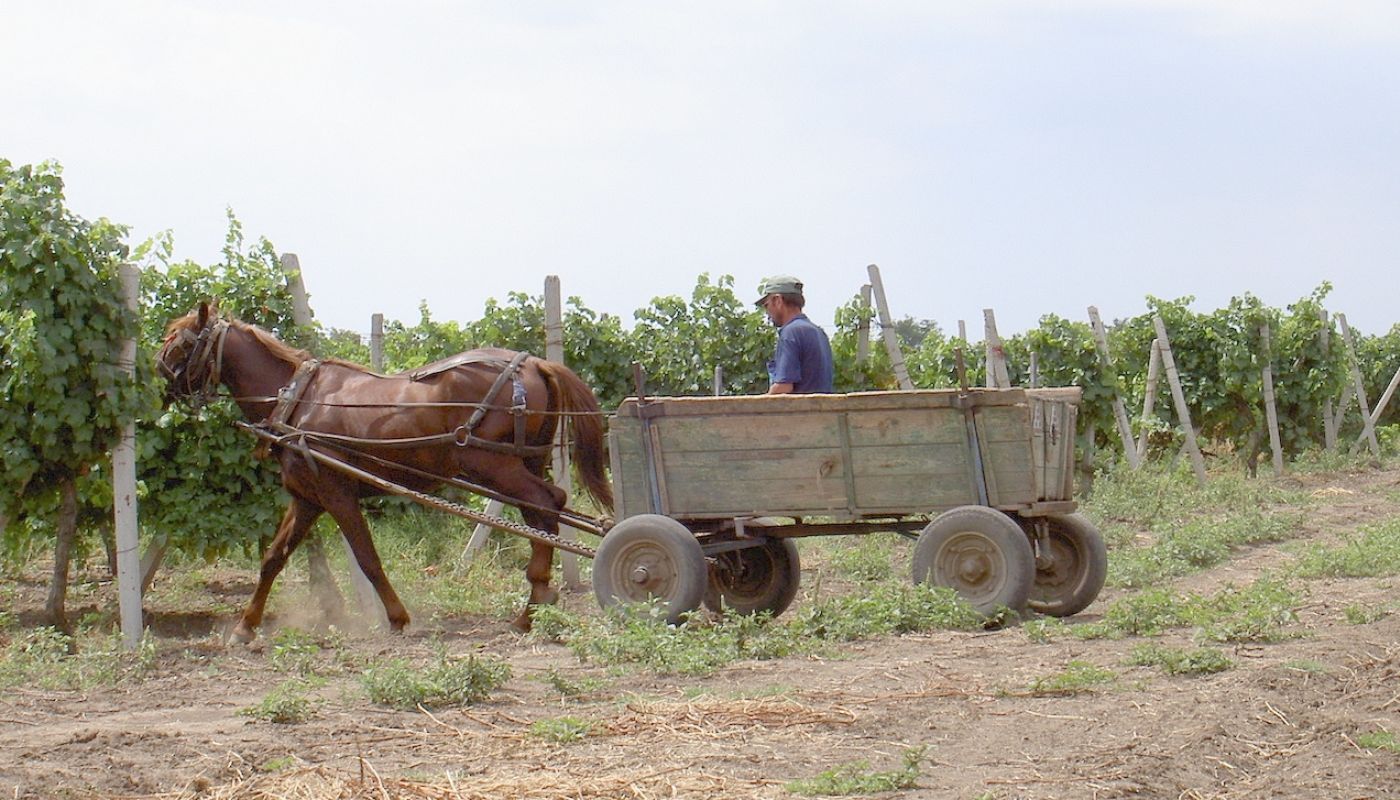
Laithwaite observes today, ‘going to Moldova is still like when I first visited in 2002, time travel: countryside still medieval, horses and carts, flocks of geese all over. But the big surprise now is these futuristic, state-of-the-art wineries that seem to have landed like spaceships. Their winemaking has jumped from the 19th to the 21st century and missed out the 20th.’
Some recommended Moldovan wines
Though see more in Moldova's wine revolution – the proof.
Whites
Chateau Vartely, Dealu Nucului Viorica 2021 13%
£9.99 Laithwaites
Sparkling
Radacini, Albastrele Blanc de Cabernet Sparkling Brut NV
£9.99 Laithwaites
Purcari, Cuvée de Purcari Rosé Brut NV 12.5%
$24.99 Liquor Barn, IL; £29.95 Transylvania Wine
Reds
Purcari, Freedom Blend 2020 13.5%
Widely available in the US from $21
Purcari, Freedom Blend 2019 14.5%
£17.49 M&M Wine & Food, £19.99 Novel Wines, £24.60 Turton Wines
Gitana Saperavi 2019 14%
$30.99 Unwined, VA; £32 Sorin Wines
Tasting notes in our database. Some international stockists on Wine-Searcher.com.













